Konveyor: Legacy Application Modernization Tools
konveyor.io · checked 9 Oct 2026
Open-source tools for assessing and modernizing legacy applications for Kubernetes and cloud-native platforms.
How it plugs in
Signal on Cloud Migration Tools6.1#5 of 32
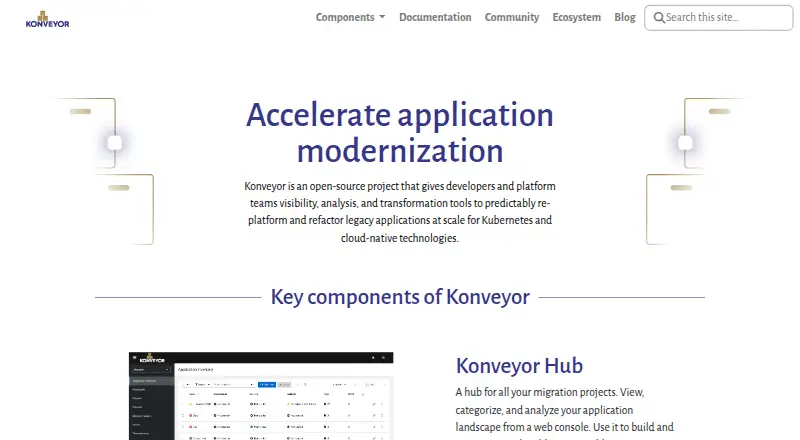
Konveyor is a free, open-source project for developers and platform teams modernizing older applications. Its web Hub organizes application landscapes and migration plans, while Kantra analyzes Go, .NET, Node.js, and Java code or binaries. It also offers assessments, dependency analysis, Kubernetes asset generation, and optional AI-assisted fixes for Java issues.
Review
In a line
Konveyor is a self-hosted, open-source toolkit for examining and updating legacy applications for Kubernetes and other cloud-native technologies. It runs through a web console, Linux tools, and a Visual Studio Code extension.
What it does
Konveyor Hub gives teams a web view of their application landscape. They can categorize applications, review analysis results, and manage migration plans. A questionnaire-based assessment rates modernization suitability and risks, producing reports that can support an adoption plan.
Kantra performs static analysis, which checks source code or compiled files against rules, for Go, .NET, Node.js, and Java. It examines dependencies, reports issues and estimated effort, and can generate Kubernetes assets. Konveyor also supports dependency mapping and database migration work.
Konveyor AI uses analysis context and a language model to suggest or apply code changes for issues found in Java applications. Its AI features are available through a Visual Studio Code extension.
How it connects
Konveyor can retrieve applications from Git and Subversion repositories and Maven binary repositories. It includes more than 2,400 rules for Java technologies, and teams can create rules for their own frameworks or technologies.
The project is open source and can be installed with an Operator on Kubernetes distributions such as Minikube. Konveyor AI can use configurable providers including OpenAI, Azure OpenAI, Amazon Bedrock, Google Gemini, Ollama, and OpenShift AI.
Administrator, Architect, and Migrator roles have different permissions. Administrators manage stored source-control, Maven, and proxy credentials, while Architects assign those credentials to applications.
Good fit
Konveyor suits development and platform teams planning a move from older applications to Kubernetes or cloud-native platforms. It is useful when you need a shared application inventory, risk assessment, dependency information, rule-based code findings, and migration planning.
Teams already using Git, Subversion, Maven, Kubernetes, or a supported language-model provider can connect those systems to the workflow.
Watch for
This is self-hosted software, so your team handles installation and operation. The AI setup requires Java 17 or later, Maven 3.9.9 or later, Git, and an LLM API key.
Enabling the Konveyor AI Solution Server requires a 5 GiB read-write-once persistent volume for its database. Check that your Kubernetes environment can provide this storage and that your chosen language-model provider is supported.
Konveyor's privacy statement says information posted in its public forums becomes public information. General and developer questions are directed to community mailing lists and Kubernetes Slack channels.
Pricing
Konveyor is free to use and open source.
Self-hosting still requires your own Kubernetes environment, and AI features require the listed software, API-key, and storage prerequisites.
Verdict
Choose Konveyor if your organization needs a self-hosted way to inventory legacy applications, assess modernization risk, and turn code findings into Kubernetes migration work. Its broad language coverage, Java rule set, repository connections, and optional AI assistance support a structured process.
It may not suit teams looking for a hosted service or teams that cannot supply Kubernetes storage and administration. Review the AI prerequisites, credential responsibilities, and community-based support before adopting it. For adjacent options, browse Cloud Migration Tools or Code Refactoring Tools.
Our take
Konveyor is a practical choice for organizations moving older applications toward Kubernetes while keeping control of deployment and source data. The Hub, Kantra, assessments, and dependency views cover discovery through analysis, and Java teams can add AI-generated fixes. It demands operational work because deployment is self-hosted, and AI adds software, API-key, and storage requirements. Choose it when those requirements fit your platform team; otherwise, a hosted migration service may be easier.
- Free and open-source project
- Web Hub manages application landscapes and migration plans
- Static analysis covers Go, .NET, Node.js, and Java
- More than 2,400 Java analysis rules, plus custom rules
- Optional AI code fixes through supported language-model providers
- Self-hosted deployment requires your own Kubernetes environment
- AI setup needs Java, Maven, Git, an LLM key, and 5 GiB of storage
- Support is provided through community mailing lists and Kubernetes Slack
- Public forum posts become public information
- Pick it ifPlatform teams planning Kubernetes modernization; Developers assessing legacy code and dependencies; Java teams wanting AI-assisted issue fixes
- Skip it ifYou need a hosted service instead of self-hosted deployment; You cannot provide Kubernetes storage or the AI prerequisites; Your team requires vendor-managed support
Pricing
Konveyor is free and open source, with a free plan. Running it still requires your own self-hosted infrastructure; AI features add the stated software, API-key, and storage requirements.
Questions
Is Konveyor free?
Yes. The project is open source and listed as free, with a free plan.
Where does Konveyor run?
It is self-hosted and runs through a web console, Linux tools, an extension, and Kubernetes installations using its Operator.
Which languages can Kantra analyze?
Kantra performs static analysis for Go, .NET, Node.js, and Java.
What repositories can Konveyor use?
Its documented repository integrations include Git and Subversion, plus Maven binary repositories.
Which AI providers work with Konveyor AI?
The documentation lists OpenAI, Azure OpenAI, Amazon Bedrock, Google Gemini, Ollama, and OpenShift AI as configurable providers.
What does Konveyor AI require?
The setup guide lists Java 17 or later, Maven 3.9.9 or later, Git, and an LLM API key. The Solution Server also needs a 5 GiB read-write-once volume.
Does Konveyor include migration assessments?
Yes. A questionnaire evaluates modernization suitability and risks, and reports can inform an adoption plan.
Near it
All alternatives →- AT
 AWS Transform MGN (formerly AWS Application Migration Service)#4 on this board
- GC
 Google Compute Engine#6 on this board
- GM
 Google Migrate to Containers#3 on this board
- TCTencent Cloud Cloud Migration Service#7 on this board
- GC
 Google Cloud Migration Center#2 on this board
- FO
 Flexera One IT Asset Management#8 on this board
- AD
 Amazon Database Migration Service#1 on this board
- CH
 CAST Highlight#9 on this board
- S
 Striim#10 on this board
- AS
 AWS Schema Conversion Tool#11 on this board