Law Firm Client Onboarding Software
Reviewing Law Ruler's legal CRM and client intake
lawruler.com · checked 15 Nov 2026
A legal practice platform for client records, intake, outreach, reporting, and connections through an open API.
How it plugs in
Signal on Law Firm Client Onboarding Software6.7#4 of 18
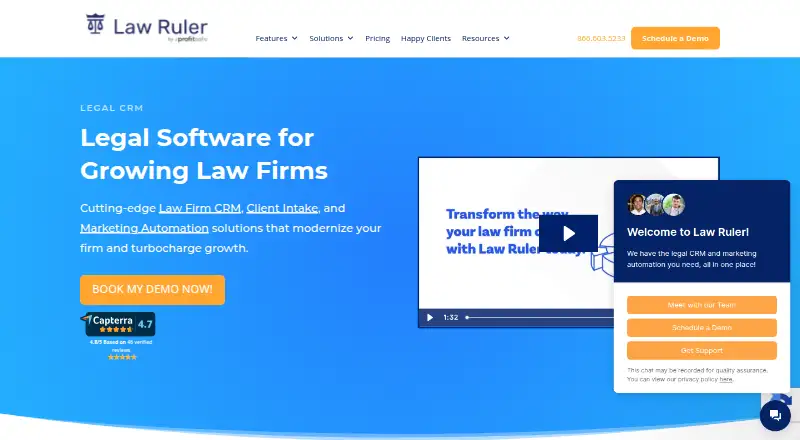
Law Ruler gives law firms a legal CRM for handling prospects, clients, intake, marketing, and case workflows. It runs on the web, iOS, Android, and self-hosted setups, with cloud-only mobile apps. Plans are paid and priced on request, with a free demo and vendor-listed free-trial information that conflicts with other terms.
Review
In a line
For law firms, Law Ruler brings together client records, intake processes, automated marketing, and reporting tools. It helps organize prospects, clients, and case-related work.
What it does
The CRM keeps leads, prospects, and clients together with their marketing sources, deadlines, and relationship information. Automated email follow-ups, voice campaigns, call tracking, call recording, and two-way text, picture, and video messaging support ongoing contact.
Branded, mobile-friendly intake forms can use custom fields and conditional questions; the pipeline also supports automated entry, status monitoring, document generation, uploads, and one-click signatures. Signature requests may also go out by text.
Configurable dashboards show case metrics, client activity, staff productivity, firm KPIs, and marketing return on investment. Conditional workflow automation, payment collection, and a client portal are available.
How it connects
HelloSign, Gmail, and Zapier appear among the available integrations. Twilio and Microsoft Office 365 are listed as well.
All subscription plans include Open API access, which the vendor advertises without a separate API charge. The API supports posting leads, updating records by LeadID, checking duplicates, and optional JSON responses. Administrators may set GET, POST, or PUT webhooks for lead or case-status changes; outgoing webhook bodies currently use form-data.
The product can be used through a browser, on iOS or Android, via API, or in self-hosted deployments. Cloud customers can use the mobile apps, whereas legacy self-hosted customers cannot. It is not open source.
Good fit
Firms looking to handle intake, contact records, follow-ups, communications, signatures, and marketing tracking in one system may value its broad feature set. The maker presents solutions for personal injury, criminal defense, consumer protection, mass tort, business, Social Security disability, immigration, and employment law.
Teams connecting lead forms or status changes with other systems can use the open API and webhooks. Custom dashboards can help firms follow operational and marketing measures.
Watch for
Pricing is not published, and plans require annual terms even though billing is monthly. Review the user, contact, automation, onboarding-fee, and setup details for each tier before choosing.
Usage charges can apply: $1 per API e-signature request, $0.02 for each email above 2,500 per user per month, $10 per extra gigabyte of monthly storage, and a $50 prepaid voice or SMS refill. Individual files are limited to 32 MB, with possible variation by file type.
The product requires internet access. Mobile apps do not support legacy self-hosted clients. Security terms describe U.S.-based cloud hosting, encryption in transit, restricted employee access, and daily backups; confirm whether that arrangement meets your firm's requirements.
Pricing
Law Ruler has no free plan. Enterprise, Premium, and Pro prices are provided on request, with monthly billing under annual terms. Paying the year upfront saves 15%.
The Pro tier allows 3 users, 10,000 contacts, and 3 automations. Premium allows 3 users, 15,000 contacts, and 100 automations. Enterprise starts at 10 users and provides unlimited contacts and automations with white-glove setup. Open API access is included in all three; Pro and Premium have a one-time onboarding fee.
The facts list a free trial, while the maker's terms say there is no free trial and instead offer a no-cost demo. Confirm which option applies before signing up.
Verdict
Law Ruler may suit firms wanting one legal-focused system for intake, client records, automated follow-ups, signatures, communications, and performance reporting. Its API, webhooks, and integrations help connect lead and case workflows to other tools.
It is a weaker fit for buyers who need transparent prices, a guaranteed free trial, or mobile apps for legacy self-hosted deployments. Firms should also budget for possible message, storage, and e-signature charges and verify annual commitments, user caps, and onboarding fees.
Our take
Firms seeking legal intake and client-record tools alongside messaging, calling, signatures, marketing automation, and reporting may consider Law Ruler. Open API access and status webhooks can support connections to existing systems. The main trade-offs are unpublished plan prices, annual commitments, extra usage fees, and uncertainty about free-trial availability. Older self-hosted deployments cannot use the iOS or Android apps. A detailed price and deployment review is sensible before purchase.
- Combines legal CRM functions with intake, marketing automation, and reporting
- Open API access is part of each subscription tier
- Offers forms, e-signatures, messaging, calling, and customizable dashboards
- Webhooks can respond to lead and case-status changes
- Available through web, iOS, Android, API, and self-hosted deployments
- Plan prices are available only on request
- Plans have annual terms; Pro and Premium also have one-time onboarding fees
- Extra charges can apply to emails, storage, voice/SMS, and API signatures
- Legacy self-hosted customers cannot use the mobile apps
- Free-trial information conflicts with the no-trial statement
- Pick it ifFirms bringing intake, client records, communications, and marketing tracking together; Teams needing API and webhook connections for lead workflows; Firms using cloud deployments with mobile access
- Skip it ifYou need published prices or a clearly defined free trial; You support legacy self-hosted users who need mobile apps; Your budget cannot absorb usage-based communication and storage fees
Pricing
Prices are provided on request; billing is monthly under an annual term, and annual prepayment saves 15%. Pro and Premium permit up to 3 users, while Enterprise starts at 10. Usage fees may apply.
- Enterprisemonthly on annual term; annual prepaid saves 15% · 10-user minimum · unlimited contacts · unlimited automations · white-glove setup · open APIOn request
- Premiummonthly on annual term; annual prepaid saves 15% · up to 3 users · 15,000 contacts · 100 automations · one-time onboarding fee · open APIOn request
- Promonthly on annual term; annual prepaid saves 15% · up to 3 users · 10,000 contacts · 3 automations · one-time onboarding fee · open APIOn request
As lawruler.com lists them, checked 21 Oct 2026.
Questions
Is there a free plan for Law Ruler?
Law Ruler has no free plan. The maker describes a no-cost demo, while the facts also list a free trial and separately say no trial is offered, so confirm current access terms.
Where can I use Law Ruler?
It supports web, iOS, Android, API, and self-hosted use. The iOS and Android apps are for cloud-based clients, not legacy self-hosted clients.
What integrations are available?
HelloSign, Gmail, Zapier, Twilio, and Microsoft Office 365 are among the integrations listed.
Does a subscription include API access?
Yes. Open API access is part of every subscription tier, and the vendor says it does not charge an API fee. API functions include lead posting, LeadID updates, duplicate checks, and optional JSON responses.
How are the plans priced?
Pro, Premium, and Enterprise prices are provided on request. Billing is monthly under an annual term, and annual prepayment saves 15%.
Can usage incur additional charges?
Terms list $1 per API e-signature request, $0.02 per email above 2,500 per user monthly, $10 per extra gigabyte of monthly storage, and a $50 prepaid voice or SMS refill.
Is Law Ruler open source?
No. The terms describe paid software licensing and do not publish an open-source license.