Lexical Review: Web Text Editor Framework
lexical.dev · checked 11 Oct 2026
Open-source, web-based text editor framework with a small core and optional packages.
How it plugs in
Signal on Rich Text Editor Software6.0#13 of 37
Lexical is a free, open-source framework for building web text editors. Its dependency-free core can support plain inputs, rich-text and document editors, and collaborative editing. Optional packages add features such as tables, images, links, mentions, and React bindings. Your application must provide the surrounding interface, styling, and storage.
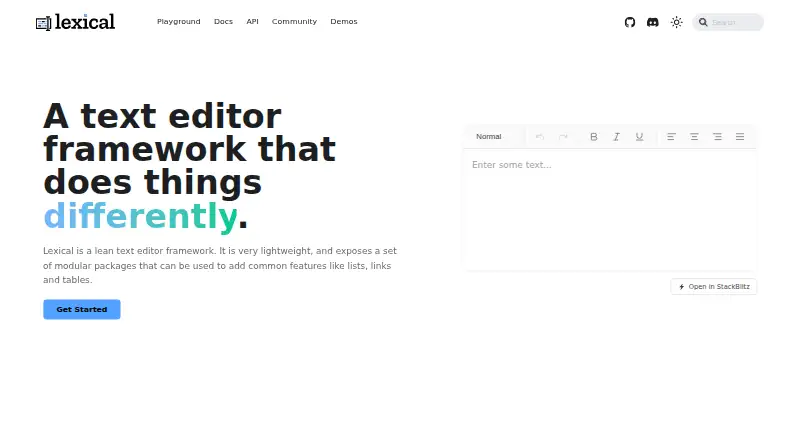
Review
In a line
Lexical is an open-source text editor framework for the web. It provides the editing foundation rather than a finished editor application.
What it does
You can use Lexical for plain-text fields, rich-text editors, full document tools, or real-time collaborative editors. Supported content includes links, mentions, hashtags, custom emoji, tables, lists, code blocks, and images.
Content can move between JSON, HTML, and Markdown. Collaborative editing, shared content, and remote cursors are available through its Yjs integration.
How it connects
The core does not depend on a particular framework. An optional @lexical/react package adds React bindings, while other packages provide additional features.
Lexical works in web applications and can run without a document page for server-side code or tests. Your application still needs to build the layout, menus, toolbars, styling, and storage. Its structured content can be imported and exported as JSON, HTML, or Markdown.
Good fit
Lexical suits teams building a custom web editor that need control over the interface and data format. It can cover simple text entry through document editing and collaborative work.
Screen-reader and other assistive-technology support follows WCAG best practices. The project is MIT licensed and began at Meta as an open-source community project.
Watch for
Lexical supplies editing infrastructure, not the complete product around it. Plan to create and maintain the interface, visual styling, menus, toolbars, and storage yourself.
If you use React, all Lexical packages should stay on the same version. Questions and bug reports are directed to the Lexical Discord server, while security issues follow Meta's Bug Bounty process.
Pricing
Lexical is free and open source. There is no paid plan or free trial; the project is MIT licensed.
Verdict
Choose Lexical when you are building a web editor and want a small, composable base that can grow from plain text to structured or collaborative documents. Its JSON, HTML, and Markdown conversion helps when content must move between systems, and React users have an optional package.
Look elsewhere if you need a ready-made editor with its layout, menus, styling, and storage already supplied. Teams should also check their framework choices and package-version discipline before adopting it.
Our take
Lexical is a sensible starting point for product teams that want to assemble their own web editing experience. It covers a broad range of content and can extend to shared, live editing, while keeping the core small and dependency free. The trade-off is substantial application work: the editor shell, appearance, controls, and data storage remain yours to build. Its free MIT license removes a purchase decision, but React projects must keep package versions aligned. Pick it for control and composability, not for an out-of-the-box writing tool.
- Free and open-source under the MIT license
- Small, dependency-free core with optional packages
- Supports JSON, HTML, and Markdown conversion
- Can handle real-time collaboration through Yjs
- Includes React bindings and accessibility support
- You must build the layout, controls, styling, and storage
- It is a framework, not a finished editor product
- React packages need matching versions
- Support and security reporting use separate community channels
- Pick it ifTeams building custom web text or document editors; Projects needing structured content or live collaboration; React applications that want an optional editor binding
- Skip it ifYou need a complete editor interface without building menus and toolbars; You need the framework to provide storage and interface elements
Pricing
Lexical costs nothing to use and is open source under the MIT license. There is no trial because the software is already free.
Questions
Is Lexical free?
Yes. Lexical is free, open-source software with an MIT license. It has no paid plan or free trial.
What can I build with Lexical?
It can power plain-text inputs, rich-text editors, full document editors, and real-time collaborative editors on the web.
Does Lexical work with React?
Yes. The core is framework-agnostic, and the optional @lexical/react package provides React bindings.
Can Lexical export content?
Lexical content can be converted to and from JSON, HTML, and Markdown.
Does Lexical include a complete editor interface?
No. Lexical provides editing infrastructure. Your application supplies the layout, toolbars, menus, styling, and storage.
How does collaboration work?
Real-time shared content and remote cursors are available through the Yjs integration.
Where can I ask for help?
The project homepage directs questions and bug reports to the Lexical Discord server.