How it plugs in
Signal on Ecommerce platforms6.6#29 of 280
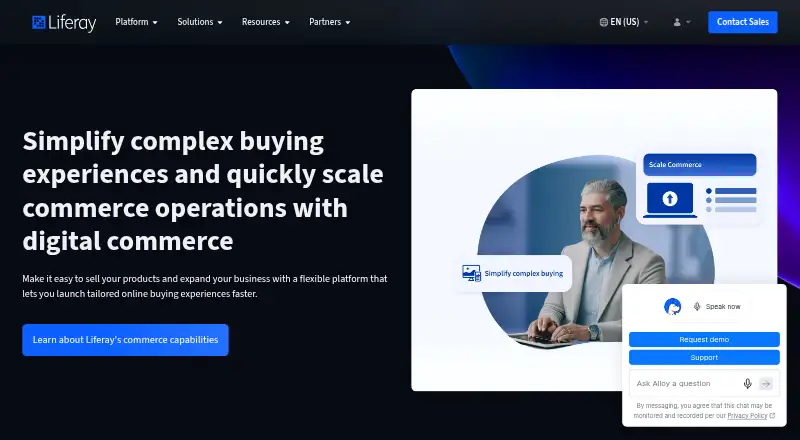
Liferay Commerce is used to build, manage, and scale online stores for B2B or B2C.
Review
<p>Liferay Commerce is a commerce platform for B2B and B2C stores, best suited to organizations with account-specific purchasing rules and established business systems to connect. Its strongest case is the combination of detailed B2B controls, headless options, and flexible deployment; custom enterprise pricing makes it a more involved choice than a low-cost storefront.</p><h2>Overview</h2><p>The platform supports multichannel sales and digital products, with an app marketplace alongside its commerce capabilities. Its B2B features address procurement structures: multiple buyers can act under one account, use negotiated pricing and custom catalogs, and route orders through approval workflows. That makes it a better fit for organizations with formal purchasing processes than for a small merchant looking for a simple shop.</p><p>Liferay, Inc. was founded in 2004 and is headquartered in Diamond Bar, California. Commerce is offered through Liferay DXP, which can run as SaaS, PaaS, or self-hosted software, including on-premises or in a customer cloud.</p><h2>Key features</h2><h3>Account-aware catalogs and pricing</h3><p>Account-specific catalogs and prices, price tiers, promotions, and discounts let teams tailor product access and pricing to buyers. Paired with negotiated terms and approval flows, those controls can support complex B2B purchasing; they add little for a shop with one public catalog and uncomplicated checkout.</p><h3>Product information and discovery</h3><p>Product information tools handle descriptions, images, video, attributes, hierarchies, and product relationships. The product page describes recommendations based on a user's role, history, and previous purchases, which may help surface relevant items in a broad catalog. The value of those capabilities depends on whether a business has enough product data and customer context to use them.</p><h3>Integration and headless options</h3><p>APIs and connectors link commerce with ERP, CRM, procurement, order management, shipping, and accounting systems. Headless commerce can extend catalog, pricing, order, and inventory logic into existing portals, apps, and dealer experiences. This is useful when commerce must fit into established customer channels, though it also makes Liferay a less direct choice for teams seeking only a standalone storefront.</p><h3>Security and support</h3><p>Liferay describes a vulnerability disclosure program established in 2012, CVE reporting, and 24/7 monitoring and security management for SaaS. Its subscription options state that the platform complies with ISO, CSA, and SOC2 through verification. Enterprise subscriptions add professional support and SLAs; the free tier does not include them, an important distinction for teams that need contracted support.</p><h2>Pricing</h2><table><thead><tr><th>Plan</th><th>Price</th><th>What it includes</th></tr></thead><tbody><tr><td>Liferay DXP Free Tier</td><td>free</td><td>Core platform at no cost, for exploration, development, and pre-production.</td></tr><tr><td>Liferay DXP Enterprise Subscription</td><td>Custom pricing</td><td>SaaS, PaaS, or self-hosted deployment; price depends on deployment model and implementation scope.</td></tr></tbody></table><p>The free tier gives teams a way to explore and develop against the core platform, but it is framed for pre-production rather than a supported enterprise operation. Enterprise subscriptions add professional support and SLAs, with the trade-off that pricing depends on deployment and implementation scope. No seat or usage quota is stated for either plan, so buyers should establish scope and commercial terms directly before committing.</p><h2>Platforms</h2><p>Liferay Commerce supports API, Linux, self-hosted, and web environments. DXP deployment choices span SaaS and PaaS as well as self-hosting on-premises or in a customer cloud, giving organizations room to match deployment to their infrastructure and operating requirements.</p><h2>Who it's for</h2><p>Liferay Commerce is a strong candidate for B2B teams managing account-specific catalogs, negotiated pricing, buyer approvals, and integrations with operational systems. It also suits organizations that need commerce logic in existing portals, apps, or dealer experiences, or that require a choice between managed and self-hosted deployment.</p><p>It is less compelling for a small shop with a simple catalog and no need for enterprise integrations or procurement controls. The custom-priced enterprise subscription and deployment choices are easier to justify when those capabilities address real operational requirements.</p><h2>Pros and cons</h2><ul><li><strong>Pros:</strong> Multiple buyers per account, negotiated pricing, custom catalogs, and approval workflows suit structured B2B purchasing.</li><li><strong>Pros:</strong> APIs, connectors, and headless commerce can connect commerce logic to business systems and existing customer channels.</li><li><strong>Pros:</strong> SaaS, PaaS, and self-hosted options accommodate different infrastructure needs, while a free tier supports exploration and pre-production.</li><li><strong>Cons:</strong> Enterprise pricing depends on deployment and implementation scope, so the cost is not a simple fixed subscription.</li><li><strong>Cons:</strong> The free tier lacks professional support and SLAs, making it a poor substitute for an enterprise operating plan.</li><li><strong>Cons:</strong> Its extensive purchasing and integration capabilities are unnecessary overhead for a straightforward small storefront.</li></ul><h2>Alternatives</h2><p><a href="/best/ecommerce-platforms/">Ecommerce platforms</a> offers a broader category starting point for comparing store software. Consider <a href="/platforms/lightspeed-ecom/">Lightspeed eCom</a> when a free-forever account and Android, iOS, API, and web platforms better match the need. Its Free plan costs nothing and requires no credit card.</p><p><a href="/platforms/orocommerce/">OroCommerce</a> is an alternative with a free-to-use, customizable open-source Community Edition designed for developers and technical teams. <a href="/platforms/nopcommerce/">nopCommerce</a> is another option for teams seeking a free open-source platform with self-hosted deployment; its built-in features are free.</p><p><a href="/platforms/spree-commerce/">Spree Commerce</a> offers a self-hosted open-source Community Edition for DTC, B2B, and marketplace use. <a href="/platforms/commerce-layer/">Commerce Layer</a> may suit a tightly scoped developer project: its Developer plan includes one organization, two users, two markets, 1,000 SKUs, 10 links, and 100 free live orders per month.</p><p><a href="/platforms/big-cartel/">Big Cartel</a> is an alternative for a small catalog: its free Gold plan supports five products and one customizable store template, while Platinum costs $15 a month and supports 50 products. <a href="/platforms/spwig/">Spwig</a> and <a href="/platforms/bagisto/">Bagisto</a> are also alternatives; Bagisto is a free open-source download for self-hosting.</p><h2>Verdict</h2><p>Choose Liferay Commerce if your organization needs account-aware B2B purchasing, integrations, and the ability to deploy commerce across existing channels and infrastructure. Its breadth is the reason to choose it; custom enterprise pricing and the lack of support in the free tier are the reasons to look elsewhere if your needs are simple or your budget must be predictable.</p>
Our take
Liferay Commerce offers detailed B2B commerce functions alongside multichannel and headless options. Its deployment choices and free tier provide paths to evaluate, while enterprise pricing depends on scope.
- ["Supports multichannel sales and digital products.", "B2B workflows include multiple buyers and approvals.", "APIs and connectors link business systems.", "Offers SaaS, PaaS, and self-hosted deployment.", "Free tier supports exploration and development."]
- ["Enterprise pricing depends on deployment and implementation scope.", "Professional support and SLAs are not in the free tier."]
- Pick it ifIt suits B2B or B2C organizations building online stores, especially those needing account-specific catalogs, negotiated pricing, or integrations with business systems. Teams can consider SaaS, PaaS, or self-hosted deployment options.
Pricing
- Liferay DXP Free TierCore platform at no cost · for exploration, development, and pre-productionFree
- Liferay DXP Enterprise SubscriptionPricing depends on deployment model and implementation scope · SaaS, PaaS, or self-hostedOn request
As liferay.com lists them, checked 12 Oct 2026.