MailCatcher: Free Local Email Inspection
mailcatcher.me · checked 10 Oct 2026
A local SMTP server that lets you inspect captured email in a browser.
How it plugs in
Signal on Email Testing Software6.0#11 of 28
MailCatcher is a free, open-source option for checking development email. It accepts messages through a local SMTP server and presents available HTML, plain-text, and source views, alongside links, images, and attachments. The project offers Ruby gem installation and a Docker image, plus a URL API for message data.
Review
In a line
MailCatcher receives application email through a local SMTP server and makes captured messages available in a browser. It is intended for inspecting development messages rather than delivering them to real recipients.
What it does
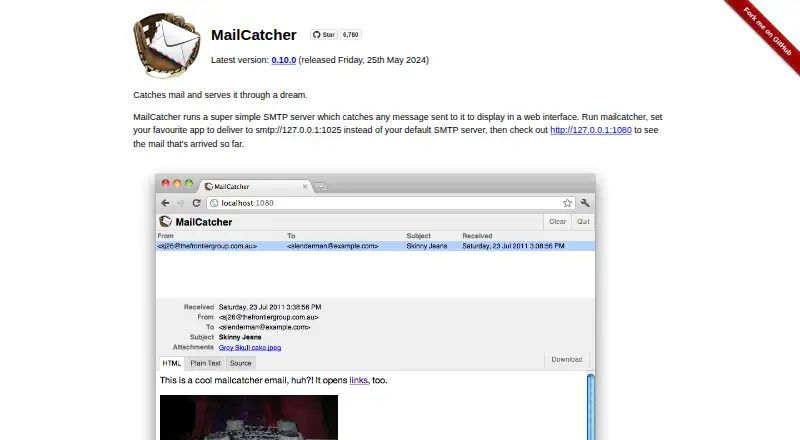
Configure an application to use MailCatcher's local SMTP endpoint, then review the resulting messages in its web interface. When available, the interface presents HTML, plain-text, and source views.
For HTML mail, it adjusts embedded images for display and opens links in a separate window. Attachments are listed individually; you can download message parts or the original email.
With WebSockets support, browsers receive new messages instantly. Other browsers update the message list every thirty seconds.
How it connects
MailCatcher offers a URL API for retrieving message lists and JSON metadata, as well as HTML, plain text, attachment parts, and full source.
Setup examples are documented for Rails, PHP, and Django. You can install MailCatcher as a Ruby gem or use its Docker image; supported platforms include Linux, macOS, self-hosted setups, and the web interface.
The project uses the MIT License.
Good fit
MailCatcher is suited to developers checking application email in development without sending it beyond a local environment. It can help with reviewing layouts, links, images, message source, and attachments.
Tools and scripts can use its API to access captured messages and their parts. Setup examples are documented for Rails, PHP, and Django.
Watch for
Mail processing is basic, and UTF-8 sent directly over the wire is not fully supported. The maker advises using a mail library that encodes messages according to SMTP server capabilities.
Ruby 3.3 or newer is required, and dependency installation may need build tools. Check your environment before installation.
For troubleshooting, the maker asks users to file an issue and include the complete message that caused the problem.
Pricing
MailCatcher is free and released under the MIT License. You can run it yourself with the Ruby gem or Docker image.
Verdict
Choose MailCatcher for a no-cost local mailbox where you can review development email before it reaches real inboxes. It provides browser-based message views, downloads, source access, and a URL API for common inspection tasks.
Look elsewhere if you need advanced mail processing or complete direct UTF-8 support. The documented installation requires Ruby 3.3 or newer, and dependencies may need build tools.
Our take
MailCatcher is a practical choice for development teams that need to see test email safely on a local or self-hosted setup. The free MIT-licensed project offers browser previews, downloads, and an API. Before adopting it, confirm that your stack can meet the Ruby and dependency requirements, and that your mail library handles UTF-8 correctly. Its basic processing makes it less suitable for sophisticated email handling or production delivery workflows.
- Free and open source under the MIT License
- Provides HTML, plain-text, and source views of captured mail when available
- Lists and supports downloads of attachments and original messages
- URL API provides JSON, message parts, and full source
- Supports Linux, macOS, self-hosted setups, and a web interface
- Mail processing is basic
- Direct UTF-8 support over the wire is incomplete
- Ruby 3.3 or newer is required
- Dependencies may need build tools
- Browsers without WebSockets support update only every thirty seconds
- Pick it ifDevelopers inspecting application email locally; Teams using Rails, PHP, or Django during development; Scripts that need an API for captured message data
- Skip it ifYou need advanced mail processing or complete direct UTF-8 handling; Your environment cannot run Ruby 3.3 or install dependencies; You need a production email delivery service
Pricing
MailCatcher is free and open source. It can be run using the Ruby gem or Docker image.
Questions
Is MailCatcher free?
Yes. MailCatcher is free and released under the MIT License.
Where can MailCatcher run?
It supports Linux, macOS, self-hosted setups, and a web interface. Installation options include a Ruby gem and a Docker image.
How does MailCatcher receive email?
It provides a local SMTP server. For development inspection, applications are configured to send messages to that endpoint.
Does MailCatcher have an API?
Yes. Its URL API returns message lists and JSON metadata, along with HTML, plain text, attachment parts, and full source.
What email content can I view?
When available, the interface presents HTML, plain-text, and source views. It also lists attachments and lets you download message parts or the original email.
Does MailCatcher support UTF-8?
UTF-8 sent directly over the wire is not completely supported. The maker advises using a mail library that encodes according to SMTP server capabilities.
What Ruby version does it need?
The README specifies Ruby 3.3 or newer. Dependency installation may also need build tools.