Manifest Review: Open Gateway for AI Requests
manifest.build · checked 15 Oct 2026
Route AI traffic through an open gateway with failover, Autofix, and spend controls.
How it plugs in
Signal on LLM gateways8.3#3 of 33
Manifest gives OpenAI- and Anthropic-compatible clients a common endpoint for AI requests. It routes across providers, retries during outages, repairs certain malformed requests, and records usage and costs. You can use Manifest Cloud or deploy the Docker service yourself, including offline and local-model setups.
Review
In a line
Manifest is open-source infrastructure for AI model traffic. Applications get one address while Manifest manages routing, fallback attempts, request repair, and spending records.
What it does
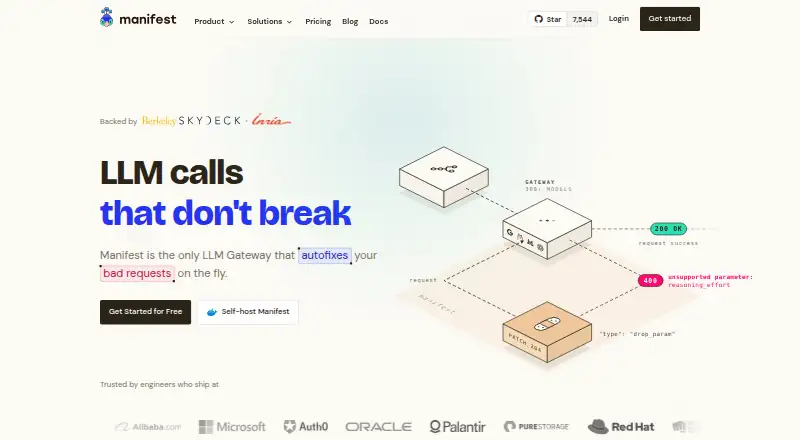
You send a model request to Manifest, and its routing rules choose how to handle it. If a provider becomes unavailable, the gateway retries through a different provider. Autofix repairs invalid request formats and sends them again when a simple retry would not address the problem.
The dashboard breaks down harness spending, identifies the models that handled requests, records failures, and displays full provider request and response bodies. Budget alerts and spending caps for each harness help monitor inference use.
How it connects
Manifest exposes endpoints shaped for OpenAI and Anthropic clients, so OpenAI-style software can use it by replacing its base URL. Its documented chat route is POST /v1/chat/completions, with a harness key beginning mnfst_.
You can attach provider API keys, OAuth-backed subscriptions, local models, and custom endpoints. Named local connections include Ollama, llama.cpp, and LM Studio. The public repository lists 35 built-in provider connections, 18 subscription flows, and more than 300 models.
The gateway is available as an API, web service, Linux software, or self-hosted deployment. A Docker deployment runs without an account, functions offline, and supports amd64 and arm64. The code uses the MIT licence. For related tools, see LLM gateways.
Good fit
Manifest suits AI builders, teams, startups, and platforms that need one gateway for several providers or subscriptions. It can help manage agents and workflows, keep requests running through provider outages, and watch inference spending.
Self-hosting fits people who need local model routing or want routing and request data to remain on their own servers, apart from documented telemetry and Autofix flows.
Watch for
Cloud Free permits 10,000 routed requests in each calendar month and cannot connect to local models on your machine. Unlimited self-hosted requests require running the software yourself.
Cloud recordings are kept for 7 days on Free and 365 days on Pro. Check whether those retention periods, support levels, and your provider connections fit your needs before choosing a plan.
Pricing
Manifest has a free plan. Free is available through Manifest Cloud or Docker self-hosting and includes 10,000 Cloud requests per calendar month or unlimited self-hosted requests, all providers, Autofix, budget alerts, 7-day dashboard retention, unlimited agents, and Discord community support.
Pro costs $19 a month for hosted Manifest Cloud with unlimited routed requests, 365-day dashboard retention, basic support, and one user.
Enterprise pricing is on request. It adds on-premise, VPC, or private-cloud deployment, multiple seats, SSO/SAML, audit logs, custom retention, a contractual uptime SLA, HIPAA and custom BAAs, custom guardrails, and dedicated Slack and email support.
Verdict
Choose Manifest if you want a single compatible address for many AI providers, automatic provider failover, and spending visibility. It is also a practical option when local models, offline operation, or self-managed data handling matter.
Look elsewhere if you only need one provider, do not want to operate Docker or another self-hosted setup, or need Cloud access to local models. Review request retention and support terms before moving production traffic.
Our take
Manifest is a sensible fit for applications that already use OpenAI-style clients but need to switch among providers, subscriptions, and local models. Its fallback routing and Autofix can reduce interruptions, while logs and budget controls make usage easier to follow. The free option supports experimentation and self-hosting, but Cloud Free has a monthly request cap and no access to local machines. For one hosted user, Pro removes that request ceiling. Larger organizations should confirm that Enterprise controls, retention choices, and support arrangements match their requirements.
- OpenAI- and Anthropic-compatible endpoints
- Automatic fallbacks and Autofix for failed requests
- Cloud or offline Docker self-hosting
- Usage logs, spending limits, and budget alerts
- MIT-licensed open-source code
- Cloud Free permits only 10,000 requests monthly
- Cloud Free cannot reach local models on your machine
- Pro is a single-user plan
- Cloud recording retention varies by plan
- Pick it ifTeams routing agents across several AI providers; Users who need local or offline model access; Buyers tracking inference spending
- Skip it ifYou need only one provider and no gateway features; You require Cloud access to models on your own computer; You do not want to manage a self-hosted deployment
Pricing
Cloud or Docker self-hosting is covered by the free tier, with Cloud capped at 10,000 requests monthly. Pro costs $19 a month for unlimited hosted requests; Enterprise pricing is on request.
- Free$0 /month · Manifest Cloud or Docker self-hosted · MIT licence · unlimited agents · 10,000 routed Cloud requests/month · unlimited self-hosted requests · all providers · 7-day dashboard retention · Autofix · budget alerts · Discord community supportFree
- Pro$19 /month · Hosted Manifest Cloud · unlimited routed requests · 365-day dashboard retention · basic support · single-user plan$19/mo
- EnterpriseLet's Talk · On-premise, VPC or private cloud · multiple seats and team management · SSO/SAML · audit logs · custom retention · contractual uptime SLA · HIPAA and custom BAAs · custom guardrails · dedicated Slack and email supportOn request
As manifest.build lists them, checked 15 Oct 2026.
Questions
What is Manifest?
Manifest is open-source gateway software that directs requests among providers, attempts fallback routes, fixes certain failed requests, and records model use and spending.
Can existing OpenAI SDKs use Manifest?
Yes. Since the API uses OpenAI compatibility, OpenAI-style SDKs and agents can point to Manifest once you change the base URL.
Can Manifest run local models?
Self-hosted Manifest can route to Ollama, LM Studio, llama.cpp, and other local servers. Cloud Free cannot reach local models on your machine.
Is Manifest open source?
Yes. The repository publishes the software under the MIT licence.
How much does Manifest cost?
Manifest offers a free plan, a $19-per-month Pro plan, and Enterprise pricing on request.
How long are Cloud requests kept?
Cloud request recordings last 7 days on Free and 365 days on Pro.
Does Manifest provide fallbacks?
Yes. If a provider fails, Manifest can route the request to another; Autofix can also correct malformed requests before another submission.