Medusa: Open-Source Commerce Platform Review
medusajs.com · checked 30 Sept 2026
Open-source commerce platform for building custom stores and commerce features.
How it plugs in
Signal on Ecommerce platforms6.3#59 of 280
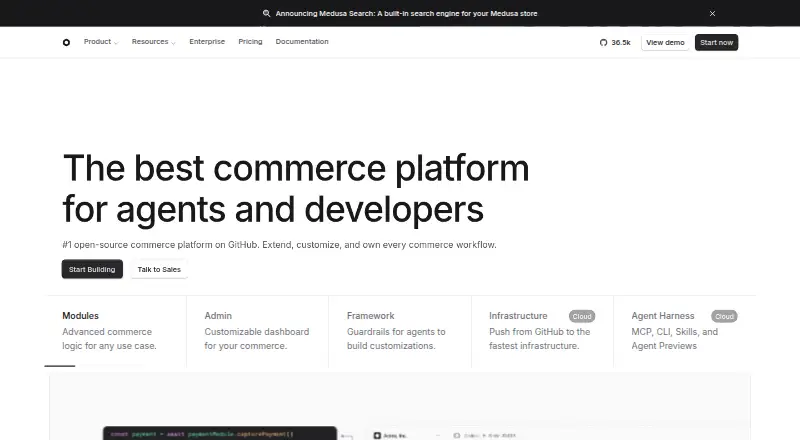
Medusa provides an open-source, AI-native foundation for creating tailored commerce solutions. It includes modules for inventory, carts, payments, and orders, plus a configurable merchant dashboard. Teams can run it through an API, on their own hosting, or on the web, with optional managed Cloud deployment and several listed service integrations.
Review
In a line
Teams can use Medusa’s open-source platform to create customized shopping experiences and stores.
What it does
Its commerce modules cover inventory tracking, cart totals, payments, and order management. Other listed features include product management, multiple sales channels, multi-warehouse inventory, regional settings, and promotions.
Merchants can configure and operate their store from a customizable admin dashboard. The framework also supports custom business logic, data models, workflows, automations, and API endpoints.
How it connects
Medusa can run through an API, on your own hosting, or on the web. You can deploy a standalone production build to a hosting provider, or use Medusa Cloud for managed deployment.
The documentation lists payment connections for Stripe and PayPal, fulfillment through ShipStation, CMS connections for Sanity and Strapi, and search with Algolia or Meilisearch. Its authentication module supports email and password, social or other third-party sign-in, email verification, and multifactor authentication.
Its flexible commerce framework can connect to third-party services and lets teams create their own data models and endpoints. For broader category comparisons, see headless ecommerce platforms.
Good fit
Medusa suits businesses and teams of different sizes with unusual commerce requirements, as well as developers building custom features. It fits stores selling digital products across multiple sales channels.
Teams comparing broader options can also review ecommerce platforms.
Watch for
Medusa does not include abandoned-cart recovery. With self-hosting, you manage deployment; on Cloud, usage charges may start once the included monthly search, email, and storefront edge-request allowances are exceeded.
The maker says its infrastructure provider maintains GDPR-aligned controls and security certifications, but each customer remains responsible for meeting legal requirements in its jurisdiction.
Pricing
Medusa has a free plan. Paid Cloud plans start at $29 a month, and there is no transaction fee.
The Develop tier is $29 a month. Launch is $99 a month and adds autoscaling, custom storefront domains, backups, webhooks, a Redis-backed key-value store, and concurrent previews. Scale is $299 a month and adds background workers, priority Cloud support, semantic search, longer backup retention, 10 million edge requests, and a custom backend domain. Enterprise pricing is available on request and includes an Enterprise license, 24/7 support, service-level agreements, and other listed controls.
Cloud includes 10,000 free-text search requests, 1,000 emails, and 1 million storefront edge requests per month before usage charges apply.
Verdict
Choose Medusa if your store needs a programmable foundation rather than a fixed storefront system. Its open-source code, modular commerce functions, and custom endpoints leave room for specialized workflows and services.
It is less suitable if abandoned-cart recovery is essential or if you want a fully managed setup without checking usage thresholds and compliance duties. The free plan lowers the entry cost, while the paid tiers add hosting capacity and support as requirements grow.
Our take
Medusa makes sense for companies whose sales process does not fit a standard store template. The free option lets teams start without a platform transaction charge, and digital products are supported. Buyers should plan for technical ownership when self-hosting and review Cloud limits before launch. If your priorities are built-in abandoned-cart messages or minimal customization work, another commerce product may be a better match.
- Open-source base for tailored commerce features
- Modules cover inventory, carts, payments, and orders
- Supports multiple sales channels and digital products
- No transaction fee listed
- Free plan available
- No abandoned-cart recovery
- Self-hosting requires deployment work
- Cloud charges may begin after included usage allowances
- Customers remain responsible for jurisdictional compliance
- Pick it ifTeams creating tailored commerce workflows; Stores with multiple sales channels; Developers needing extensible commerce modules
- Skip it ifBuilt-in abandoned-cart recovery is required; You want no deployment or usage-limit decisions; Your team cannot manage compliance responsibilities
Pricing
A free plan is available. Cloud includes set monthly usage amounts before extra charges apply.
- DevelopFrom $29 /mo · 1 shared server · 1 long-lived environment · 1 preview environment · 600 compute hours/mo · 10 GB/mo data transfer · 10 GB-mo object storage · 1 GB-mo database storage$29/mo
- LaunchFrom $99 /mo · Everything in Develop · autoscaling infrastructure · custom storefront domains · automatic backups · webhook events · Redis-backed KV store · concurrent previews$99/mo
- ScaleFrom $299 /mo · Everything in Launch · background workers · priority Cloud support · semantic search · longer backup retention · 10M edge requests · custom backend domain$299/mo
- EnterpriseCustom · Enterprise license · 24/7 support · platform SLAs · RBAC, SSO, audit logs · dedicated support engineer · BYOC · 99.99% uptime guarantee · data sovereignty, SOC2, custom DPAOn request
As medusajs.com lists them, checked 30 Sept 2026.
Questions
Does Medusa have a free plan?
Yes. Medusa offers a free plan. Paid Cloud plans start at $29 a month.
What payment services does Medusa connect to?
The listed payment integrations are Stripe and PayPal.
Can Medusa be self-hosted?
Yes. You can deploy a standalone production build to a hosting provider. Medusa also offers managed Medusa Cloud deployment.
Are transaction fees charged by Medusa?
Medusa lists no transaction fee. Cloud usage charges may apply after the included monthly allowances.
Are digital products supported by Medusa?
Yes. Digital products are listed among its commerce capabilities.