Mockfly review: hosted mock APIs and pricing
mockfly.dev · checked 15 Oct 2026
Hosted REST and WebSocket mocks let teams test while the real backend is still in progress.
How it plugs in
Signal on API Mocking Tools6.4#5 of 26
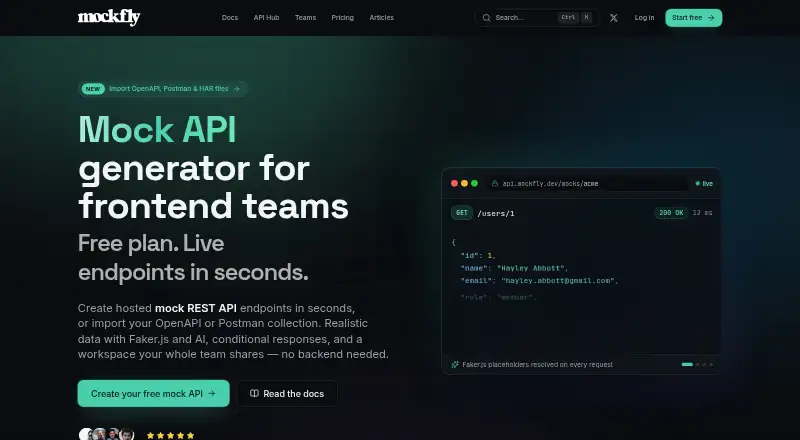
Mockfly lets teams create hosted HTTPS mock APIs in a browser. Responses may be JSON, XML, or files, while request-based rules determine which reply is returned. It imports common API descriptions, supports team editing, and can run projects offline through its CLI. A free plan is available, with paid plans from €15 per month.
Review
In a line
Mockfly is a hosted service for making mock REST and WebSocket endpoints. Teams use them while a real backend is still being built.
What it does
In a browser, you set paths, HTTP methods, status codes, headers, and response bodies without installing software. Routes can include parameters such as /users/:id.
An endpoint can hold several responses for successes, errors, and edge cases. Rules choose a response from request parameters, headers, or body content. Responses may be JSON, XML, PDF, CSV, or other files.
Faker.js placeholders create changing sample details such as names and addresses. Natural-language prompts can generate JSON structures and endpoint descriptions. Mockfly also creates shareable documentation, supports proxying to a real API, and can mock WebSocket endpoints.
How it connects
OpenAPI, Swagger, Postman collections, and HAR captures can all be brought into Mockfly. Through its Chrome extension, browser requests can be captured and selected endpoints added to a project.
A public REST API, with an OpenAPI 3.1 description and Postman collection, manages projects, endpoints, responses, and rules using account API keys. An MCP client can manage the same items from Claude Desktop or Antigravity.
Using the mockfly-cli npm package, you can pull a project and serve it offline at localhost:4000. The public JavaScript SDK is Apache-2.0 licensed; a public Python SDK documents installation and two methods but has no published releases.
Projects provide shared workspaces, invitations, real-time editing, request logs, and response history. Paid plans add custom domains with Mockfly-managed TLS certificates and delayed webhooks with retries and optional HMAC-SHA256 signatures.
Good fit
Mockfly describes frontend, backend, mobile, QA, and testing engineers as its users when they need shared mock APIs. It suits teams that want to work before backend endpoints exist, exercise error cases, or share a documented test service.
The browser-based setup, imports, conditional responses, local CLI, and automation API cover both quick prototypes and repeatable workflows.
Watch for
Starter permits 500 requests each day, one project, four endpoints, and two responses per endpoint. There is no free trial.
Mockfly is not open source. Hosted use stores mock definitions and project request logs to operate the service; Mockfly says it does not sell that data or set tracking cookies. It also says data is encrypted and protected by strict security protocols.
Custom domains and callbacks require a paid plan. The Python SDK has no published releases, so check its status if you need a released Python package.
Pricing
The Starter tier has no monthly charge (€0) and includes 500 daily requests, one project, four endpoints, and two responses per endpoint.
Pro costs €15 per month, or €150 per year when billed annually. It adds unlimited requests, projects, endpoints, and responses, plus AI JSON generation, AI endpoint descriptions, custom domains, and callbacks.
Team costs €49 per month for five seats, with €9 per extra seat. It includes Pro features, free-account collaborators, one invoice, and priority support. Company starts from €199 per month on request, with custom seats, integrations, SLA, and direct builder contact.
Verdict
Choose Mockfly if your team needs shared, hosted test endpoints before production APIs are available, especially when imports, conditional responses, offline serving, or scripted management matter. The free tier can cover a small project, while Pro removes its main usage caps.
Look elsewhere if you require open-source software, a free trial, or a mature published Python package. Teams needing custom billing, seats, or service agreements should review the Company plan rather than assuming those terms are included elsewhere.
Our take
Mockfly fits teams that need a common place to define and share temporary APIs across frontend, backend, mobile, and QA work. Its browser editor, imports, conditional replies, generated sample data, and offline CLI give projects several ways to keep moving before a backend exists. The Starter limits make it suitable for small experiments, while Pro or Team cover heavier use and collaboration. Buyers should account for the lack of open-source code and free trial, and confirm whether the unpublished Python SDK matters to their workflow.
- Starter includes one project and four endpoints at no monthly cost
- Conditional responses based on request details
- Bring in OpenAPI, Swagger, Postman, or HAR definitions
- Serve projects offline with the mockfly-cli npm tool
- Public REST API and MCP automation options
- Starter permits only 500 requests per day
- No free trial
- Not open source
- Python SDK has no published releases
- Custom domains and callbacks require paid plans
- Pick it ifTeams working before a backend is available; Shared REST or WebSocket mocks for QA and frontend work; Projects needing imports, offline serving, or API automation
- Skip it ifYou need open-source software or a free trial; You require a published Python package with releases; Your project exceeds Starter limits but cannot pay
Pricing
Starter is free but capped at 500 requests per day, one project, four endpoints, and two responses per endpoint. Pro is €15/month or €150/year. Team is €49/month for five seats plus €9 per extra seat.
- Starter0€ per month · 500 requests/day · 1 project · 4 endpoints · 2 responses per endpointFree
- Pro15€ per month · Unlimited requests · projects · endpoints · responses · AI JSON generation · AI endpoint descriptions · custom domain · callbacks€15/mo
- Team49€ per month for 5 seats · Everything in Pro · 5 seats · 9€ per extra seat · free-account collaborators · one invoice · priority support€49/mo
- Pro annual150€ per year · Same Pro features and limits€150/yr
- CompanyFrom 199€ per month · Everything in Team · OpenAPI/Postman setup · centralized billing · custom seats/integrations/SLA · direct builder contact€199
As mockfly.dev lists them, checked 15 Oct 2026.
Questions
Does Mockfly have a free plan?
Yes. The Starter tier costs €0 monthly and covers 500 requests per day, one project, four endpoints, and two responses per endpoint.
What formats can Mockfly return?
Mock endpoints support JSON, XML, and files including PDF and CSV.
Can Mockfly choose different replies?
Yes. Conditional rules can pick among multiple responses from request parameters, headers, or body content.
Can I import existing API definitions?
Yes. OpenAPI, Swagger, Postman collections, and HAR captures are supported for import.
Can projects run without an internet connection?
Yes. The mockfly-cli npm tool pulls a project and serves it locally at localhost:4000.
Does Mockfly have an API?
Yes. Its public REST API manages projects, endpoints, responses, and rules with account API keys. An MCP client is also available.
Is Mockfly open source?
No. The public JavaScript SDK repository is Apache-2.0 licensed, but the Mockfly service itself is not open source.
What does Team cost?
Team costs €49 per month for five seats. Extra seats cost €9 each.