MolView: Small-Molecule Sketching in the Browser
molview.com · checked 15 Oct 2026
MolView is a browser-based tool for sketching and viewing small molecules in 2D and 3D.
How it plugs in
Signal on Chemistry Simulation Software6.3#7 of 33
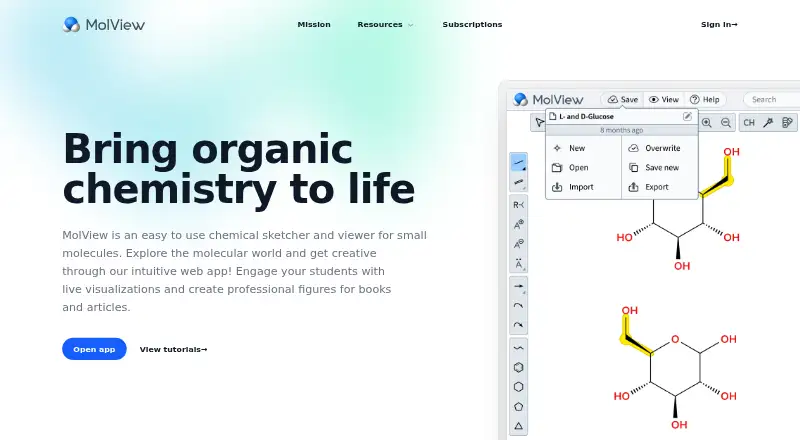
MolView lets students, teachers, authors, and developers draw small molecules, edit reactions, and view synchronized 3D models in a browser. It supports chemical-name and identifier searches, image and structural-data exports, cloud saving on paid plans, and an embeddable component for JavaScript or React. The 2024 app does not include several older protein, crystal, or spectroscopy views.
Review
In a line
MolView is a web app for drawing and viewing small molecules. Its 3D display updates as you change the 2D sketch.
What it does
You can draw atoms, several bond types, charges, lone pairs, radicals, chains, and rings. The sketcher also handles reaction arrows, electron-pushing arrows, curved mechanism paths, keyboard shortcuts, and automatic cleanup.
Search accepts common names, IUPAC names, SMILES, InChI, InChIKey, and molecular formulas. The viewer offers ball-and-stick, licorice, or spacefill models, spinning, split views, lighting controls, and CPU or web-service rendering.
Infocards show identifiers and PubChem links. Exports include SDF structural data, SVG vectors, transparent-background images, and custom image sizes.
How it connects
MolView runs on the web and is also offered through an API and self-hosting options. Its embeddable sketcher works in plain JavaScript and React, with a customizable toolbar and diagram style. The API can save and load diagram objects and convert formats such as SMILES.
The legacy service retrieves information from PubChem, RCSB Protein Data Bank, NIST Chemistry WebBook, Crystallography Open Database, and NCI/CADD Chemical Identifier Resolver. You can explore other chemistry simulation software if you need a wider tool set.
Paid users can save and load work and make shareable links. The API sketcher is for subscribers; production embedding needs each user to subscribe or a production-domain license.
Good fit
MolView suits students and teachers learning molecular structures, authors preparing diagrams, and developers adding a chemical sketcher to a JavaScript or React site.
It is a good match for small-molecule drawing, reaction diagrams, synchronized 3D views, and publication images.
Watch for
The new app is limited to sketching and small molecules. It does not include the old app's protein structures, crystal lattices, spectroscopy, Jmol measurements, MEP surfaces, dipoles, or Jmol visualization.
Free diagrams cannot be saved. API production use has licensing rules, and some functions depend on outside web services; the terms do not promise uninterrupted or error-free operation.
Account information is stored in a United States server database on a ScalaHosting VPS. Google Analytics 4 collects anonymized usage data, and purchaser details are shared with Paddle. Users keep intellectual property in diagrams but grant MolView an ongoing license to host, display, and process them.
The help center is under construction. Questions and ideas can be sent to the listed contact email.
Pricing
MolView has a free plan with no sign-up for searching, sketching, and viewing small molecules; saving is disabled.
Student is $9 a year, billed $9/year including sales tax, for students. It adds saving, loading, and reaction mechanisms, but excludes custom styling and SVG, SDF, and XYZ export.
Academic is $49 a year or $19 per quarter, including sales tax. It includes all features, molecular-data exports, custom 2D/3D styling, and unlimited publication-quality SVG export, but no commercial use.
Standard is $99/user/year or $19/user/month, excluding sales tax, for commercial use and all features, with up to 10 SVG exports monthly. Publisher is $250/user/year, excluding sales tax, with unlimited publication-quality SVG export. Institution and Enterprise pricing is by request; Enterprise includes single sign-on, enterprise support, new features, and a developer API for Web Components.
Verdict
Choose MolView when you need a browser sketcher focused on small molecules, reaction drawings, and synchronized 3D display. The free tier is useful for one-off viewing and drawing, while paid plans add storage, exports, styling, or commercial rights.
Check the plan restrictions before buying: student and academic licenses have usage limits, Standard limits SVG output, and API embedding requires a subscription or domain license. Look elsewhere if you need protein, crystal-lattice, spectroscopy, or other legacy visualization features; tools such as Beyond Labz or PraxiLabs may be worth comparing.
Our take
MolView is a sensible choice for people who need quick small-molecule diagrams without installing a desktop program. Its browser workflow combines 2D editing, reaction notation, searchable chemical identifiers, and a linked 3D view. Paid tiers matter if you need saved projects, data exports, publication graphics, or commercial embedding. The product is not a broad molecular-visualization suite: several older protein, crystal, spectroscopy, and measurement tools are gone. Buyers should also review API licensing, external-service dependence, and the plan-specific export limits before committing.
- Free browser access for searching, sketching, and viewing small molecules
- 2D sketch and 3D viewer stay synchronized while editing
- Supports reaction arrows, mechanism paths, and configurable diagram styles
- Exports SDF data, SVG vectors, and custom-resolution images
- Embeddable component supports vanilla JavaScript and React
- New app omits protein, crystal-lattice, spectroscopy, and Jmol features
- Free plan cannot save diagrams
- Production API embedding requires subscriptions or a domain license
- Some features depend on external web services
- Academic and Standard plans restrict commercial use or SVG volume
- Pick it ifStudents and teachers drawing small molecules; Authors making publication diagrams; Developers embedding a chemical sketcher in JavaScript or React
- Skip it ifYou need protein, crystal-lattice, spectroscopy, or Jmol visualization; You require unrestricted commercial API embedding without licensing; You need free cloud saving
Pricing
A free no-sign-up tier covers basic searching, sketching, and viewing. Features and commercial rights vary by plan.
- FreeNo sign-up · search, sketch and view small molecules · diagrams cannot be savedFree
- Student$9/year including sales tax · Students only · save/load files · reaction mechanisms · no custom styling · no SVG/SDF/XYZ export$9/yr
- Academic$49/year or $19/quarter including sales tax · All features · molecular data exports · custom diagram/3D styling · unlimited publication-quality SVG · no commercial use$49/yr
- Standard$99/user/year or $19/user/month excluding sales tax · Commercial use · all features · not for content creators/publishers · up to 10 SVG exports monthly$99/yr
- Publisher$250/user/year excluding sales tax · Commercial use · all features · unlimited publication-quality SVG export$250/yr
- InstitutionContact us · Single sign-on · volume discount · smart homework systemsOn request
- EnterpriseContact us · Single sign-on · enterprise support and new features · developer API for Web ComponentsOn request
As molview.com lists them, checked 15 Oct 2026.
Questions
Does MolView have a free plan?
Yes. The Free plan requires no sign-up and supports searching, sketching, and viewing small molecules, but diagrams cannot be saved.
What can MolView search for?
Search supports common names, IUPAC names, SMILES, InChI, InChIKey, and molecular formulas.
Can MolView save diagrams?
Saving and loading are available to paid users. The free plan does not save diagrams.
Can I embed MolView in a website?
The embeddable sketcher works with vanilla JavaScript and React. Production use requires each user to subscribe or a production-domain license.
Does MolView support 3D models?
Yes. Its 3D viewer follows edits in the sketching canvas and offers ball-and-stick, licorice, and spacefill models.
What features were removed from the new app?
The new app does not include protein structures, crystal lattices, spectroscopy, Jmol measurements, MEP surfaces, dipoles, or Jmol visualization.
Who operates MolView?
MolView says it is developed and operated by Bergwerf Labs in the Netherlands.
Where is MolView hosted?
Its policy says the server is in the United States, account data is held on a ScalaHosting VPS, and anonymized usage data is collected through Google Analytics 4.
Near it
All alternatives →- PIPhET Interactive Simulations#6 on this board
- CH
 Collisions Higher Education#8 on this board
- PPraxiLabs#5 on this board
- IC
 Interactive Chemistry#9 on this board
- CVChemCollective Virtual Lab#4 on this board
- CChemLab#10 on this board
- BL
 Beyond Labz#3 on this board
- CChemTube3D#11 on this board
- AAvidemux#2 on this board
- VLVirtual Labs#12 on this board