Payment Orchestration Platforms
MoneyHash Review: Payment Infrastructure for Emerging Markets
moneyhash.io · checked 3 Oct 2026
Cloud payment infrastructure and orchestration focused on emerging markets in Africa and the Middle East.
How it plugs in
Signal on Payment Orchestration Platforms5.5#10 of 26
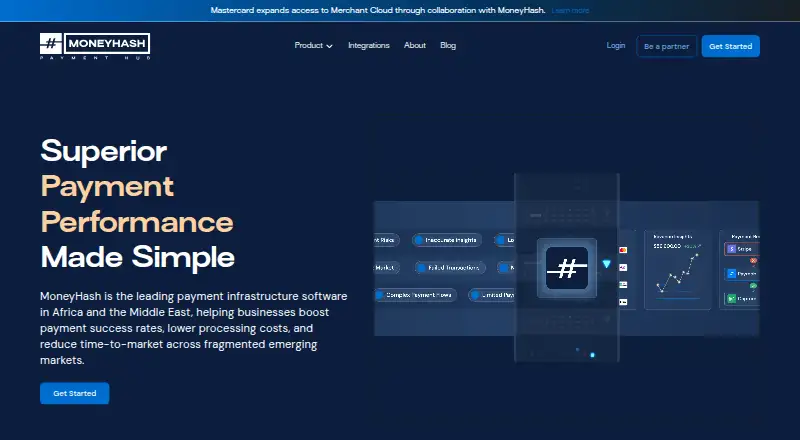
MoneyHash provides cloud infrastructure for payments in emerging markets. Its unified API, hosted and embedded checkout, routing controls, retry handling, and provider fallback support payment operations. Pay-in and payout services, alternative methods, subscriptions, and tokenization are part of the suite. A dashboard tracks transactions and revenue. The service supports web, iOS, Android, and API use, with fees quoted on request.
Review
In a line
MoneyHash provides payment infrastructure software for companies serving Africa and the Middle East. A single integration brings payment providers and methods into one system.
What it does
The suite covers pay-ins, payouts, recurring billing, payment links, virtual wallets, digital invoices, and alternative payment methods. Checkout can be delivered through hosted pages, web embeds, mobile SDKs, or a direct API.
Rules-based controls can direct transactions among providers. Retries and fallback connections can help when a payment attempt fails. Its dashboard displays transactions, revenue, refunds, and channel performance.
How it connects
One MoneyHash API links providers and payment methods, with provider configuration handled in the dashboard. The pay-in product page reports connections to 300+ providers in 100+ markets, covering cards, wallets, buy now, pay later, and open banking.
The developer hub offers guides, API documentation, SDKs, and troubleshooting resources. Available SDKs include JavaScript, iOS, Android, Flutter, and React Native. Webhooks, idempotent APIs, sandbox environments, and PCI-DSS Level 1 tokenization are also described.
A direct API implementation requires PCI DSS Level 1 certification, while the merchant remains responsible for collecting, handling, and transmitting cardholder data.
Good fit
MoneyHash is aimed at companies launching or operating in emerging markets, particularly Africa and the Middle East. It can suit teams coordinating multiple providers, local payment methods, recurring billing, or marketplace payouts.
The company says its team helps with technical integrations, infrastructure, and payment strategy throughout the payment lifecycle.
Watch for
Its product is tailored to emerging markets, with particular emphasis on Africa and the Middle East. Verify that the countries and providers you need are supported before choosing it.
Using the direct API carries PCI DSS Level 1 obligations, including responsibility for cardholder data. Businesses comparing alternatives can review Payment Orchestration Platforms.
Pricing
MoneyHash is a paid product, and subscription rates are not published. Contact the company to obtain plan and pricing details.
Verdict
MoneyHash is worth considering when payment operations span African or Middle Eastern markets and one connection to numerous providers and methods is useful. Routing, retry handling, fallback providers, several checkout formats, and an operations dashboard address collection and payout workflows.
It may be unsuitable for a company that only needs one processor or cannot take on the compliance work of a direct API setup. Confirm regional coverage, provider access, implementation requirements, and the quoted fee before signing up.
Our take
MoneyHash can fit companies handling payments across fragmented markets in Africa and the Middle East. Its unified integration, routing settings, recovery features, checkout choices, and transaction dashboard may limit the number of separate provider connections a team maintains. Key considerations are regional coverage, direct-API compliance responsibilities, and company-provided pricing. Businesses outside its stated focus, or seeking a basic single-processor arrangement, may prefer another tool.
- One integration connects multiple payment providers and methods
- Rules-based routing, retries, and fallback providers are available
- Hosted, embedded, mobile SDK, and direct API checkout formats
- SDKs are available for web, iOS, Android, Flutter, and React Native
- Dashboard covers transactions, refunds, revenue, and channel results
- Subscription rates are not published
- Direct API implementations carry PCI DSS Level 1 certification requirements
- Merchants remain responsible for cardholder data in direct API setups
- The product is focused on Africa, the Middle East, and other emerging markets
- Pick it ifCompanies collecting payments in Africa and the Middle East; Teams coordinating multiple providers, local methods, or payouts; Businesses building recurring or marketplace payment flows
- Skip it ifYou require a publicly listed subscription price; You cannot satisfy PCI DSS Level 1 obligations for a direct API implementation; Your payment activity lies outside the platform's regional focus
Pricing
MoneyHash is paid, with pricing quoted on request.
Questions
What is MoneyHash?
MoneyHash is cloud payment infrastructure and orchestration software for businesses in Africa, the Middle East, and other emerging markets.
Which payment methods does MoneyHash support?
Pay-in integrations cover cards, wallets, buy now, pay later, and open banking, alongside recurring payments and other payment services.
How many providers can MoneyHash connect?
Its pay-in integration page reports connections to more than 300 providers across over 100 markets.
Does MoneyHash offer an API and SDKs?
Yes. The platform includes a unified API, API documentation, and SDKs for JavaScript, iOS, Android, Flutter, and React Native.
What checkout options are available?
Merchants can choose hosted pages, web embeds, mobile SDKs, or a direct API connection.
What does MoneyHash cost?
MoneyHash is paid, but its subscription price is not published; pricing is quoted on request.
Is direct API integration subject to compliance requirements?
Yes. Direct API use requires PCI DSS Level 1 certification, and the merchant handles collection, handling, and transmission of cardholder data.