Mood CMS: A Multilingual Website Platform
moodcms.com · checked 11 Oct 2026
A cloud-based CMS for organizations managing websites in multiple markets and languages.
How it plugs in
Signal on Nonprofit Website Builders5.1#27 of 32
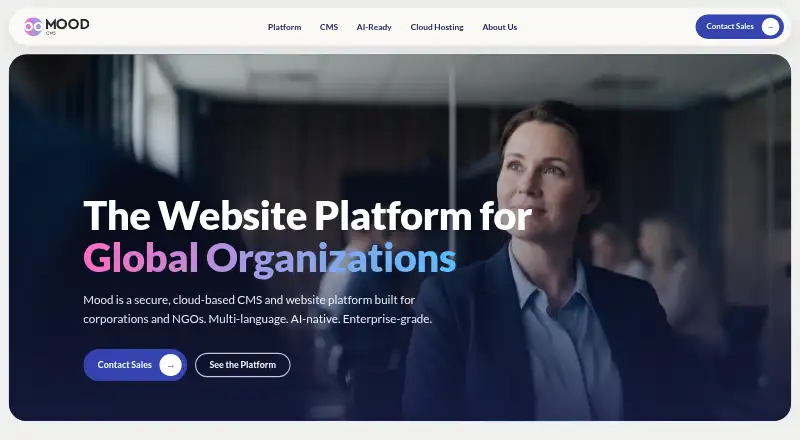
Mood CMS helps marketing and communications teams create and manage multilingual websites. Its visual editor supports writing, translation, review, and publishing, while regional teams can approve their own language versions. The platform includes AI tools, a form builder, and connections to Salesforce, HubSpot, SAP, and Priority. Mood shares pricing on request, and service details are set by agreement.
Review
In a line
Mood CMS provides corporations and NGOs with a cloud-hosted CMS and website platform. It is designed for organizations that manage sites across countries and languages.
What it does
In a visual editor, marketing and communications teams can create, revise, translate, and publish site content without developer involvement. Mood keeps content for different languages in one place, where regional teams can check and approve their versions.
Mood lists built-in AI for content creation and translation, along with search, SEO tagging, customer support, and lead qualification. It also includes a form builder and supports multilingual pages.
How it connects
Mood identifies Salesforce and HubSpot as CRM options, and SAP and Priority for ERP. A REST API—a way for software systems to exchange information—can connect Mood with other systems.
The platform runs as a web service and offers an API. Its service is hosted on Microsoft Azure, with global content delivery, backups, and automatic scaling.
Good fit
Mood may suit global organizations and NGOs whose marketing or communications teams manage websites in multiple markets. Central content management and local review and approval help teams coordinate language versions.
For organizations switching platforms, Mood's team handles migration steps from audit and planning through rebuild, staging review, and launch.
Watch for
Mood does not publish plan prices. Each organization's agreement specifies the applicable service scope, features, service levels, availability commitments, and support terms; review these details before signing.
Mood says it is GDPR compliant and that its Azure infrastructure encrypts data at rest and in transit. Listed safeguards include MFA, IP allowlisting, audit logs, separate development, staging, and production environments, and a web application firewall protecting production traffic.
Pricing
Mood is paid software, and its product pages provide no plan prices; prospective customers are directed to contact sales or book a demo.
The contact page offers a 30-minute demo and says the Mood team will respond within one business day.
Verdict
Consider Mood if your organization needs a centrally managed multilingual website and regional teams need to review their own versions. Its visual editor, named business-system connections, and migration service may fit teams moving website work away from developers.
Costs are difficult to compare before speaking with sales, and the agreement determines key service details. Ask about the price, feature scope, support terms, and availability commitments that apply to your organization.
Our take
Mood is worth considering for corporations and NGOs that manage websites across several markets and languages. Its visual editing and regional approval process are aimed at marketing and communications teams, while named CRM and ERP connections may help it fit into existing business systems. The main buying hurdle is that pricing and service commitments are set through sales and an agreement. Get those terms in writing and confirm the features and support included before deciding whether Mood fits your needs.
- Visual editing supports writing, translation, and publishing without developers.
- Regional teams can check and approve their language versions.
- Names Salesforce, HubSpot, SAP, and Priority, and provides a REST API.
- Migration service includes planning, rebuild, review, and launch.
- Managed hosting includes backups and automatic scaling.
- Prices are available only on request.
- Service scope and support terms depend on the agreement.
- Designed for global organizations and multilingual website work.
- Pick it ifGlobal organizations managing content across languages; Marketing and communications teams that want regional review; Organizations planning a managed migration to a new platform
- Skip it ifYou need published prices to compare plans before contacting sales.; Your organization does not need multilingual website management.
Pricing
Mood is paid, but its pages do not state prices. Discuss pricing with sales or book a demo; the agreement sets the scope and terms for your organization.
Questions
What does Mood CMS cost?
Mood is paid software, but it does not publish prices. Contact sales or book a demo to discuss pricing.
Which organizations is Mood CMS designed for?
Corporations and NGOs, especially global organizations and marketing and communications teams managing websites across markets and languages.
Can regional teams review translated content?
Yes. Mood manages content for different languages centrally, and regional teams can review and approve their own versions.
Which business systems does Mood connect to?
Mood identifies Salesforce and HubSpot for CRM and SAP and Priority for ERP; a REST API supports connections to other systems.
Does Mood include AI tools?
Mood lists AI for creating and translating content, search, SEO tagging, customer support, and lead qualification.
What happens if we move from another platform?
Mood says its team can manage migration, including an audit and plan, rebuild, staging review, and launch.
What hosting and uptime does Mood offer?
Mood's managed hosting uses Microsoft Azure and includes monitoring, global content delivery, backups, and automatic scaling. The cloud-hosting page states a 99.99% uptime SLA, with applicable commitments defined by agreement.
Near it
All alternatives →- FN
 Firespring Nonprofit Website Builder#26 on this board
- M
 Morweb#28 on this board
- I
 iCharityCMS#25 on this board
- NSNGO Sathi#29 on this board
- WWeebly#24 on this board
- C
 Charitiflow#30 on this board
- IDi4a Directory Builder#23 on this board
- DWDonorDirect Websites#31 on this board
- DDuda#22 on this board
- SSilkStart#32 on this board