NaiveSystems Analyze: C/C++ Security and Compliance
naive.systems · checked 21 Oct 2026
Open-source C and C++ analysis for security, quality, and coding-standard compliance.
How it plugs in
Signal on SAST Tools7.6#3 of 26
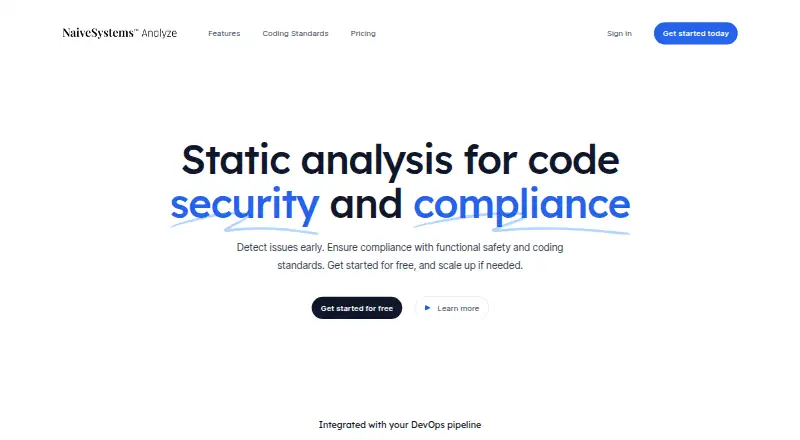
NaiveSystems Analyze examines source code for security and quality defects and checks rules including MISRA, AUTOSAR C++14, CERT, CWE, and OWASP. Containerized analyzers plus an open-source runner allow deployment on the customer’s premises, and Community Edition runs on Linux. GCC and Clang projects of up to 100,000 lines fit Free, while Enterprise expands standards coverage, capacity, and support.
Review
In a line
NaiveSystems Analyze examines source code for security and quality defects while testing functional-safety and coding requirements. The software is open source and designed to run within an organization’s own environment.
What it does
Using syntax trees, symbolic execution, and context-sensitive interprocedural data-flow analysis, the tool identifies issues such as null-pointer dereferences, memory leaks, tainted data, and buffer overflows.
Filters, suppressions, and baselines let teams target critical defects, while actionable diagnostics help address severe findings. Its rule coverage spans MISRA C and C++, AUTOSAR C++14, the CERT C and C++ rule sets, CWE Top 25, and OWASP Top 10.
How it connects
DevOps pipeline connections shown for the product include GitHub, GitLab, Gerrit, Jenkins, and Buildbot. An official GitHub Actions workflow checks Google C++ Style, and a Visual Studio Code extension shows analysis output.
Community users may run the published container images with Podman or Docker. Supported workflows documented by the project include Makefiles, CMake, and Keil MDK. An open-source runner is available, but the reviewed pages do not document a public REST API or SDK.
Good fit
It is aimed at DevOps and DevSecOps teams developing C or C++, with automotive, medical-device, and embedded work highlighted where standards reporting is important.
It also fits organizations that want source code kept on their own systems and need custom security rules, IDE output, or CI/CD checks.
Watch for
Linux with Podman is the officially supported Community Edition setup. Enterprise adds Windows and macOS, as well as support for compilers beyond GCC and Clang. Work on analyzers for languages other than C and C++ is ongoing.
MITRE’s compatibility entry says a CCR XML coverage file is not publicly posted and must be requested by email. It also says CWE-related documentation lacks an index. Community code is GPL-3.0, while some components and Enterprise use separate terms.
Pricing
The no-cost Free tier includes a FOSS on-premises runner, MISRA C/C++ checks, projects up to 100,000 lines, and four CPUs on one node; both commercial and non-commercial use are allowed.
Enterprise is quoted on request. It retains the Free capabilities while adding every available coding standard, unlimited lines, unlimited CPUs and nodes, single sign-on, and priority support.
Verdict
Choose NaiveSystems Analyze when C or C++ compliance and security checks must run inside your environment, particularly for regulated or embedded work. The free plan gives smaller projects a substantial starting point.
Check platform, compiler, language, licensing, and reporting needs first. Windows or macOS, non-GCC/Clang compilers, and projects exceeding 100,000 lines require Enterprise; support for other languages is still being developed.
Our take
NaiveSystems Analyze is suited to organizations that need C and C++ checks mapped to MISRA, AUTOSAR, CERT, CWE, or OWASP rules while retaining source code on their own systems. Free permits commercial use but sets size and hardware ceilings; Enterprise removes those ceilings and adds Windows, macOS, wider compiler support, SSO, and priority assistance. Look elsewhere if support for additional languages is needed immediately, or if you require a documented API or publicly downloadable CWE coverage files.
- The Free tier permits both commercial and non-commercial use
- On-premises runner and containers keep source code under your control
- Rule coverage spans MISRA, AUTOSAR, CERT, CWE Top 25, and OWASP Top 10
- Pipeline connections are shown for GitHub, GitLab, Gerrit, Jenkins, and Buildbot
- Custom security rules and Visual Studio Code output are supported
- Free is limited to 100,000 lines and four CPUs on one node
- Windows and macOS support are limited to Enterprise
- Compilers beyond GCC and Clang require Enterprise
- Support for languages outside C and C++ is still being developed
- No public REST API or SDK is documented
- Pick it ifC and C++ groups that must demonstrate coding-standard compliance; Automotive, medical-device, and embedded development; Organizations requiring on-premises analysis
- Skip it ifYou need analysis for languages beyond C and C++ today; You require Windows, macOS, or non-GCC/Clang compilers on the free plan; You need a documented public API or public CCR XML coverage file
Pricing
Free covers up to 100,000 lines and four CPUs on one node. Enterprise pricing is quoted on request and brings unlimited scale, all available standards, SSO, and priority support.
- FreeFOSS on-premises runner · MISRA C/C++ · up to 100,000 lines · up to 4 CPUs on one node · commercial or non-commercial useFree
- EnterpriseEverything in Free · all available coding standards · unlimited lines · unlimited CPUs and nodes · SSO · priority supportOn request
As naive.systems lists them, checked 21 Oct 2026.
Questions
Is NaiveSystems Analyze free?
Yes. The Free tier costs nothing, allows commercial and non-commercial use, and covers up to 100,000 lines with four CPUs on one node.
Which languages and compilers are supported?
Current analyzers target C and C++. GCC and Clang are available in Free; other compilers require Enterprise. Additional language analyzers are still under development.
Can it run on-premises?
Yes. Containerized analyzers and the open-source runner are intended for deployment on the customer’s premises. Community users may run published images through Podman or Docker.
Does it integrate with CI/CD tools?
The product lists GitHub, GitLab, Gerrit, Jenkins, and Buildbot for pipeline use. An official GitHub Actions workflow is available for Google C++ Style checking.
What coding standards does it check?
Coverage listed by the site includes MISRA C:2012, MISRA C++:2008, AUTOSAR C++14, the full CERT C and C++ rule sets, CWE Top 25, and OWASP Top 10.
Does it have a public API?
The reviewed product pages and repository do not document a public REST API or SDK.
What does Enterprise add?
Enterprise carries over Free and adds all available coding standards, unlimited lines, unlimited CPUs and nodes, SSO, Windows and macOS support, and priority support. Pricing is on request.