NamiTech VoiceDNA review
namitech.io · checked 5 Oct 2026
Voice biometrics for passwordless authentication, fraud checks, and deepfake detection.
How it plugs in
Signal on AI Voice Biometrics Software5.0#14 of 22
NamiTech VoiceDNA applies voice biometrics to customer authentication, fraud detection, and deepfake checks. It verifies people during normal conversation, supports real-time audio and REST API connections, and can run on company servers or in the cloud. The company handles pricing through requests, while the page gives no trial terms.
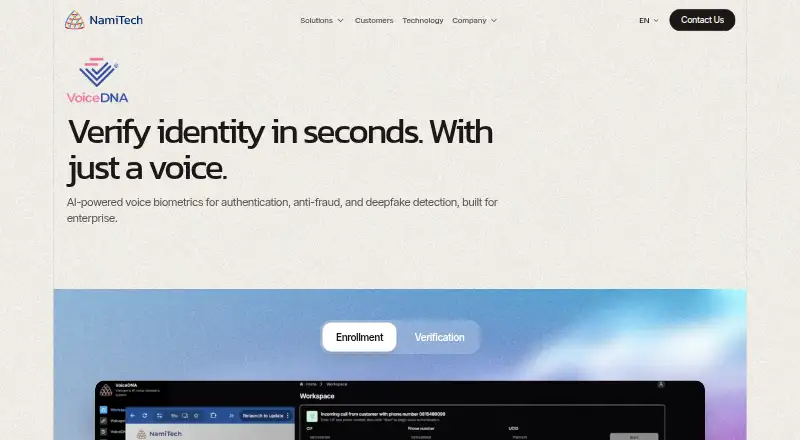
Review
In a line
NamiTech VoiceDNA uses voice biometrics to authenticate customers, flag fraud, and screen for deepfake audio.
What it does
During a natural conversation, VoiceDNA checks a customer's voice, allowing authentication without passwords, security questions, or one-time codes. Enrollment may need only 10 seconds of voice, and a subsequent check may use 4 seconds of live audio.
Its liveness system is intended to spot voice clones, synthetic speech, text-to-speech audio, and physical replay attacks. Before processing, it filters samples for background noise, low volume, and overlapping speakers.
The stated applications span contact-center authentication, mobile banking and other digital channels, insurance onboarding and claims, and broader fraud prevention.
How it connects
Real-time audio streams and a REST API let other software exchange data with the service. It is available through an API or as self-hosted software.
NamiTech says VoiceDNA can operate on CPU hardware without a graphics processor, whether deployed on premises or in the cloud. Supported input includes 8 kHz telephone audio and audio at 16 kHz or above.
For enterprise deployments, NamiTech says it acts as a data processor under a written data-processing agreement. It says deployment data is not used for its own purposes or model training unless agreed in writing.
Good fit
VoiceDNA suits organizations that need voice-based customer checks in contact centers, banking, insurance, or digital services. NamiTech says speaker verification works independently of spoken language, speaker age, and gender.
Organizations needing review trails may value traceable model decisions, logged model versions, replayable calls, and audit logs available for review.
Watch for
The system screens out audio with heavy background noise, low volume, or people speaking over one another, so recording conditions matter. Confirm that your channels provide supported audio quality.
NamiTech lists API and self-hosted options, but the page does not state implementation details for a specific deployment.
Pricing is not published. You need to ask NamiTech for a quote and describe your use case; the company says its team will respond within one business day.
Pricing
VoiceDNA is sold on a paid, quote-based basis. The page includes a demo request but does not state trial terms.
Verdict
Choose VoiceDNA if your organization needs passwordless voice authentication together with checks for cloned, synthetic, or replayed speech. Its API, self-hosted option, CPU support, and stated enterprise data controls may fit teams with deployment or privacy requirements.
Look elsewhere if you need a published price, a stated free trial, or audio requirements outside the supported telephone and 16 kHz-and-above formats.
Our take
VoiceDNA is aimed at enterprises that want voice to verify customers and flag manipulated audio in live interactions. It covers authentication, speaker identification, liveness checks, and fraud use cases, with API and self-hosted delivery. The product can work on CPU hardware and includes stated controls for enterprise data handling and audit review. Buyers should plan for a sales-led process because pricing and trial details are not shown, and they should confirm that their recordings meet the supported quality and sampling conditions.
- Password-free checks during ordinary customer conversations
- Identifies cloned, synthetic, text-to-speech, and replayed audio
- API access plus a self-hosted option
- Runs on CPU hardware without a GPU
- Handles telephone audio and 16 kHz-or-higher input
- Public pricing is not provided
- The page does not state trial terms
- Audio with noise, low volume, or overlapping speakers is screened out
- Enterprise deployment requires checking fit with your audio setup
- Pick it ifContact centers needing voice authentication; Banking, insurance, and digital-channel fraud checks; Teams needing API or self-hosted deployment
- Skip it ifYou require transparent public pricing or stated trial terms; Your audio does not meet the supported quality and sampling conditions
Pricing
VoiceDNA uses paid, request-based pricing. The page provides a demo request but does not state trial terms.
Questions
What is NamiTech VoiceDNA?
VoiceDNA is NamiTech's voice-biometrics service for authenticating customers, detecting fraud, and checking for deepfake audio.
Can VoiceDNA replace passwords or one-time codes?
Customers can be verified by voice during a natural conversation without using passwords, security questions, or one-time codes.
What attacks can it detect?
Its liveness feature is intended to recognize cloned voices, synthetic and text-to-speech audio, and physical replay attempts.
How much voice audio is needed?
The enrollment sample may be as short as 10 seconds; a later authentication attempt may require 4 seconds of live audio.
How can a company integrate VoiceDNA?
The service accepts real-time streams and REST API calls, with deployment available through the API or as self-hosted software.
Which audio formats are supported?
NamiTech says VoiceDNA operates with 8 kHz telephony audio and with audio at 16 kHz or higher. Samples with substantial noise, low volume, or overlapping speakers are screened out.
How is enterprise data handled?
Under a written data-processing agreement, NamiTech says it serves as the enterprise data processor and does not use deployment data for its own purposes or model training unless that is agreed in writing.
What is the pricing approach for VoiceDNA?
It is a paid service priced by request; the page offers a demo request but does not state trial terms.
Near it
All alternatives →- LA
 LumenVox Active Voice Biometrics#13 on this board
- PVPhonexia Voice Verify#15 on this board
- CV
 Clearspeed Voice Risk Assessment#12 on this board
- GSGoVivace Speaker Verification API#16 on this board
- VVVoiceVantage VoiceCheck#11 on this board
- LVLifegence Voiceprint API#17 on this board
- KVKardome VoiceID#10 on this board
- VVVoxEQ Verify#18 on this board
- L
 Lexis+#9 on this board
- AVAwareSDK Voice#19 on this board