
Nango: API Integration Infrastructure
nango.dev · checked 15 Oct 2026
Open-source infrastructure for connecting products and AI agents to external APIs.
How it plugs in
Signal on Unified API7.3#1 of 28
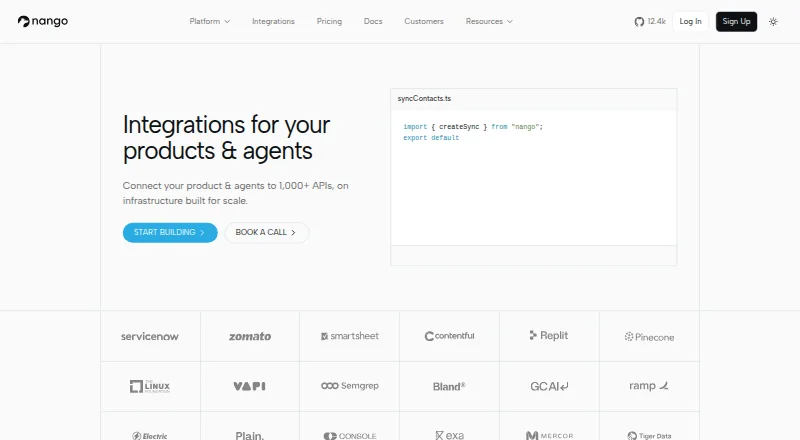
Nango is an open-source integration layer for products and AI agents. It connects to more than 1,000 APIs, handling authentication, credentials, webhooks, rate limits, pagination and data syncing. Teams build integrations as code, run Nango in the cloud or their own environment, and use a public API, SDK and self-hosted options.
Review
In a line
Nango provides infrastructure for building and operating connections between software products or AI agents and outside APIs. It is made by a United States company founded in 2023.
What it does
Teams write code-based integrations that let an application call provider APIs through Nango. Its proxy adds stored credentials, retries, pagination and rate-limit handling to those calls.
Nango Functions can run scheduled incremental or two-way data syncs, transform records and resume from checkpoints. Provider webhooks can be checked, routed and processed before reaching an application.
The platform also supports authentication, agent tools, triggers and reusable workflows. Its Unified API lets teams keep one schema across areas such as CRM, HR, accounting, recruiting and ticketing.
How it connects
Nango lists more than 1,000 supported APIs and includes tooling for authorization, webhooks, pagination and rate limits. Supported sign-in methods include OAuth 2.0, OAuth 1.0a, API keys, JWT, Basic authentication and MCP authentication.
It exposes more than 7,000 prebuilt tools through MCP while keeping provider credentials hidden from agents. A public API is available through direct cURL calls and the @nangohq/node package. Integrations can use custom connectors, webhooks and syncs.
The service can run on Nango Cloud, in a customer cloud through BYOC, or as a self-managed deployment. Its public repository is open source under Elastic License 2.0.
Good fit
Nango suits teams building a product or AI agent that must connect to many outside services. It is useful when developers want provider-specific authentication, retries, rate limits, webhooks and synchronization handled in one integration layer.
The workflow is code-first and supports local development, CI/CD and multiple environments. Hosted runtime features include resumable runs, logs, metrics and alerts.
Watch for
The free plan has hard monthly caps: 10 connections, 10 compute hours and 10GB of data transfer. Limits reset each month rather than rolling over.
Nango does not currently offer an EU-hosted cloud. Enterprise customers can use BYOC in AWS, GCP or Azure regions instead.
New users may need time to learn the platform, and beginner training material is limited. Check the required connectors, hosting region and usage limits before choosing a plan.
Pricing
Free: $0/mo, with API and MCP authentication, tools and syncs, plus 10 connections, 10 compute hours per month and 10GB of data transfer per month. These limits are hard caps.
Pay-as-you-go: $50/mo, including $50 in monthly usage credits. Extra usage is $0.29 per connection, $0.72 per compute hour and $0.50 per GB of egress.
Growth add-on: $450/mo, adding growth features to Pay-as-you-go and five-day requested-integration delivery. Enterprise uses custom pricing and includes commitment discounts, self-hosting or BYOC, an MSA, an SLA and two-day requested-integration delivery.
Verdict
Choose Nango if your product or agent needs many API connections and your team is comfortable maintaining integrations as code. Its catalog, credential handling, sync tools and webhook processing can reduce repeated provider work.
It is less suitable if you need an EU-hosted cloud today, prefer a visual workflow builder, or want generous usage beyond the free caps. Review the Elastic License 2.0, hosting model and expected connection and compute counts before committing.
Our take
Nango is a code-first choice for teams that need one layer between their software and many external APIs. The catalog, authentication options, sync functions, webhooks and agent tools cover common integration chores, while cloud, BYOC and self-managed deployment offer hosting choices. The trade-offs are clear: free usage is tightly capped, the cloud has no EU-hosted region, and newcomers may face a learning curve. Its $50 monthly entry plan fits projects that can forecast usage; larger deployments should ask about enterprise terms and regional hosting.
- More than 1,000 supported APIs
- Open-source and self-hosted deployment options
- Handles credentials, retries, pagination and rate limits
- Supports webhooks, scheduled syncs and agent tools
- Public API and Node SDK available
- Free plan caps connections, compute and data transfer
- No EU-hosted cloud currently
- Code-first workflow may not suit nondevelopers
- Beginner documentation and training are limited
- Enterprise pricing requires a request
- Pick it ifProducts connecting to many third-party APIs; AI agents that need managed external tools; Teams wanting cloud, BYOC or self-managed hosting
- Skip it ifYou require an EU-hosted cloud without using BYOC; You need a visual, no-code workflow builder; Your usage will exceed free limits but not justify paid plans
Pricing
A free tier is available with hard monthly caps. Growth adds $450/mo; Enterprise pricing is custom.
- Pay-as-you-go$50 /mo · $50 monthly usage credits · $0.29/connection · $0.72/compute hour · $0.50/GB egress$50/mo
- Free$0 /mo · API & MCP auth, tools & syncs · 10 connections · 10 compute hours/month · 10GB data transfer/month · hard-capped monthly limitsFree
- Growth add-on$450/mo · 5-day requested-integration delivery · adds growth features to Pay-as-you-go$450/mo
- EnterpriseCustom pricing · Commitment discounts · self-hosting or BYOC · MSA · SLA · 2-day requested-integration deliveryOn request
As nango.dev lists them, checked 15 Oct 2026.
Questions
What is Nango?
Nango is infrastructure for connecting products and AI agents to external APIs. It handles authentication, credentials, webhooks, retries, rate limits, pagination and data syncing.
How many APIs does Nango support?
Its catalog lists more than 1,000 supported APIs. It also provides more than 7,000 prebuilt tools through MCP for AI agents.
Can I self-host Nango?
Yes. Nango can run on its cloud, in a customer cloud through BYOC, or as a self-managed deployment. A limited free self-hosted edition is available.
Is Nango open source?
Yes. Its public repository is open source under Elastic License 2.0.
Does Nango have a free plan?
Yes. The free plan costs $0/mo and includes 10 connections, 10 compute hours per month and 10GB of monthly data transfer, with hard caps.
Does Nango host data in the European Union?
Nango says it does not currently offer an EU-hosted cloud. Enterprise BYOC can run in AWS, GCP or Azure regions.
What does the paid plan cost?
Pay-as-you-go costs $50/mo and includes $50 in usage credits. Additional charges are $0.29 per connection, $0.72 per compute hour and $0.50 per GB of egress.