Nuster Proxy and Cache Server
github.com · checked 11 Oct 2026
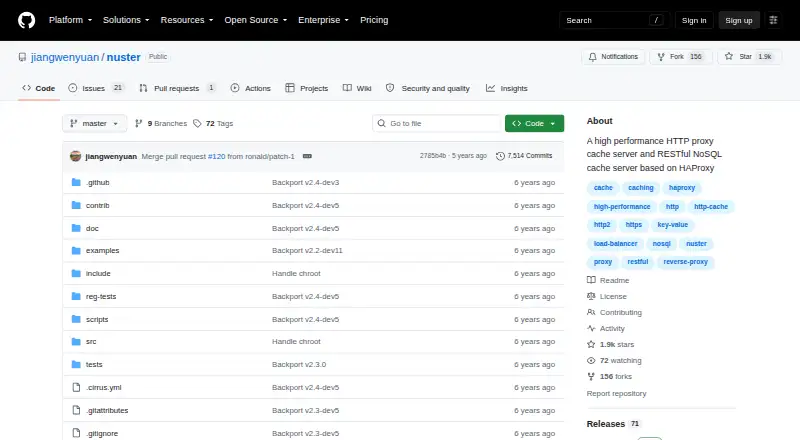
Open-source HTTP proxy, response cache, and RESTful key-value cache built on HAProxy.
How it plugs in
Signal on Reverse Proxy Software5.9#25 of 33
Built on HAProxy, Nuster is a self-hosted server for HTTP proxy caching and RESTful NoSQL caching. It balances HTTP and TCP traffic, caches responses, terminates TLS, and handles key-value operations through HTTP. Nuster runs on Linux, can be deployed with Docker, and is free under an open-source license.
Review
In a line
Nuster is a self-hosted proxy and cache server built on HAProxy. It combines HTTP response caching with a REST-style key-value cache.
What it does
Nuster routes HTTP and TCP traffic and can balance requests across servers. Front-end and back-end HTTPS, compression, HTTP/2, rewriting, monitoring, stickiness, access rules, and content switching are supported.
Its HTTP cache can store dynamic or static responses. Rules can inspect request or response content, headers, cookies, server state, SSL details, and connection metrics. Cache controls include purging, statistics, expiration times, and disk persistence.
Through HTTP POST, GET, and DELETE, the RESTful cache sets, retrieves, and deletes key-value objects. It accepts arbitrary data.
How it connects
Nuster works with HAProxy and carries over its feature set. It can sit between an application and a database such as Memcached or Redis, or between users and an application.
Any programming language that can send HTTP requests can use its RESTful cache. Nuster has an HTTP API, uses file-based configuration, and supports Linux and Docker for self-hosted deployment.
Its HTTPS support and access-control lists provide security controls. The manager, statistics, and purge API are disabled by default; access should be restricted if you enable them.
Good fit
Nuster suits teams that want a self-hosted reverse proxy with caching and HAProxy compatibility. It can handle traffic balancing, TLS termination, and cached responses in one service.
Applications can also use its HTTP key-value cache without requiring clients to share a programming language or data type.
Watch for
Nuster is self-hosted and configured through files, so you need to manage its Linux or Docker deployment yourself. The project lists version 5.2.5.22 as stable, released December 19, 2020; version 5.3.0.23 is labeled mainline, and some older releases are unmaintained or receive critical fixes only.
Enabling the manager, statistics, or purge API requires careful access restrictions. The package is covered by the GPL unless an exception applies, including an exception for OpenSSL use.
Pricing
Nuster is free and open source. There is no paid plan listed, and the software is intended for self-hosted use.
Verdict
Choose Nuster if you need HAProxy-compatible routing, HTTP caching, and a REST-based key-value cache in a Linux or Docker deployment. Its broad cache rules and HTTP interface can serve applications written in different languages.
Consider another option if you need a hosted service or a simpler setup without file configuration and access-control work. Check the release status and license terms before putting it into a new production system.
Our take
Nuster makes sense for teams comfortable operating their own Linux or Docker services and wanting HAProxy-compatible traffic handling plus two kinds of caching. Its REST interface can keep clients language-independent, while cache rules cover detailed request and response conditions. The main cautions are its self-hosted setup, file configuration, security responsibility around management APIs, and the age and maintenance labels of listed releases. It is less suitable for buyers seeking a hosted product.
- Free and open source
- Compatible with HAProxy features
- HTTP and TCP load balancing with TLS support
- RESTful cache accepts arbitrary data over HTTP
- Cache purging, statistics, TTLs, and disk persistence
- Self-hosted deployment on Linux or Docker
- File-based configuration
- Stable release listed from December 2020
- Management and purge APIs need restricted access
- Some older versions are unmaintained or limited to critical fixes
- Pick it ifSelf-hosted HAProxy-compatible proxy and cache deployments; Applications needing a language-neutral HTTP key-value cache; Teams managing Linux or Docker infrastructure
- Skip it ifYou need a hosted service instead of self-hosting; You cannot manage file configuration and API access controls
Pricing
Nuster is free and open source. The facts list no paid plans; deployment is self-hosted.
Questions
Is Nuster free?
Yes. Nuster is free and open source, with no paid plan listed.
What is Nuster used for?
It combines HTTP proxying and response caching with HTTP/TCP load balancing and a RESTful key-value cache.
Where can Nuster run?
Nuster is self-hosted on Linux and can also be deployed with Docker.
Can applications in different languages use Nuster's cache?
Yes. Any programming language that supports HTTP can use its RESTful cache, which accepts arbitrary data.
Does Nuster work with HAProxy?
Yes. The project states that Nuster is fully compatible with HAProxy and carries over its features.
What should I secure when enabling Nuster APIs?
The manager, statistics, and purge APIs are disabled by default. Restrict access if you enable them.
What is the listed stable Nuster version?
Version 5.2.5.22 is listed as stable with a December 19, 2020 release date. Version 5.3.0.23 is labeled mainline.
Near it
All alternatives →- EP
 Envoy Proxy#24 on this board
- RRedbird#26 on this board
- SPSNI Proxy#23 on this board
- CA
 Cloudflare Advanced Certificate Manager#27 on this board
- B
 BunkerWeb#22 on this board
- CT
 Cloudflare Tunnel#28 on this board
- VC
 Varnish Cache#21 on this board
- PPingora#29 on this board
- NP
 Nginx Proxy Manager#20 on this board
- PPiko#30 on this board