NVIDIA Riva Review
developer.nvidia.com · checked 21 Oct 2026
GPU-accelerated speech recognition, text-to-speech and translation services for real-time applications.
How it plugs in
Signal on Speech Recognition Software6.4#21 of 32
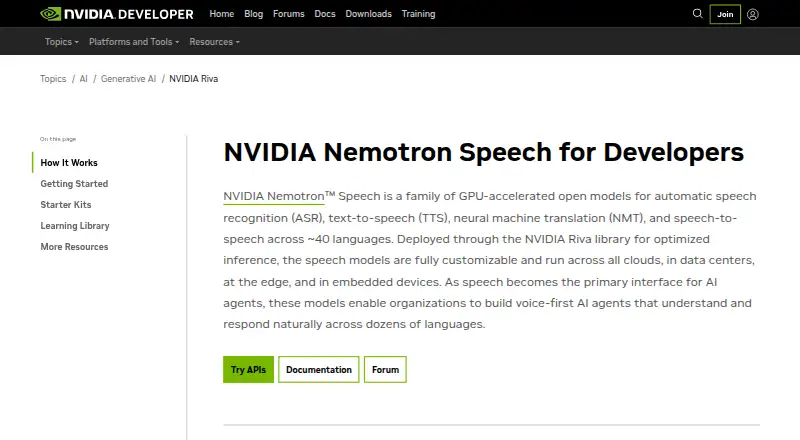
NVIDIA Riva is a GPU-accelerated SDK for building customizable speech and translation applications. It offers speech recognition, text-to-speech, natural language processing and machine translation through APIs. You can run it on Linux, in your cloud, on premises, at the edge or on embedded devices. A free 90-day NVIDIA AI Enterprise trial is available.
Review
In a line
NVIDIA Riva is a software development kit for creating real-time speech and language applications. It combines recognition, speech synthesis, translation and language services in deployable microservices.
What it does
Riva turns spoken audio into text, creates speech from text and handles text, speech-to-text and speech-to-speech translation. Automatic speech recognition works in streaming, offline and batch modes, with options such as punctuation, word timestamps, confidence scores and speaker separation.
Text-to-speech supports streaming or offline use, SSML input, audio encoding and custom pronunciation dictionaries. Zero Shot TTS and emotion mixing are listed as beta features. Riva also provides multilingual services and can act as a voice layer for applications that use large language models or retrieval-augmented generation.
NVIDIA describes optimized inference below 150 milliseconds and real-time interaction below 300 milliseconds.
How it connects
Riva exposes services through gRPC APIs, with Python and C++ client examples. It also documents Protocol Buffers, command-line clients and, on Jetson platforms in Riva 2.26, HTTP REST and WebSocket interfaces for speech recognition and text-to-speech.
The software is distributed as containers. Docker Quick Start scripts support local self-hosting, while Helm charts support Kubernetes deployments. You can use pretrained models from NGC or fine-tune models with NVIDIA NeMo and custom data.
Riva server software uses NVIDIA license terms, not an open-source license. Public client repositories use MIT licenses. The audio format is WAV, and text-to-speech supports SSML.
Good fit
Riva suits teams building speech, captioning, translation or voice interfaces that need control over deployment and data. It can run in public clouds, customer clouds, on premises, at the edge and on embedded devices.
It supports Linux x86_64 and aarch64 systems, plus L4T aarch64 for embedded deployments. NVIDIA Turing or newer GPUs are supported, with at least 16 GB of GPU memory recommended for data-center models.
Watch for
Riva is not open source, and its server license has specific terms. The internal test and development grant described in the license requires systems with NVIDIA GPUs and excludes production use under that grant.
Plan for GPU infrastructure and the documented Linux or embedded software stacks. NVIDIA has disclosed high- and medium-severity improper-access-control issues in Riva; affected versions were fixed through 2.19.0, so check the version and security notices before deployment.
Pricing
Riva uses a freemium model. The NVIDIA AI Enterprise trial is free for 90 days and provides evaluation access to Riva workflows, containers and pretrained models. The NVIDIA API Catalog is also free for individuals through managed APIs and UI demos using sample data.
NVIDIA Riva on Google Cloud VMI is price on request; the listed billing is $60 per GPU hour for high-performance GPUs such as NVIDIA A100. NVIDIA Riva Enterprise is price on request, with one-year or three-year terms, unlimited workloads, ASR and TTS subscriptions and enterprise support. Paid access starts from $1.
Verdict
Choose Riva if your application needs customizable multilingual speech services and you can operate NVIDIA GPU infrastructure. Its deployment choices cover private systems, cloud accounts and embedded hardware, while its APIs and containers provide several integration paths.
Look elsewhere if you require open-source server software, non-NVIDIA hardware or a simple hosted tool with no infrastructure work. Review the license, supported operating systems, GPU memory and current security fixes before committing.
Our take
NVIDIA Riva is a fit for organizations building their own voice or translation features rather than buying a finished end-user app. The free trial lets a team evaluate containers, models and workflows for 90 days, while the free NVIDIA API Catalog plan includes managed API access and enterprise subscriptions are available. Its main trade-offs are NVIDIA GPU dependence, a proprietary server license and the operational work of running containers or Kubernetes. Teams needing private data processing, custom models or embedded deployment may find that effort worthwhile.
- Real-time streaming and offline speech recognition
- Text-to-speech with SSML and pronunciation dictionaries
- Runs on premises, in clouds, at the edge and on embedded devices
- Custom models through NVIDIA NeMo and pretrained NGC models
- Python, C++, gRPC, REST and WebSocket integration options
- Development supports NVIDIA Turing or newer GPUs; 16 GB or more of GPU memory is recommended for data-center models
- Riva server is proprietary, not open source
- Container and Linux or embedded stack setup takes technical work
- Enterprise and Google Cloud VMI prices require a request
- Pick it ifTeams building custom speech, translation or voice applications; Organizations needing private or edge deployment; Developers integrating speech services with LLM or RAG apps
- Skip it ifYou need open-source server software or non-NVIDIA hardware; You want a ready-to-use hosted transcription application; You cannot operate GPU containers or the required Linux stack
Pricing
Freemium access includes a free 90-day NVIDIA AI Enterprise trial and a free NVIDIA API Catalog plan. Google Cloud VMI and Enterprise plans are price on request; the VMI listing bills $60 per GPU hour for high-performance GPUs such as NVIDIA A100.
- NVIDIA AI Enterprise trial90 days · Evaluation access to Riva workflows, containers and pretrained modelsFree
- NVIDIA API CatalogFree access for individuals through managed API and UI demos · Sample data · NVIDIA-managed endpointsFree
- NVIDIA Riva on Google Cloud VMI$60 per GPU hour for high-performance GPUs such as NVIDIA A100 · Alternative GPU options or private offers require contacting NVIDIA$60
- NVIDIA Riva Enterprise1-year or 3-year subscription terms · Unlimited workloads · ASR and TTS subscriptions · Enterprise supportOn request
As docs.nvidia.com lists them, checked 21 Oct 2026.
Questions
Is NVIDIA Riva free?
It has free options: a 90-day NVIDIA AI Enterprise trial and a free NVIDIA API Catalog plan for individuals. Paid access starts from $1; some plans are price on request.
What can Riva do?
Riva provides speech recognition, text-to-speech, natural language processing and text, speech-to-text and speech-to-speech translation.
Where can Riva run?
It supports Linux, public clouds, customer clouds, on-premises systems, edge locations and embedded devices. Docker and Kubernetes deployment tools are provided.
Does Riva have an API?
Yes. Services use gRPC, with Python and C++ clients. Riva 2.26 adds HTTP REST and WebSocket APIs for ASR and TTS on Jetson platforms.
Is Riva open source?
No. The Riva server uses NVIDIA license terms. Public client repositories use MIT licenses.
What hardware does Riva need?
Development supports NVIDIA Turing or newer GPUs. NVIDIA recommends 16 GB or more of GPU memory for data-center models.
Can Riva process data privately?
NVIDIA says Riva data can be processed on premises or in the customer’s cloud.