OpenCart Review: Store Management and Features
opencart.com · checked 21 Oct 2026
Software for managing one or more online shops.
How it plugs in
Signal on Ecommerce platforms7.4#12 of 280
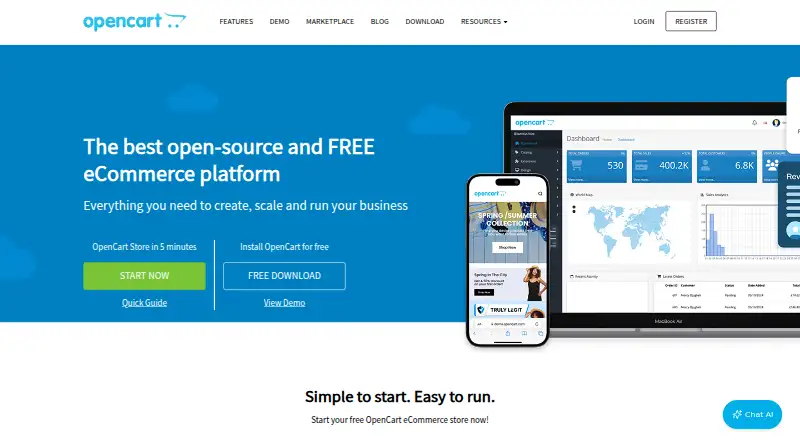
OpenCart is open-source software for running online stores at no charge. Its dashboard brings together order, sales and customer information, while features include multiple stores, downloadable products, recurring payments and a range of payment and shipping integrations. It is available as a hosted service or for installation on your own server, with additional capabilities in its marketplace.
Review
In a line
OpenCart is a web-based, open-source shopping-cart and store-management system for one or more shops. It can be hosted or installed on your own server.
What it does
Dashboard widgets bring orders, sales, customer details, online visitors and analytics into view. Administrators can assign separate access privileges through user groups.
A shared administration area can oversee multiple shops, each with its own theme, regional settings and product pricing. The catalog accommodates any number of categories and products, including downloadable products, and supports attributes such as size and color, along with discounts, coupons and special prices.
Store capabilities include reviews and ratings, reward points, filters, various currencies and over 40 languages. Checkout is available to guests and registered users; recurring charges, affiliate tracking and automatic currency-rate updates are also supported.
How it connects
OpenCart’s API allows outside applications to interact with a store. Its marketplace features over 13,000 modules and themes for payments, shipping, marketing, accounting, reporting, language packs and other integrations.
According to the features page, 36 payment options are built in, among them PayPal, Authorize.Net, Klarna, Skrill and SagePay. Shipping connections include Australia Post, FedEx, Royal Mail, UPS and USPS, and the marketplace offers further options.
For self-hosting, the minimums include a web server, PHP, cURL and a database. Documentation calls for PHP 8.0 or later and supports MySQLi, PDO or PostgreSQL. OpenCart can also be considered alongside ecommerce platforms.
Good fit
OpenCart may suit businesses running one shop or several through a common admin area. It supports downloadable products, multiple currencies and languages, subscriptions, affiliates and common store promotions.
It may also fit teams seeking open-source code, an API and a broad extension marketplace. Users can configure their own backup and restore processes, and support is available through a community forum or paid technical assistance.
Watch for
Running OpenCart on your own server means meeting requirements for server software, PHP, a database and supporting libraries. The download instructions explain how to upload files to a server and start the installer.
There is no abandoned-cart recovery feature. Some payment, shipping and other services may depend on marketplace extensions, so check extension and hosting requirements before committing.
Pricing
OpenCart’s plan provides downloads and updates at no charge, with no monthly fee.
The open-source download option also costs nothing and includes unlimited categories and products, self-hosted installation and no monthly fee.
Verdict
OpenCart is worth considering for free, open-source store software with multi-store administration, extensive language and currency support, and a broad add-on selection. It also provides an API and a self-hosted option.
It may be a poor fit if you need built-in abandoned-cart recovery or want to avoid server setup and extension selection.
Our take
OpenCart is an option for organizations looking for free software and control over their online-store setup. Its multi-store administration, catalog tools, payment and shipping integrations, API and marketplace cover a range of store needs. The trade-off is technical responsibility: self-hosting has specific server and PHP requirements, and some capabilities depend on extensions. Since abandoned-cart recovery is absent, stores that need it should consider another product. Teams seeking open-source flexibility may want to shortlist it; those looking for a managed, low-maintenance setup may not.
- Downloads and updates are free, with no monthly fees
- Open-source software with an API for third-party applications
- Multiple stores managed from one admin interface
- Marketplace with over 13,000 modules and themes
- More than 40 languages and multiple currencies supported
- No abandoned-cart recovery
- Self-hosting needs a web server, PHP, cURL and a database
- Some payment and shipping methods are available through extensions
- Dedicated technical support is commercial
- Pick it ifBusinesses managing one or more online stores; Teams seeking open-source, self-hosted store software; Stores selling downloadable products
- Skip it ifYou need built-in abandoned-cart recovery; You want to avoid server requirements and extension management; You need features not covered by its marketplace
Pricing
Both listed plans are free and have no monthly fees. The open-source download plan is self-hosted.
- OpenCartOpen-source store software · free download and updates · no monthly feesFree
- OpenCart open-source downloadUnlimited categories and products · self-hosted installation · no monthly feesFree
As opencart.com lists them, checked 8 Oct 2026.
Questions
Is OpenCart free?
Yes. The OpenCart plan and the open-source download plan both cost nothing and have no monthly fees.
Can OpenCart run more than one store?
Yes. A single admin interface can handle multiple stores with distinct themes, localized settings and per-store product prices.
What payment methods work with OpenCart?
The features page names 36 integrated payment methods, including PayPal, Authorize.Net, Klarna, Skrill and SagePay. Other methods are available through the marketplace.
Does OpenCart support downloadable products?
Yes. Stores can sell downloadable products.
What does self-hosting require?
A web server, PHP, cURL and a database are minimum requirements. Documentation specifies PHP 8.0 or later and support for MySQLi, PDO or PostgreSQL.
Does OpenCart recover abandoned carts?
No. Abandoned-cart recovery is not included.
Does OpenCart have an API?
Yes. OpenCart’s API lets third-party applications communicate with a store.