
OpenFamily review: self-hosted family GPS tracking
openfamily.app · checked 15 Oct 2026
Private family location sharing with a server you operate yourself.
How it plugs in
Signal on Family Locator Apps7.6#1 of 29
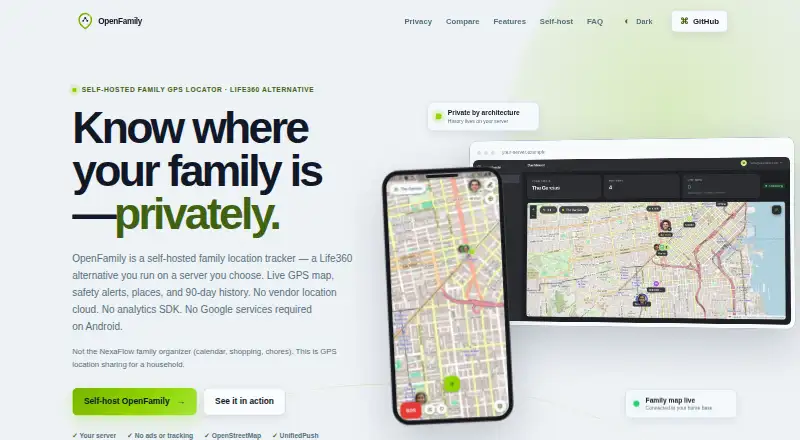
OpenFamily lets households share GPS locations through a self-hosted, open-source service. It offers live maps, saved-place alerts, location history, SOS and check-ins. Android and iOS clients connect to a Docker Compose deployment on a VPS, NAS, home server or LAN machine. Location records stay in the operator's PostgreSQL database, while optional integrations handle maps, notifications and SMS.
Review
In a line
Households can use OpenFamily to share GPS positions from infrastructure they operate. It is positioned as a private alternative to Life360.
What it does
Family members appear on a live OpenStreetMap view with photo avatars, battery level, last-seen time and movement state. Street and satellite layers, movement indicators and overlapping-user clusters are included.
Saved places can send arrival or departure alerts. Recorded locations provide trails, stays, stops and in-transit segments, with detailed history kept for 90 days.
Safety workflows cover SOS alerts, a discreet ten-second countdown, check-ins with notes and non-emergency Help requests. Devices can pause reporting, require biometrics, change theme and adjust background updates.
How it connects
The Docker Compose deployment bundles Caddy, a Go REST and WebSocket API, PostgreSQL with PostGIS and TimescaleDB, and ntfy. Public API documentation covers health, configuration, authentication, family, place, device, location and alert endpoints, plus a WebSocket stream.
Android push travels through UnifiedPush and ntfy without Google Play Services or a Google account. iOS alerts depend on Apple APNs; optional SOS text messages use Twilio after the operator enables them.
OpenStreetMap is the default map source. Operators can select Esri satellite tiles, another raster provider or their own tile URL. The code is open source under AGPL-3.0, and the standard setup requires Docker and Docker Compose.
Good fit
OpenFamily is intended for households with someone able to operate a small Docker stack and maintain backups and TLS. Family invites support admin, member and child roles.
Supported placements include VPS, Synology NAS, home-server and LAN deployments. Accounts, coordinates, saved places and history stay in PostgreSQL on the operator's machine rather than a vendor location cloud.
Watch for
Operating OpenFamily involves server administration. The project recommends production mode, strong secrets, closed public registration, backups and host-disk encryption. The application does not encrypt database rows itself.
Default map hosts may see the area being viewed. iOS push relies on APNs, and SMS is an optional Twilio service. Synology guidance calls for an x86_64 device with Container Manager and at least 4 GB of RAM.
The project targets household use instead of fleets or public tracking. If you want other family-location apps, see family locator apps, Glympse or OwnTracks.
Pricing
OpenFamily costs nothing and is open source. Its self-hosted plan is billed free, uses an AGPL-3.0 deployment, requires your own Docker server and includes 90 days of detailed history for household use.
Verdict
Choose OpenFamily when keeping location data on equipment you control matters and your household can handle Docker hosting, updates, backups and TLS. Its live map, alerts and safety workflows support everyday family coordination.
Look elsewhere for a hosted service, fleet management or public tracking. Also account for outside services: map tiles may expose viewed areas, APNs handles iOS notifications and Twilio is needed for optional SMS.
Our take
OpenFamily suits privacy-minded households willing to operate their own server. It combines family roles, live location, saved-place alerts, history and SOS tools without a vendor-hosted location database. The tradeoff is ongoing technical care: Docker deployment, secure configuration, backups, TLS and host encryption are your responsibility. It targets households rather than fleets or public tracking, and integrations include APNs, ntfy, Twilio and configurable tile providers. Pick it when control matters more than convenience; avoid it if you want a managed service.
- Free AGPL-3.0 open-source software
- Self-hosted data in your PostgreSQL database
- Live map, alerts, history and SOS workflows
- Android push without Google Play Services
- Public REST and WebSocket API
- Requires Docker hosting and ongoing maintenance
- Database rows are not encrypted by the app
- Some map, iOS push and SMS functions rely on external providers
- Designed for households, not fleets or public tracking
- Pick it ifHouseholds that can run a small Docker stack; People wanting location data on their own server; Families needing alerts and SOS tools
- Skip it ifYou want a hosted tracker with no server administration; You need fleet management or public tracking; You cannot maintain backups, TLS and host security
Pricing
OpenFamily has one free, self-hosted option. You provide the Docker server; the plan includes 90 days of detailed history for household use.
- Open source self-hostedSelf-hosted deployment · AGPL-3.0Free
- Self-hosted OpenFamilyfree · Requires your own Docker server · 90-day detailed history · household useFree
As openfamily.app lists them, checked 9 Oct 2026.
Questions
Is OpenFamily free?
Yes. The self-hosted OpenFamily plan is billed free and is released under AGPL-3.0.
Where can I run OpenFamily?
Documentation covers VPS, Synology NAS, home-server and LAN deployments. Standard installation needs Docker and Docker Compose.
Does OpenFamily need Google services?
Android notifications use UnifiedPush through ntfy and do not require Google Play Services or a Google account. iOS notifications use Apple APNs.
Where is location data stored?
The operator's PostgreSQL server stores accounts, coordinates, saved places and history instead of a vendor location cloud.
How long is detailed history kept?
Detailed location history remains available for 90 days and includes trails, place stays, stops and in-transit segments.
Can OpenFamily send SOS texts?
Yes, optional SOS SMS uses Twilio. An operator must configure and enable that service first.
Does it have an API?
Yes. The public Go API covers health, configuration, authentication, families, places, devices, locations and alerts, with a WebSocket stream.