OpenRepo: Self-Hosted Package Repository Server
github.com · checked 11 Oct 2026
Web-based, open-source server for Debian, Red Hat, and generic package repositories.
How it plugs in
Signal on Artifact repository software6.0#29 of 64
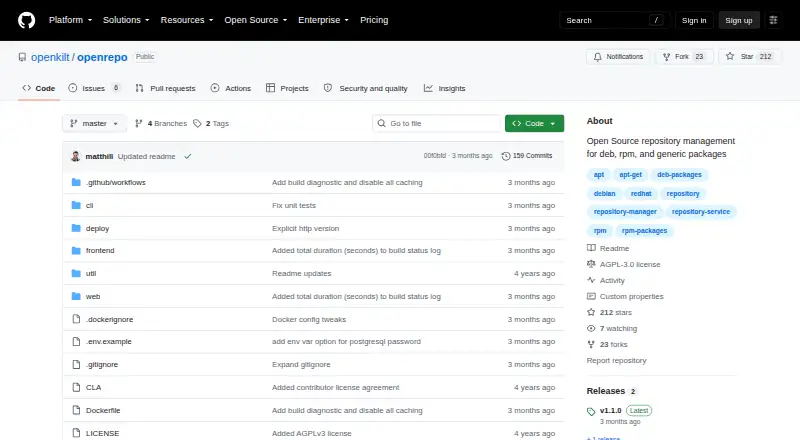
OpenRepo is a self-hosted web server for Debian apt/deb, Red Hat rpm, and generic package repositories. It lets users upload, remove, copy, and promote packages across environments such as development, QA, beta, and production. A REST API and command-line tool support repository work and continuous integration. Docker Compose is the preferred deployment method.
Review
In a line
OpenRepo provides a web interface for hosting and administering Debian, Red Hat, and generic package repositories. It runs on Linux or as a self-hosted service, with an API available for automation.
What it does
The server creates and hosts RPM, Deb, and generic repositories that work with Debian or Ubuntu apt-get and Red Hat yum tools.
Users can upload, delete, copy, and promote packages between repositories. This supports stages such as development, QA, beta, and production. OpenRepo also manages package versions and PGP signing keys.
How it connects
Repository, package, and signing-key operations are exposed through OpenRepo's REST interface, while a command-line app handles continuous-integration jobs. These tools can upload packages and copy or promote them between repositories.
The preferred setup uses Docker Compose. It starts the required services and a PostgreSQL database, storing database, cache, PGP keys, and package files in an `openrepo-data` folder. The code is licensed under AGPL-3.0.
Good fit
OpenRepo suits teams that need a self-hosted place for Debian, Red Hat, or generic packages and want staged movement from development through production.
It is useful when automated builds must push packages or move them between repositories through an API or command-line tool.
Watch for
Write permission is granted separately for each repository. Regular users can read all repositories, while super users have read and write access everywhere plus administrative rights.
PostgreSQL is the default database and is recommended for production; SQLite is mentioned for development. Administrators should change the default admin password after the first login and set custom Django and PostgreSQL secrets through environment variables.
Pricing
OpenRepo is free and open source. There is no paid plan listed.
Verdict
Choose OpenRepo if you need to host RPM, Deb, or generic repositories under your own control and want API or command-line support for package workflows.
A hosted service or unsupported package format may call for another choice: deployment is self-hosted, and the documented formats are RPM, Deb, and generic repositories.
Our take
OpenRepo is a practical choice for organizations that want an open-source package server they run themselves. Its support for apt-get and yum-compatible repositories covers common Debian and Red Hat delivery paths, while repository permissions and staged promotion help separate release steps. The REST API and CLI add automation without requiring users to work only through the web interface. Buyers must provide the deployment, database, storage, and security administration, so a hosted alternative may fit better when infrastructure ownership is not wanted.
- Free package repository server with open-source code
- Handles RPM, Deb, and generic repositories
- REST and command-line interfaces can support CI workflows
- Packages can move between staged repositories
- Per-repository write permissions and super users
- Self-hosted deployment is required
- PostgreSQL is recommended for production
- Administrators must change default credentials
- Documented formats are limited to RPM, Deb, and generic packages
- Pick it ifTeams hosting Debian or Red Hat packages themselves; CI workflows that promote packages between repositories; Organizations needing repository-level write control
- Skip it ifYou want a fully hosted package service; You need package formats outside RPM, Deb, or generic repositories; You cannot manage Docker Compose and a database
Pricing
OpenRepo is free, with an open-source license and no paid plan listed.
Questions
What package formats does OpenRepo support?
It provides RPM, Deb, and generic repositories for use with Debian or Ubuntu apt-get and Red Hat yum.
Does OpenRepo have an API?
Yes. Repository, package, and signing-key operations are available through its REST interface, and the command-line app can upload, copy, or promote packages for CI.
How is OpenRepo deployed?
Docker Compose is the recommended setup; it launches the needed services, creates a PostgreSQL database, and places database, cache, PGP-key, and package data in `openrepo-data`.
Is OpenRepo free?
Yes. It is released as free software under AGPL-3.0.
How do permissions work?
Regular users can read every repository but require repository-specific write permission. Super users can read and write across repositories and administer the service.
Which database does OpenRepo use?
PostgreSQL is the standard database and is advised for production; SQLite is noted for development use.
Near it
All alternatives →- PPPosit Package Manager#28 on this board
- AN
 Anaconda Notebooks#30 on this board
- Ddevpi#27 on this board
- HC
 Huawei Cloud CodeArts Artifact#31 on this board
- CCachix#26 on this board
- RRepman#32 on this board
- ACAlibaba Cloud DevOps Packages#25 on this board
- AKArtifact Keeper#33 on this board
- R
 RepoFlow#24 on this board
- NNORA#34 on this board