OpenRubric: Hackathon Judging Software Review
openrubric.vercel.app · checked 15 Oct 2026
Hackathon judging managed with shared rubrics, imports, GitHub timeline review, rankings, and CSV output.
How it plugs in
Signal on Rubric Software6.3#3 of 22
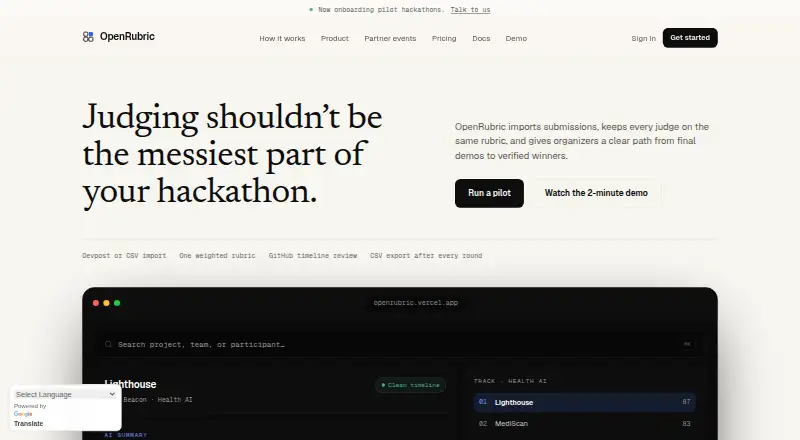
Hackathon judging is managed by OpenRubric, which brings in projects from Devpost, CSV files, or manual entry, then sets weighted criteria, tracks, and judges. Judges keep separate scores and comments while the service calculates rankings. Optional GitHub timeline checks and AI-written summaries support review, and results can be exported to CSV.
Review
In a line
OpenRubric provides managed infrastructure for hackathon judging. It brings submissions, rubrics, judge scores, review timelines, and rankings into one place.
What it does
Projects can enter OpenRubric through a public Devpost page, a CSV upload, or manual entry. Organizers then set weighted criteria and prize tracks and assign judges.
Judges score each criterion and can leave comments. Their records remain separate, while rankings are produced for each track and overall; event data is available as a CSV during or after judging.
After a read-only GitHub token is configured, OpenRubric examines repository dates, commits, event-related activity, and contributors for organizer review. It can also draft short project summaries and, according to its guide, suggest rubric criteria from an uploaded rubric image.
How it connects
OpenRubric is available through its web app, an API, or operator-controlled infrastructure. Its documented API covers hackathons, imports, submissions, scoring, rankings, GitHub scans, summaries, and review cases.
It lists Devpost and CSV imports, GitHub repository review, Supabase for hosted data and sign-in, and AI providers for summaries. The summary endpoint accepts the OpenAI chat-completions format and can target OpenAI, Azure OpenAI, Together, Groq, or local Ollama.
The software is not open source. The license permits an unmodified copy for evaluation or a bona fide judging event, while disallowing redistribution, changes, hosted service use, and competing products.
Good fit
OpenRubric suits hackathon organizers and judges who need a shared points-based rubric, separate judge records, prize tracks, and a clear export of results.
It can help teams review repository timelines, block a winner while a high-priority case is unresolved, and show when others are viewing a submission through Supabase presence indicators. Managed events come with email help before and during the event, while pilot events receive live judging assistance.
Watch for
OpenRubric says it is neither a cheating detector nor an AI judge. People assign scores and prizes, and turning off AI summaries does not alter ranking calculations.
Because Devpost offers no stable public judging API, imports rely on public metadata and may need a CSV file or manual links. GitHub review also requires a token.
The product is onboarding pilot hackathons and runs those events with its team present. It supports analytic rubrics, but not holistic rubrics, LMS connections, or collaborative authoring. Its proprietary license also limits reuse and modification.
Pricing
A Managed event is priced at $50 once per event. The package covers AI credits, rubrics, tracks, judge assignments, GitHub timeline review, email support, and a CSV backup. Larger events are quoted; the listed hackathon range is $50 to $100.
Verdict
Choose OpenRubric if your event needs structured judging rather than a general form or spreadsheet, especially when Devpost imports, GitHub checks, track winners, and CSV output matter. The free Partner event lowers the cost of a first event, while Managed event adds support and review tools. Look elsewhere if you need open-source rights, a stable Devpost judging connection, holistic scoring, LMS integration, or judges to co-author rubrics.
Our take
OpenRubric is aimed at organizers who want one workflow for collecting hackathon projects, assigning judges, applying weighted criteria, and producing winners. Its separate score records, track rankings, GitHub timeline review, and CSV exports cover practical event work. The free Partner event plan offers a low-cost starting point, while the paid Managed event adds support and AI credits. However, Devpost imports may need a fallback, the product is still in pilot onboarding, and its proprietary license prevents modification or redistribution. It is not a fit for teams seeking open-source software or automated judging.
- Imports projects from public Devpost pages, CSV files, or manual entry
- Separate autosaved score records prevent judges from overwriting each other
- Ranks winners by prize track and overall, with CSV export
- Optional GitHub timeline checks and AI-written project summaries
- Free Partner event plan includes setup, support, and rankings
- Devpost lacks a stable judging API, so imports may need CSV or manual links
- Not open source; the license restricts modification, redistribution, and hosted services
- No holistic rubrics, LMS integration, or collaborative authoring
- It is onboarding pilot hackathons and runs events with the team present
- GitHub timeline review requires a read-only token
- Pick it ifHackathon organizers using weighted rubrics and prize tracks; Events that need judge separation, GitHub checks, and CSV results; Teams wanting managed support during judging
- Skip it ifYou need open-source rights or want to modify and redistribute the software; Your event depends on a stable Devpost judging API; You require holistic rubrics, LMS links, or collaborative rubric editing
Pricing
Partner event is free. Managed event is $50 one-time per event, with larger events quoted and a listed $50 to $100 per-hackathon range.
- Partner eventfirst event · Event setup and rubric configuration · Devpost or CSV import · Judge onboarding · Live support · Rankings and CSV export · Sponsor recognitionFree
- Managed eventper event · $50 to $100 per hackathon · AI credits · Rubric, tracks and judge assignments · GitHub timeline review · Email support · CSV backup · Larger events quoted$50 one-time
As openrubric.vercel.app lists them, checked 15 Oct 2026.
Questions
Can OpenRubric import Devpost submissions?
Yes. Organizers may provide a public Devpost URL, though Devpost has no stable judging API. OpenRubric uses public metadata and can switch to CSV or manual links.
Does OpenRubric judge projects automatically?
No. People assign scores and make award decisions. OpenRubric says it is neither a cheating detector nor an AI judge, and it does not automatically deduct points.
Can judges work independently?
Yes. Every judge has an independent score record, and autosave does not replace another judge’s work.
What does GitHub review check?
Using a read-only GitHub token, the review covers repository creation, first and last commits, activity before or after the event, and contributors.
Is OpenRubric open source?
No. Its published license allows an unchanged copy for evaluation or a bona fide judging event, but prohibits redistribution, modification, hosted services, and competing products.
How much does OpenRubric cost?
The Partner event plan is free. A Managed event costs $50 once per event; larger events are quoted, with a listed range of $50 to $100 per hackathon.