User and Entity Behavior Analytics Software
OpenUBA: UEBA for Users and Entities
github.com · checked 8 Oct 2026
Inspectable, open framework for analyzing user and entity behavior.
How it plugs in
Signal on User and Entity Behavior Analytics Software6.1#2 of 21
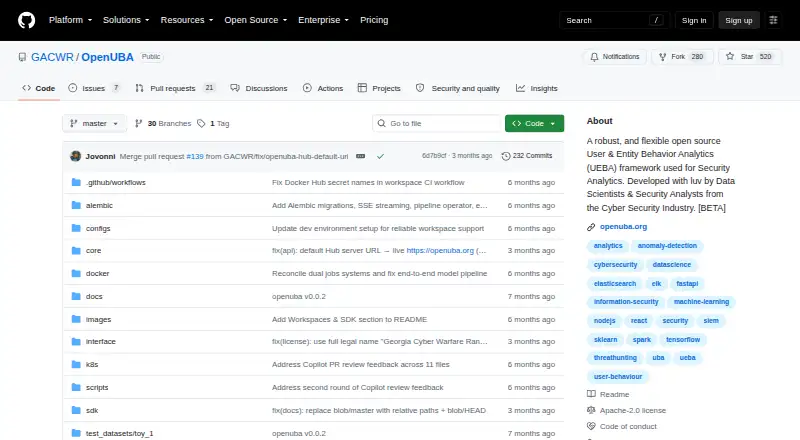
OpenUBA provides an open-source framework for security analytics on users and other entities. It lets teams install, train, run, and version models, then build visual detection rules that create alerts linked to anomalies and cases. It runs through a web interface and APIs on Linux or self-hosted Kubernetes deployments. The project is in beta, release v0.0.2.
Review
In a line
For security work, OpenUBA analyzes user and entity behavior through models that can be inspected and audited.
What it does
The platform supports model installation, training, execution, version and artifact tracking, plus feedback and shadow modes across the lifecycle. It supports hybrid methods for finding unusual behavior among users and entities.
A visual builder lets you assemble flows from model outputs and logical conditions. Triggered alerts can point to anomalies and cases.
Its supported model stack spans scikit-learn, PyTorch, TensorFlow, Keras, NetworkX, and Spark MLlib.
How it connects
Available loaders handle local CSV data, Elasticsearch, Spark, and aggregated inputs from multiple sources. Model registries listed by the project include GitHub, OpenUBA Hub, Kubeflow, and local storage; its adapter table marks HuggingFace support as planned.
The project exposes REST and GraphQL interfaces plus a Python SDK for model registration, job submission, and data visualization. It runs as a web and API service on Linux, with self-hosted deployment.
The architecture is built for Kubernetes. Containerized components target either a development Kind cluster or a production Kubernetes cluster. Training and inference run in isolated Docker containers or ephemeral Kubernetes Jobs with resource limits.
README-listed controls cover JWT sign-in, four roles, per-page read and write permissions, audit logs, and model-hash checks. Its assistant works with local Ollama and cloud APIs from OpenAI, Claude, and Gemini.
Good fit
Security analysts investigating how behavior models work, including their source code, may find OpenUBA suitable. It fits teams that need to manage their own model training and connect several listed data sources.
Its visual rules, alert links, model tracking, and APIs cover workflows from model jobs through investigation cases.
Watch for
The repository labels OpenUBA as beta, and the GitHub release v0.0.2 is marked pre-release. Check its maturity against your operational needs before adopting it.
Self-hosting requires managing containers or Kubernetes. The security policy recommends a reverse proxy with TLS, Kubernetes access controls and secrets, network policies, and regular container-image updates.
HuggingFace appears as a planned adapter rather than completed support in the project’s adapter table.
Pricing
OpenUBA is free and open source. A free plan is listed.
Verdict
OpenUBA is worth considering when you need an inspectable UEBA framework, control over model training and deployment, and APIs for connecting your own security workflow. Its open code and model tracking can help teams review how detections are produced.
Look elsewhere if you need a mature, supported release or do not want to operate Linux, containers, or Kubernetes yourself. Treat the pre-release status and planned HuggingFace adapter as adoption checks, not minor details.
Our take
OpenUBA is a reasonable starting point for security teams that value open models and want to run the full behavior-analytics workflow themselves. It offers model management, visual rules, several data loaders, and REST, GraphQL, and Python interfaces without a license fee. The trade-off is operational: deployment is self-hosted and Kubernetes-oriented, while the project remains beta at pre-release v0.0.2. Teams needing a finished product, established support, or a simpler hosted setup should wait or choose another tool.
- Free and open-source framework
- Inspectable and auditable model code
- REST, GraphQL, and Python interfaces
- Rules can connect triggered alerts with anomalies and cases
- Supports several data loaders and model frameworks
- Beta project with pre-release v0.0.2
- Self-hosted Kubernetes deployment adds operational work
- HuggingFace adapter is listed as planned
- Deployment guidance calls for TLS, Kubernetes access controls and secrets, network policies, and regular image updates
- Pick it ifSecurity analysts examining and managing behavior models; Teams able to run Linux, containers, or Kubernetes; Projects needing open APIs and visual detection rules
- Skip it ifYou need a mature, fully released product; You want a hosted service instead of self-hosting; You require completed HuggingFace registry support
Pricing
OpenUBA is free and open source, and a free plan is listed.
Questions
Is OpenUBA free?
Yes. It is free and open source, and a free plan is listed.
Where can OpenUBA run?
It runs as web and API software on Linux with self-hosted deployment. The project describes containerized deployment to Kind for development or Kubernetes for production.
Which data sources can it load?
Its listed loaders handle local CSV files, Elasticsearch, Spark, and aggregated multi-source inputs.
Does OpenUBA provide an API?
Yes. REST and GraphQL endpoints and a Python SDK support model registration, job submission, and visualization.
Which model frameworks are supported?
The listed frameworks are scikit-learn, PyTorch, TensorFlow, Keras, NetworkX, and Spark MLlib.
Is OpenUBA production-ready?
The README labels it beta, and the GitHub release v0.0.2 is marked pre-release. Check that status before using it for critical operations.
Which LLM services can its assistant use?
The assistant works with local Ollama and cloud APIs from OpenAI, Claude, and Gemini.
Near it
All alternatives →- MDMicrosoft Defender for Business#1 on this board
- TITeramind Insider Risk Management#3 on this board
- NP
 NetWitness Platform#4 on this board
- SVSecurity Vision UEBA#5 on this board
- VI
 Veriato Insider Risk Management#6 on this board
- EU
 eyeCloudXOAR UEBA#7 on this board
- VUVbtEngine UEBA#8 on this board
- NO
 Netskope One Behavior Analytics#9 on this board
- DI
 DTEX Insider Risk Management#10 on this board
- CU
 CYBERQUEST UEBA#11 on this board