
Integration Platform as a Service Software
Oracle Integration: Features, Connections, and Pricing
oracle.com · checked 3 Oct 2026
Cloud platform for connecting apps and data, automating workflows, and managing APIs.
How it plugs in
Signal on Integration Platform as a Service Software5.9#47 of 113
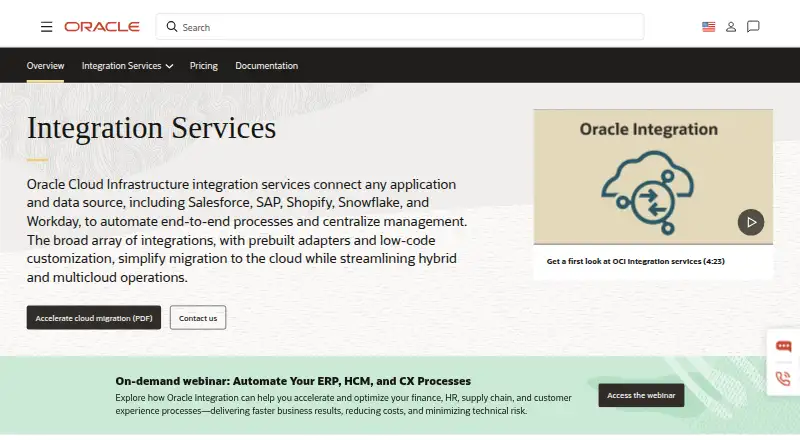
Oracle Integration offers a managed cloud environment, reached through web and API interfaces, for linking Oracle and third-party applications. It can transform and synchronize information while coordinating workflows. Its capabilities span automation, API management, healthcare functions, an embedded file server, and Visual Builder. A free trial is available, while plan prices require a request.
Review
In a line
Oracle Integration brings applications and data together in the cloud. Users can work through its web interface or API, with workflow automation and API management built in.
What it does
The service can coordinate workflows, transform data, and keep information synchronized in real time. Its automation tools include robotic process automation, decision models, and workflows that include human review.
Its AI assistant can create integrations, define schedules, describe integration components, generate FHIR and ATP queries, and help resolve errors. Healthcare users can intake, transform, and synchronize health data, support HL7 workflows, and modernize applications with FHIR.
Visual Builder is included for making responsive visual applications. An embedded SFTP-compatible File Server stores and retrieves files.
How it connects
Oracle and external applications can be linked with the product's prebuilt adapters. Documented options include REST, SOAP, and FTP, and Oracle gives Salesforce, SAP, ServiceNow, Shopify, Snowflake, and Workday as examples.
On-premises connectors are available. API features include a catalog, hosted portal deployment, interactive documentation, both listed developer authentication methods, and advanced usage analytics. See API integration platforms for a broader category view.
The service also provides security controls. Inbound traffic can use TLS or SFTP, data is encrypted at rest in Oracle Cloud Infrastructure services, and administrators can restrict inbound traffic with IP address allowlists. Access can be controlled for projects, the File Server, and target systems.
Good fit
Oracle Integration suits organizations that need one cloud service for application connections, data movement, workflow coordination, and API management. It can fit teams working with Oracle systems alongside services such as Salesforce, SAP, or Workday.
Its healthcare features suit projects involving HL7 and FHIR data. The included Visual Builder, File Server, and automation options can cover several related tasks in one service.
Watch for
This is a paid, cloud-only service, and plan prices are available on request. Check which edition and adapter set your project needs before committing. Standard bundles SaaS and technology adapters, File Server, and Visual Builder, while Enterprise also includes on-premises enterprise application adapters, Process Automation, B2B, and Integration Insight.
Usage is measured in billing messages per hour. Under a new Universal Credits or Oracle Integration Government license, each message pack includes 5,000 messages per hour; an existing Oracle Fusion Middleware license includes 20,000. Confirm how your license maps to these limits.
Oracle directs customers to Premier Support for product expertise and new features.
Pricing
Oracle lists Standard and Enterprise plans at price on request, each with 5,000 messages per hour. Standard BYOL and Enterprise BYOL are also price on request, with 20,000 messages per hour.
Other listed options are Oracle Integration Cloud Service - Enterprise - BYOL, Oracle Integration Cloud Service - Standard, Oracle Integration Cloud Service - Standard - BYOL, Oracle Integration Cloud Service - Enterprise, and Oracle Integration Cloud Service - Healthcare. Each is price on request; the BYOL entries show 20,000 messages per hour, while Standard, Enterprise, and Healthcare show 5,000. Healthcare is available only in Universal Credits tenancies.
Oracle offers a product-page trial; its Cloud Free Tier page describes up to $300 in credits for up to 30 days across eligible Oracle Cloud Infrastructure services.
Verdict
Choose Oracle Integration when your organization needs managed connections across Oracle and outside systems, with workflow controls, API tools, and optional healthcare support. It is also a candidate when on-premises adapters, hosted API documentation, or embedded file handling matter.
Skip it if you need a self-hosted product, a published monthly price, or usage terms outside message-based limits. Buyers should confirm the required edition, adapters, tenancy type, and license before requesting a quote. Integration platform as a service software offers context for similar products.
Our take
Oracle Integration is suited to organizations that want application links, data transformation, workflow automation, and API controls in one managed cloud service. Its adapters, on-premises options, healthcare capabilities, and embedded tools can reduce the need for separate products. The trade-offs are a cloud-only setup, quote-based pricing, and message-per-hour limits that vary by license. Review the edition differences and confirm whether your tenancy supports the Healthcare option. A trial can help assess fit before a paid commitment.
- Links Oracle and external applications with ready-made adapters
- Provides workflow coordination, data conversion, and real-time synchronization
- Includes an API catalog, hosted portal, documentation, and usage analytics
- Provides on-premises connectors and healthcare data capabilities
- Bundles Visual Builder with an SFTP-compatible File Server
- Cloud deployment only
- Plan prices are available on request
- Message-per-hour limits vary by license
- Enterprise features and adapters are edition-dependent
- Healthcare plan is limited to Universal Credits tenancies
- Pick it ifOrganizations integrating Oracle systems with outside applications; Teams combining workflow capabilities with API management; Healthcare initiatives handling HL7 or FHIR data
- Skip it ifYou need self-hosted deployment; You require published prices before contacting sales; Your workload does not fit message-per-hour licensing
Pricing
All listed plans are price on request. Standard and Enterprise show 5,000 messages per hour; BYOL options show 20,000. Oracle offers a product-page trial, and its Cloud Free Tier page describes up to $300 in credits for up to 30 days across eligible Oracle Cloud Infrastructure services.
- Standard5,000 messages per hourOn request
- Standard5,000 messages per hourOn request
- Enterprise5,000 messages per hourOn request
- Enterprise5,000 messages per hourOn request
- Standard BYOL20,000 messages per hourOn request
- Standard BYOL20,000 messages per hourOn request
- Enterprise BYOL20,000 messages per hourOn request
- Enterprise BYOL20,000 messages per hourOn request
As oracle.com lists them, checked 20 Sept 2026.
Questions
Is Oracle Integration cloud-based?
Yes. It runs in the cloud and can be reached through web and API interfaces.
Does it connect to non-Oracle applications?
Yes. Oracle cites Salesforce, SAP, ServiceNow, Shopify, Snowflake, and Workday among the applications supported by its adapters.
Can Oracle Integration connect to on-premises systems?
Yes. On-premises connectors are available, with additional enterprise application adapters in the Enterprise edition.
Does Oracle Integration have a free tier?
The product page provides a free trial. Oracle's Cloud Free Tier page describes up to $300 in credits for up to 30 days across eligible Oracle Cloud Infrastructure services.
What are the message limits?
The allowance is 5,000 or 20,000 billing messages per hour, depending on the plan and licensing arrangement.
Does it include API management?
Yes. It includes API management, an API catalog, interactive documentation, hosted portal deployment, developer authentication options, and advanced usage analytics.
Near it
All alternatives →- EEntaxy#46 on this board
- TA
 Tray.ai#48 on this board
- SISpring Integration#45 on this board
- MXMagic xpi Integration Platform#49 on this board
- S
 Striim#44 on this board
- II
 IBM Integration SaaS#50 on this board
- IC
 Informatica Cloud Application Integration#43 on this board
- IWIBM webMethods Integration#51 on this board
- OI
 Open Integration Hub#42 on this board
- OWOracle WebCenter Content#52 on this board