
Orb: Usage-Based Billing and Revenue Software
withorb.com · checked 15 Oct 2026
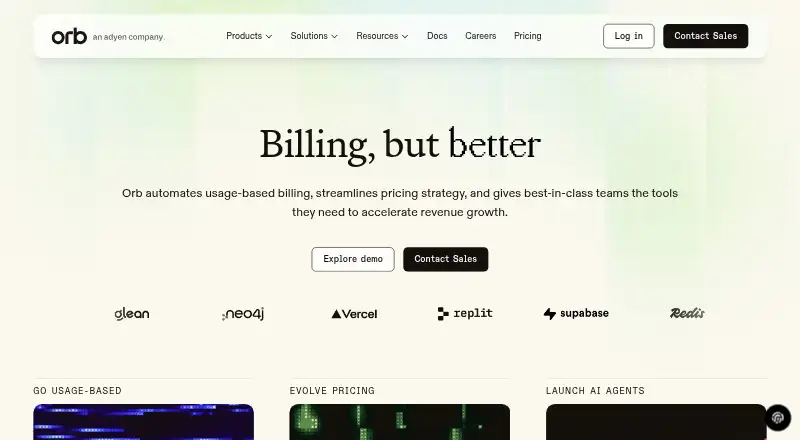
Orb is a web and API platform for usage-based billing, pricing, invoicing, and revenue workflows.
How it plugs in
Signal on API Monetization Software5.5#15 of 41
Orb helps companies build billing plans around usage, seats, fixed fees, prepaid credits, or a mix. It collects usage events, calculates charges, creates invoices, and connects with payment, accounting, tax, and business systems. The service runs as hosted software, with a REST API and public Python, Java, and Go SDKs. Pricing is on request for most plans; its Business listing shows a one-time $6 per credit.
Review
In a line
Orb is a hosted billing and revenue platform for businesses that charge customers based on usage or a mix of usage and other fees. It is available on the web and through an API.
What it does
Orb gathers usage events and turns them into customer charges and invoices. Billing plans can combine usage, fixed fees, seats, prepaid credits, or enterprise contract terms.
Teams can define billable measures with SQL, a way to calculate values from event data, and test pricing changes against past customer activity. When late or corrected data arrives, Orb can recalculate affected invoices. Alerts can flag usage, spending, balances, and subscriptions at chosen thresholds.
How it connects
Orb takes usage data through its API or from S3 and GCS. It also offers a REST API for managing customers, plans, subscriptions, invoices, and other billing information. Public SDKs are available for Python, Java, and Go; their client code is licensed under Apache-2.0.
All plans include invoicing connections to QuickBooks, Bill.com, and Stripe, plus tax connections such as Avalara, Anrok, and TaxJar. Advanced and Enterprise add Salesforce and NetSuite. Business includes Adyen and Stripe payment connections, while data exports can go to Snowflake and Redshift.
Orb is hosted on Amazon Web Services rather than documented for self-hosting. The company says it encrypts stored and transmitted customer data and undergoes an annual SOC 2 Type II audit; customers can request the report.
Good fit
Orb suits teams that need to bill for changing usage or combine usage charges with fixed and per-seat fees. Its stated audiences include developers, product managers, finance, and customer-facing teams.
It may be useful when pricing changes need to be checked against historical activity, or when late usage data requires invoice corrections. Finance teams can use its invoice, payment, accounting, and tax connections.
Watch for
Orb is a hosted service, not a documented self-hosted product. Check whether its available integrations and deployment model fit your existing systems.
Most plan prices require a request. The Business listing says $6 one-time per credit, so confirm how credits are counted and what your expected billings and event volume would cost.
Pricing
Orb has no free plan. Its pricing page says charges are based on billings and events, and Advanced and Enterprise also have a platform fee.
Business is listed at $6 one-time per credit. Core and Advanced are price on request, as are Enterprise and the optional Enterprise Support Bundle. The support add-on is for Enterprise plans; ask Orb to clarify the full cost for your needs.
Verdict
Consider Orb if your billing needs depend on customer usage, or if you want one plan to mix usage, seats, and fixed charges. Its event collection, pricing simulations, invoice recalculations, and finance integrations address several parts of that workflow.
It is a less natural fit for buyers who need a free plan, a published recurring price, or documented self-hosting. Before choosing it, ask for a quote based on your billings and event volume, and check which integrations and support tier your plan includes.
Our take
Orb is worth considering for companies that need to bill for changing usage, combine several charge types, or connect billing with finance and tax tools. Its API and SDKs may suit teams that need to send event data into a hosted service. But the published pricing leaves most costs to a quote, and there is no free plan. Buyers should confirm expected charges, included integrations, and support terms before committing. Organizations that require self-hosted software should look elsewhere.
- Handles usage, fixed-fee, seat-based, hybrid, prepaid-credit, and contract billing.
- Can test proposed price changes against historical customer activity.
- Recalculates affected invoices after late data or corrections.
- Offers a REST API and public Python, Java, and Go SDKs.
- All plans include invoice generation and customer delivery.
- There is no free plan.
- Core, Advanced, and Enterprise pricing is available only on request.
- Orb is hosted on AWS; self-hosting is not documented.
- Business is priced per credit, so buyers should clarify how credits affect their bill.
- Pick it ifBusinesses billing for customer usage or a mix of usage, seats, and fixed fees; Teams connecting billing with accounting, payments, tax, and customer systems
- Skip it ifYou need a free plan or published recurring plan price; You require a documented self-hosted deployment
Pricing
No free plan. Business is listed at $6 one-time per credit. Core, Advanced, Enterprise, and the Enterprise Support Bundle are price on request. Orb says pricing is based on billings and events; Advanced and Enterprise also have a platform fee. Ask how credits and expected volume affect the total.
- Businessper credit · real-time event ingestion · real-time alerting · hybrid and usage-based billing · Orb Invoicing and A/R aging · Adyen and Stripe payments integrations · automated price changes · finance and tax integrations$6 one-time
- AdvancedCustom pricing · Everything in Core · Data warehouse sync · Salesforce integration · NetSuite integration · Customer hierarchy · Premium supportOn request
- CoreCustom pricing · Real-time event ingestion · Real-time alerting · Hybrid and usage-based billing · Automated price changes · Orb Invoicing · Finance and tax integrationsOn request
- EnterpriseCustom; tailored to your needs · everything in Business · customer hierarchies and divisional billing · collections automation · NetSuite and Salesforce integrations · 99.9% availability SLA · data exports · custom RBAC roles and audit logsOn request
- Enterprise Support BundleCustom pricing; add-on to Enterprise plans · technical solutions engineer · dedicated Slack channel · priority response SLAs · 99.99% SLA commitment · enterprise CSM · quarterly business reviews · SIEM integration · SOX support · hosted roll-ups · premium API rate limitsOn request
As withorb.com lists them, checked 15 Oct 2026.
Questions
Does Orb have a free plan?
No. Orb's pricing model is paid, and there is no free plan.
How much does Orb cost?
Business is listed at $6 one-time per credit. Core, Advanced, Enterprise, and the Enterprise Support Bundle are price on request.
What billing types does Orb support?
It supports usage-based, seat-based, hybrid, prepaid-credit, and enterprise-contract billing. Hybrid plans can combine usage, fixed fees, and seats.
Which systems does Orb connect to?
All plans include connections for QuickBooks, Bill.com, Stripe, and several tax services. Advanced and Enterprise include NetSuite and Salesforce; Business includes Adyen and Stripe payment connections.
Can Orb be self-hosted?
Orb describes its application as software hosted on AWS and does not document a self-hosted deployment.
Does Orb have an API?
Yes. Its REST API covers event ingestion and billing resources, including customers, plans, subscriptions, and invoices. Public SDKs are available for Python, Java, and Go.
Near it
All alternatives →- AC
 Automic Continuous Delivery Automation#14 on this board
- MMaxio#16 on this board
- S
 Stigg#13 on this board
- GA
 Gravitee API Management#17 on this board
- TATyk API Management#12 on this board
- FAFiorano API Management#18 on this board
- Y
 Younium#11 on this board
- SESAP Extended Enterprise Content Management by OpenText#19 on this board
- KK
 Kong Konnect#10 on this board
- AE
 API7 Enterprise#20 on this board