Retail Store Operations Software
OrderGrid Store Operations OS
ordergrid.com · checked 9 Oct 2026
Store operations software for grocery and multi-site food retailers, with inventory, tasks, fulfillment and operational insights.
How it plugs in
Signal on Retail Store Operations Software5.4#18 of 28
OrderGrid Store Operations OS coordinates store tasks, compliance checks, inventory and fulfillment across grocery and other multi-site food locations. It runs on web, iOS and Android, with APIs for connecting business systems. Features include shelf audits, barcode-guided work, picking dashboards, role controls and natural-language operational queries. Pricing is paid and available on request.
Review
In a line
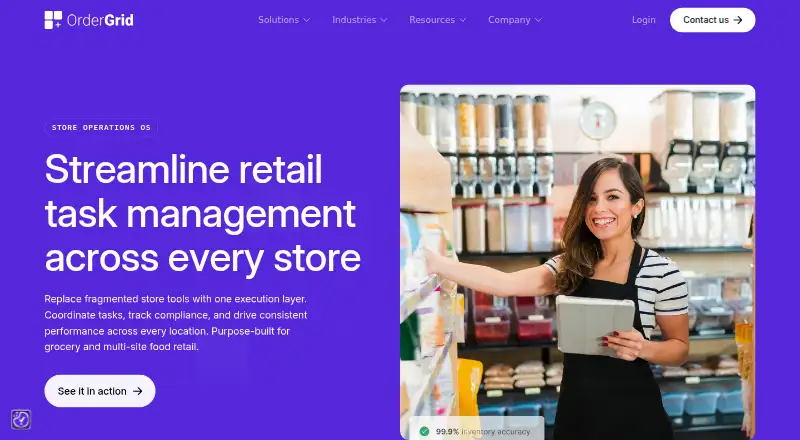
OrderGrid Store Operations OS is a system for coordinating work across grocery and multi-site food stores. It brings store tasks, inventory, compliance and fulfillment into one operation view.
What it does
Teams can assign and complete mobile tasks, follow audit checklists and record proof that work was finished. Layout-based routing, barcode-guided picking and putaway, and reordering prompts support daily store work.
Inventory tools track items at shelf level with an audit trail, lot and expiry details, validated returns and adjustments, and synchronized counts across locations.
For fulfillment, it supports picking several orders, temperature-aware staging, exception alerts, and live views of picker and order activity. A control-tower dashboard shows fulfillment health, out-of-stock issues, pick rates and store metrics. Users can ask for operational information in natural language.
How it connects
OrderGrid says its open APIs connect to point-of-sale, enterprise resource planning and order systems. Its API terms cover application, partner, REST and public APIs. The integrations directory lists NetSuite, SAP, Clover, Deliveroo and Shopify as coming soon.
The product is available on web, iOS and Android, with an API platform option. Role-based access can limit features by user type, location or responsibility. API terms call for TLS 1.2 or higher while data moves, and the privacy notice describes compliance with GDPR and CCPA/CPRA.
Good fit
This product is aimed at grocery businesses and food retailers operating across multiple sites. It suits teams that need shared inventory, store-level task control, fulfillment monitoring and central performance measures.
Store and function filters, team dashboards, shared alerts and thresholds, and centralized KPIs help different roles view the measures assigned to them.
Watch for
Check the integration timetable before committing: the listed systems are marked “Coming soon.” Confirm that your required point-of-sale and order connections are available.
OrderGrid describes setup as connecting existing systems, training store teams and launching synchronized omnichannel inventory. Plan for those steps, and ask the vendor about your rollout needs at [email protected].
Pricing
OrderGrid Store Operations OS is paid software. Pricing is available on request, so you need a quote before comparing its cost with other tools.
Verdict
Choose OrderGrid if you run grocery or multi-site food stores and want one place for shelf controls, task execution, fulfillment status and operational questions. Its mobile apps, dashboards, access rules and APIs cover store and central teams.
It is less suitable if you need a published price or immediate access to the integrations currently marked as coming soon.
Our take
OrderGrid fits grocery and multi-site food operators that need synchronized inventory, documented store work and fulfillment monitoring in one system. It also offers role-based views and natural-language questions for operational data. Buyers should first verify integrations, since the named systems are listed as coming soon, and request a price because no public rate is given. The rollout description includes system connections, team training and a live launch, so organizations should include those steps in their implementation plan. Smaller or non-food retailers may need a different focus.
- Shelf-level inventory records include audit trails and lot and expiry tracking.
- Mobile tasks support barcode-guided picking, putaway and audit checklists.
- Fulfillment dashboards show pickers, orders, exceptions and store measures.
- Natural-language queries provide operational insights.
- Role-based access and site filters tailor views by responsibility.
- Pricing is only available on request.
- Listed NetSuite, SAP, Clover, Deliveroo and Shopify links are marked coming soon.
- The product is purpose-built for grocery and multi-site food retail.
- Setup includes connecting systems and training store teams.
- Pick it ifGrocery chains and multi-site food retailers; Teams managing store tasks, inventory and fulfillment centrally
- Skip it ifYou need a published price before speaking with a vendor.; You depend on integrations currently marked as coming soon.; Your business is outside grocery or multi-site food retail.
Pricing
The software is paid, with pricing supplied on request. Buyers must contact OrderGrid for a quote rather than choosing a listed plan.
Questions
What is OrderGrid Store Operations OS?
It coordinates tasks, compliance, inventory and fulfillment across grocery and multi-site food retail locations.
Which devices can run it?
OrderGrid lists web, iOS, Android and an API platform.
Does it connect to other business systems?
It offers open APIs for POS, ERP and order sources. NetSuite, SAP, Clover, Deliveroo and Shopify are listed as coming soon.
What inventory controls are included?
Features include shelf-level tracking with audit trails, lot and expiry tracking, spot checks, validated returns and adjustments, and synchronized inventory across locations.
Can staff prove a task was completed?
Yes. The product includes audit checklists and proof of completion.
How much does it cost?
It is paid software, and pricing is available on request.
What does setup involve?
OrderGrid describes connecting existing systems, training store teams and launching with synchronized omnichannel inventory.
How is API data protected?
The API terms call for TLS 1.2 or higher for data in transit and describe technical and organizational protections.