
Pact Contract Testing: What It Does and Costs
pact.io · checked 4 Oct 2026
Code-first contract checks for Pact's HTTP and message integrations.
How it plugs in
Signal on Contract Testing Tools6.6#3 of 22
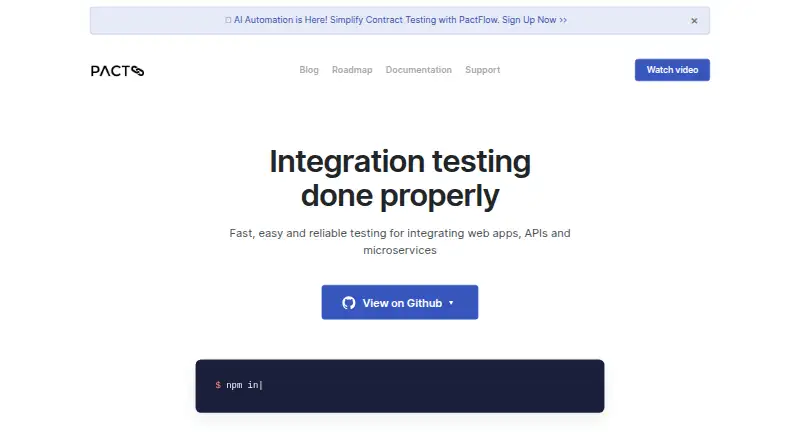
Pact uses automated consumer tests to define expected interactions, then verifies providers against those contracts. Each application can be checked independently, without deploying the entire system. It supports numerous languages, HTTP and message protocols, CI/CD checks, and a self-hosted Pact Broker. PactFlow provides additional plans and administration features.
Review
In a line
Pact applies contract tests to HTTP and message integrations through a code-first workflow. Expected consumer-provider interactions are recorded for verification.
What it does
Consumer-side automation produces contracts containing specific requests, responses, or messages exchanged by applications. Providers can then verify those expectations independently.
Applications can therefore be checked separately rather than deploying the full system. The Pact CLI supplies mock and stub servers, a provider verifier, a broker client, and a plugin CLI.
How it connects
Implementations exist for JavaScript, Java and JVM languages, .NET, Go, Python, Swift and Objective-C, Ruby, PHP, C++, Rust, and Scala. Verification covers HTTP as well as synchronous and asynchronous messages.
The open-source Pact Broker distributes contracts and verification results. You can host and administer it yourself, and its CI/CD workflows include checks indicating whether application versions can be deployed together. Documentation contains recipes involving GraphQL, Cypress, Jest, Mocha, Kafka, AWS Lambda, and API Gateway.
Message tests abstract away the queue technology. Documented examples include ActiveMQ, RabbitMQ, SNS, SQS, Kafka, and Kinesis, while plugins support protocols including gRPC, Avro, and CSV. See contract testing tools for related options.
Good fit
Pact is aimed at developer-led teams responsible for both consumer and provider applications. It helps when integrations must be checked in isolation and delivery workflows need a shared contract.
Access is available through an API, on Linux, macOS, or Windows, and as self-hosted software. Mock-server and CI/CD capabilities support checks before deployment.
Watch for
Pact documentation excludes performance or load testing, provider functional testing, and APIs whose numerous consumers cannot maintain direct relationships with the provider team.
The free Pact Broker requires self-hosting, leaving its operator responsible for security, maintenance, and upgrades. Pact describes SSO, API tokens, audit trails, and secrets as premium PactFlow features rather than core Pact capabilities.
Support options linked by Pact include documentation, a Slack community, and partners.
Pricing
Pact's open-source tooling is free, with no separate price stated on the official site; shared contract workflows require a separately hosted and operated Pact Broker. PactFlow Starter is free (billed FREE) and includes unlimited users, two integrations, and bi-directional contract testing.
PactFlow Team is $115.42 per month on annual billing ($1,385 billed yearly), or $127 monthly. Either billing option lists 50 integrations, community support, bi-directional contract testing, GitHub and Google login, and a 14-day free trial.
PactFlow Enterprise uses contact-sales pricing and lists advanced user and security management, dedicated support, plus SaaS or on-premise deployment.
Verdict
Pact fits teams whose developers own both ends of an integration and need application-version checks before release. Its language and messaging coverage accommodate mixed systems.
It is a poor choice for load testing, provider functional testing, or consumer groups that cannot maintain direct provider relationships. Also plan for operating the Broker yourself unless the available PactFlow options meet your administration and deployment requirements.
Our take
Pact suits organizations that can keep consumer and provider teams in direct contact. Contracts turn expected interactions into pre-deployment checks, while the Broker makes results available to delivery pipelines. Free tooling reduces entry cost, though self-hosting adds operational responsibility. PactFlow offers plans with additional administration and deployment capabilities. It should not replace load tests or provider functional testing, or be used where consumers cannot coordinate with providers.
- Free open-source contract-testing tools
- Handles HTTP plus synchronous and asynchronous messages
- More than 10 language implementations are available
- CI/CD can check whether application versions work together
- Includes mock and stub servers
- The free Pact Broker must be hosted and maintained by its operator
- Unsuitable for performance or load testing
- Does not cover provider functional testing
- Weak fit when consumers cannot maintain provider relationships
- Advanced security capabilities are described for premium PactFlow offerings
- Pick it ifDeveloper teams responsible for both ends of an integration; Systems combining HTTP with messaging; Teams placing contract checks in CI/CD
- Skip it ifYou require load or performance testing; Consumers cannot maintain direct relationships with provider teams; You do not want to run a self-hosted Broker
Pricing
Core Pact open-source tooling and PactFlow Starter are free. PactFlow Team is $115.42 monthly with annual billing ($1,385 yearly) or $127 monthly; both list a 14-day trial. Enterprise pricing is available through sales.
- PactFlow StarterFREE · Unlimited users · 2 integrations · Bi-Directional Contract TestingFree
- Pact open-source toolingThe official site presents Pact as open-source tooling and links to GitHub; it does not state a price. · Open-source contract testing tools · a Pact Broker must be hosted and operated separately for shared contract workflowsFree
- PactFlow Team (yearly)USD per month (billed yearly as $1,385) · 50 integrations · Community support · Bi-Directional Contract Testing · GitHub and Google Login · 14-day free trial$115/mo
- PactFlow Team (monthly)USD per month · 50 integrations · Community support · Bi-Directional Contract Testing · GitHub and Google Login · 14-day free trial$127/mo
- PactFlow EnterpriseContact Sales · Advanced user and security management · Dedicated support · SaaS or on-premise deploymentOn request
As pactflow.io lists them, checked 4 Oct 2026.
Questions
Is Pact available at no cost?
The open-source Pact tooling is free, and PactFlow Starter is also free. Other PactFlow plans are listed separately with their own features and pricing.
Which programming languages have Pact implementations?
The listed implementations include JavaScript, Java and JVM languages, .NET, Go, Python, Swift and Objective-C, Ruby, PHP, C++, Rust, and Scala.
Can Pact cover message-based systems?
Yes. Verification supports synchronous and asynchronous messages, with examples for ActiveMQ, RabbitMQ, SNS, SQS, Kafka, and Kinesis.
Can Pact participate in CI/CD workflows?
Yes. The Pact Broker provides compatibility checks indicating whether application versions can be deployed together.
Which teams benefit most from Pact?
It is most valuable to developer teams that control both consumer and provider applications and can maintain a direct relationship.
Which testing scenarios are outside Pact's scope?
Documentation says Pact is not intended for performance or load testing, provider functional testing, or APIs with many consumers that cannot maintain direct provider relationships.