Plaso: Digital Forensics Timeline Engine Review
plaso.readthedocs.io · checked 15 Oct 2026
Open-source engine for building and analyzing digital-forensics timelines from computer and cloud artifacts.
How it plugs in
Signal on Digital Forensics Software7.6#1 of 30
Plaso is a free, open-source Python engine for digital-forensics timelines. Its tools collect events from disk images, files, devices, logs, databases, browser data, and mobile artifacts into a storage file. Other tools filter, sort, analyze, and export those events in formats such as CSV, JSON, KML, and OpenSearch.
Review
In a line
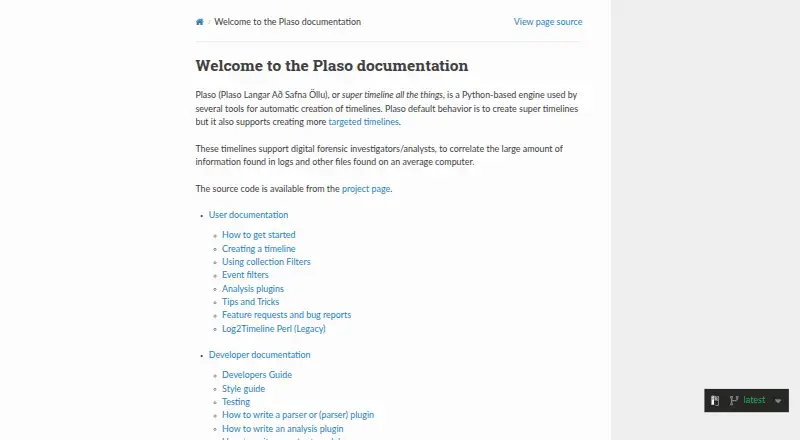
Plaso is a Python-based engine for creating timelines used in digital-forensics work. It can build broad super timelines or narrower timelines focused on selected evidence.
What it does
The log2timeline tool scans files, directories, storage-media images, and devices, then saves extracted events in a Plaso storage file. Collection can recurse through archives and compressed streams, while preprocessors add context such as operating system, hostname, time zone, and user accounts.
The pinfo and psort tools inspect or process that storage file. psort can filter, sort, and run automatic analysis. Other command-line tools include image_export and psteal; psteal can produce a CSV timeline from a storage image with its dynamic output format.
Documented inputs include Windows Registry and Event Logs, browser histories, SQLite, plist, ESE, OLE, Android and iOS artifacts, cloud logs, and many text logs. Analysis plug-ins can calculate hashes, apply YARA rules, and tag events of interest.
How it connects
Plaso is open source under the Apache-2.0 license. It has a public Python API covering packages, command-line tools, parsers, analysis modules, storage, and output classes. The project also provides a framework for adding parsers, analysis plug-ins, and scripts.
Built-in output modules include delimited text, JSON, JSON Lines, KML, legacy CSV/TLN, raw Python, and null output. Export options also include XLSX and OpenSearch. An OpenSearch output module sends events to Timesketch for timeline work.
Documented analysis plug-ins include VirusTotal, an NSRL server, and hash tagging. Official Docker instructions cover a Docker Hub image, Dockerfile builds, bind mounts, and commands for the main tools.
Good fit
Plaso suits forensic analysts who need to combine timestamps from computer logs, files, storage images, devices, and mobile artifacts. It can also handle AWS CloudTrail, Azure Cloud, Google Cloud, and Microsoft 365 audit logs.
It works as a local command-line application, in Docker, or through Linux and macOS packaging paths. The user guide documents Docker on Linux, macOS, and Windows, plus native Fedora, macOS, and Ubuntu options.
Watch for
Plaso is classified as beta software, and the current PyPI package requires Python 3.10 or newer. The documentation recommends packaged releases and a version no older than six months.
Processing can be heavyweight and slow when many unnecessary events are generated. Troubleshooting guidance warns that workers may be killed by out-of-memory conditions and that components can use excessive memory or leak it.
Support is provided through a discussion mailing list, the Open Source DFIR Slack community, a troubleshooting guide, and GitHub issues, with contributions handled on a best-effort basis.
Pricing
Plaso is free. The open-source package is self-hosted, and no paid tiers or usage limits are stated.
Verdict
Choose Plaso if you need an open-source engine that gathers evidence from many forensic formats and turns it into searchable timelines. Its parser framework, public API, Docker option, and multiple exports suit teams that can manage command-line tools and local infrastructure.
Look elsewhere if you need a polished commercial interface, guaranteed support, or predictable resource use. Plan for current releases, Python 3.10 or newer, and enough memory for large collections.
Our take
Plaso is a practical choice for forensic teams that want a no-cost, self-hosted timeline engine with broad artifact coverage. It can bring desktop, mobile, cloud, and log evidence into one workflow and feed OpenSearch-based Timesketch projects. The trade-off is operational: this is beta software delivered mainly through command-line tools, and large jobs may be slow or memory hungry. Organizations should assign staff who can maintain Python-based tooling, monitor resource use, and keep installations within the project’s recommended release window.
- Free and open-source with Apache-2.0 licensing
- Handles computer, mobile, device, database, and cloud artifacts
- Exports CSV, JSON, KML, XLSX, OpenSearch, and Timesketch data
- Public Python API and extension framework for parsers and plug-ins
- Beta package requires Python 3.10 or newer
- Large collections can be slow and create many unwanted events
- Workers may hit out-of-memory conditions or leak memory
- Primarily a self-hosted command-line workflow
- Pick it ifForensic teams building timelines from varied evidence; Analysts who need parser and output extensibility; Organizations running Docker or Linux/macOS tooling
- Skip it ifYou need a commercial product with paid support; Your workloads cannot tolerate heavy processing or memory use; You want a graphical, ready-to-use desktop application
Pricing
Plaso costs nothing and has no listed paid tiers or usage limits. You install and operate the open-source package yourself.
- Open-source Plaso packagePython-based forensic timeline engine · self-hosted installation · no paid tiers listedFree
- PlasoNo commercial plan or usage limits are statedFree
As pypi.org lists them, checked 15 Oct 2026.
Questions
What is Plaso used for?
Plaso builds super timelines or focused timelines for digital-forensics analysis by extracting events from files, logs, storage images, devices, and other artifacts.
Which operating systems can run Plaso?
The documented options cover Linux, macOS, and Windows through Docker, with native Fedora, macOS, and Ubuntu installation paths.
What formats can Plaso export?
Output options include CSV, JSON, JSON Lines, KML, TLN, XLSX, OpenSearch, and Timesketch-related output.
Does Plaso work with Timesketch?
Yes. Its OpenSearch output module writes Plaso events into OpenSearch for use with Timesketch.
Is Plaso free?
Yes. Plaso is free and open source, with no commercial plan or usage limits stated.
What Python version does Plaso need?
The current PyPI package declares Python 3.10 or newer.
Can Plaso process cloud logs?
Documented supported cloud formats include AWS CloudTrail, Azure Cloud, Google Cloud, and Microsoft 365 audit logs.