Pravega: Open-Source Stream Storage
pravega.io · checked 5 Oct 2026
Durable storage for continuous streams, with long retention and exactly-once processing.
How it plugs in
Signal on Event Streaming Platforms5.9#10 of 27
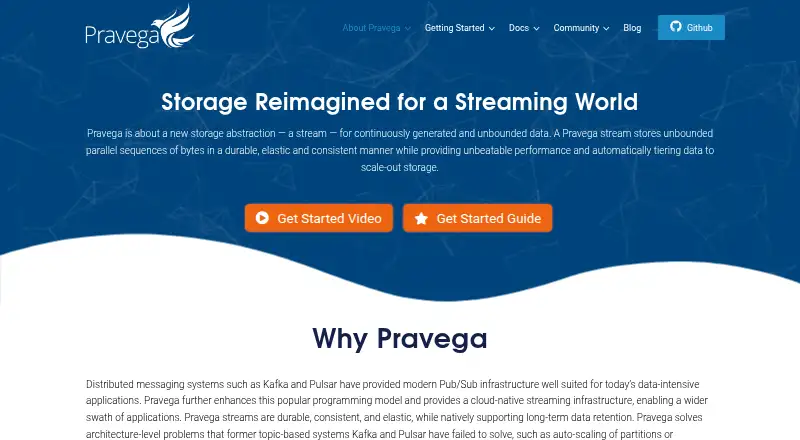
Pravega provides no-cost, open-source storage for data that continues without a fixed end. Its durable streams can expand with ingestion while preserving access to both recent and earlier events. It combines exactly-once processing and transactions with stream-processing features and connectors for Flink, Spark, Hadoop, Presto, Boomi, and Apache NiFi.
Review
In a line
Built around durable streams, Pravega is an open-source storage system that you host yourself.
What it does
A stream holds an unbounded sequence of bytes and can expand as data arrives. Individual streams can change their parallelism automatically as ingestion rates shift, with data tiered to scale-out storage.
Retention can be indefinite, allowing applications to read both new and older events. A transaction lets a developer commit a set of event writes atomically; Pravega also describes exactly-once delivery and processing that preserve ordering through client, server, or network failures.
How it connects
Pravega is hosted by the user and exposes an API. Java, Rust, and Python clients are supported. It also includes a schema registry and stream processing support.
Connectors are listed for Apache Flink, Spark, Hadoop, Presto, Boomi, and Apache NiFi. Pravega describes its components as fully open source under the Apache 2 License, with code on GitHub.
Deployment options include a single-process standalone server with long-term storage or distributed operation through Docker Compose. TLS encryption and role-based access control can be configured; standalone security settings start disabled.
Good fit
Pravega suits streaming and real-time application data, IoT data, and batch or interactive analytics over large data sets. It is aimed at applications that need low-latency access to both current and historical events.
Its durable, append-only streams may fit workloads that need retention, ordered processing, and automatic scaling.
Watch for
Pravega is self-hosted, so you manage its deployment and supporting services. Production guidance lists Java 11 and, for distributed deployments, storage such as AWS S3, Azure Blob Storage, Google Cloud Storage, HDFS, or a mounted distributed filesystem, plus ZooKeeper 3.6.3 and BookKeeper 4.14.1.
In standalone mode, clients can reach the server only through the localhost interface. That mode begins with security options disabled, so check the configuration before exposing it. Help is provided through the Pravega community on Slack, while bugs go to GitHub Issues.
Pricing
The product is available at no cost through its free plan. There is no free trial because the product itself is offered at no cost.
Verdict
Choose Pravega if you need an open-source stream store that keeps data for both live and historical reads, can scale individual streams, and offers exactly-once guarantees. Its connectors and client languages cover several established data tools.
Look elsewhere if you want a managed service or do not want to operate storage, coordination, and deployment dependencies yourself. Also review the standalone localhost restriction and the default security settings before selecting that mode.
Our take
Pravega makes sense for organizations building continuous-data systems that need durable retention instead of a short-lived event buffer. Its free Apache 2-licensed software, stream autoscaling, transactions, and exactly-once guarantees can suit demanding streaming and analytics workloads. The tradeoff is operational: deployment is self-hosted, distributed production needs several infrastructure components, and standalone access is limited to localhost. Teams wanting a hosted service should consider a different category of product.
- Apache 2-licensed software is available at no cost
- Retains streams indefinitely for live and historical access
- Exactly-once handling and processing include ordering guarantees
- Streams can scale automatically as ingestion changes
- Connectors are available for Flink, Spark, Hadoop, Presto, Boomi, and NiFi
- Self-hosted deployment requires you to run the system
- Distributed production needs storage, ZooKeeper, and BookKeeper
- Standalone clients can connect only through localhost
- Standalone security settings begin disabled
- No free trial is offered separately
- Pick it ifStreaming and real-time application data; IoT and large-scale analytics workloads; Teams needing durable current and historical events
- Skip it ifYou need a managed, hosted streaming service; You cannot operate the listed production dependencies; Your standalone clients cannot use localhost
Pricing
Pravega has a free plan and no separate free trial.
Questions
Is Pravega free?
Yes. The product is available at no cost through its free plan, and there is no separate free trial.
Is Pravega open source?
Yes. Pravega presents itself as 100% open source and community-driven, with components available under the Apache 2 License on GitHub.
What data does Pravega store?
It stores continuous, unbounded data in durable streams. Streams can retain data indefinitely and provide access to both real-time and historical events.
Which tools connect to Pravega?
Connectors are listed for Apache Flink, Spark, Hadoop, Presto, Boomi, and Apache NiFi. Java, Rust, and Python are supported client languages.
Can Pravega run on my own infrastructure?
Yes. You host it yourself, either as a standalone server or in distributed mode with Docker Compose.
What does exactly-once mean in Pravega?
Pravega describes event delivery and processing occurring once while preserving order through client, server, or network failures.
What are Pravega's standalone limits?
Standalone clients can reach the server only through the localhost interface, and security options are disabled initially in that mode.
Where can I get help?
The project directs users to its community on Slack for help and to GitHub Issues for bug reports.
Near it
All alternatives →- AP
 Apache Pulsar#9 on this board
- DADataStax Astra Streaming#11 on this board
- CC
 Confluent Cloud#8 on this board
- WWisembly#12 on this board
- R
 RisingWave#7 on this board
- A
 AutoMQ#13 on this board
- LLightstreamer#6 on this board
- AKApache Kafka#14 on this board
- SP
 Solace PubSub+ Event Broker#5 on this board
- SStreamNative#15 on this board