Pressbooks: Book Publishing Software Review
pressbooks.org · checked 15 Oct 2026
Open-source book publishing software for webbooks, EPUB, PDF, and XML exports.
How it plugs in
Signal on eBook Creation Software7.0#3 of 28
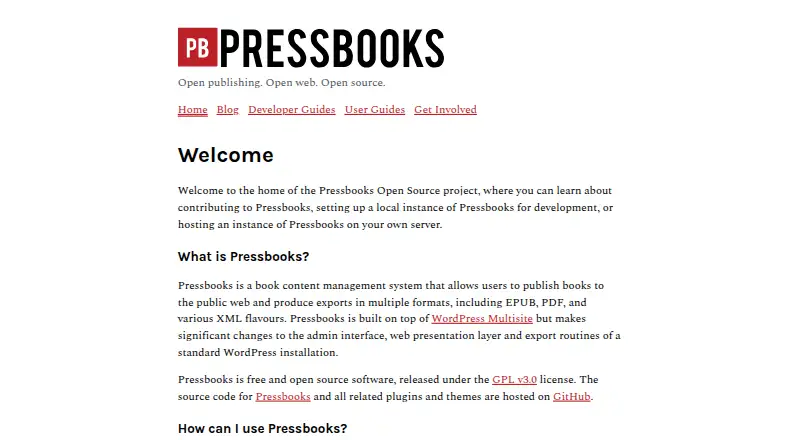
Pressbooks lets users publish books on the public web and create EPUB, PDF, XML, XHTML, and other file formats. It runs as a hosted service, an enterprise network, or a self-hosted WordPress Multisite installation. Plans range from a seven-day free trial to paid author, collaboration, and institutional options.
Review
In a line
Pressbooks helps authors build webbooks and download book files in formats including EPUB, PDF, and XML. The software is released as free, GPL version 3.0 open-source code.
What it does
Authors can import content, then arrange front matter, back matter, parts, and chapters. Sources include EPUB, DOCX, ODT, XML/WXR, HTML, URLs, and Google Docs.
Books can contain images, multimedia, glossaries, footnotes, mathematics, and scientific notation. Self-Publisher plans include more than 20 themes for changing a book's appearance.
Pressbooks can publish a webbook and produce files such as PDF, EPUB, XML, XHTML, and Common Cartridge. Enterprise networks and the Collaboration plan also support H5P quizzes and other interactive activities.
How it connects
Pressbooks can be hosted through its Self-Publisher service, run as an Enterprise Network, or installed and maintained by an organization on its own network. Self-hosting requires installing dependencies and handling software and security updates.
It is built on WordPress Multisite and exposes the WordPress REST API. The API supports standard read and write methods, but authentication must be configured separately.
Once an institutional LMS administrator completes the setup, LTI 1.3 links Pressbooks with Canvas, Moodle, D2L Brightspace, and Blackboard. Pressbooks Results can send scores from gradable H5P activities to an LMS gradebook. SSO is available for enterprise networks, with SAML and CAS plugins documented for self-hosters.
Hypothes.is adds social annotation. Self-hosted export functions may require tools including Ghostscript, ImageMagick, Poppler utilities, PrinceXML or DocRaptor, EPUBCheck, and xmllint.
Good fit
Pressbooks identifies educational institutions, academic presses, small publishers, and individual authors among its users. It supports multi-user editing for coauthors, editors, educators, and academic teams.
It fits projects that need one book organized for web reading and exported for ebook or print workflows. The Self-Publisher comparison says paid plans can produce WCAG 2.2-compliant digital books and accessible EPUB and PDF files.
Watch for
Each plan has its own media limit. Pressbooks says larger files such as videos should live on a dedicated streaming service and be embedded instead.
Self-hosting leaves installation, dependencies, maintenance, and security updates to the operator. The open-source mPDF PDF-export plugin is no longer maintained, and the installation guide says to use it at your own risk.
Enterprise networks come with managed hosting, regular security updates, premium support, and training. Self-Publisher plans list self-service guides, videos, and webinars instead.
Pricing
A free trial lasts 7 days and allows one author with 100MB of media. There is no ongoing free plan.
Single Author costs $12 a month, or $120 a year, for one author, 250MB of media, and EPUB/PDF exports. Collaboration costs $40 a month, or $400 a year, with unlimited collaborators, 1GB of media, and interactive educational material.
Institutional Network starts at $5999 a year for one institution, up to 10 books, unlimited author seats, and up to three network managers. Shared Network starts at $15999 a year for two or more institutions, up to 45 books, unlimited user seats, and up to five network managers.
Verdict
Choose Pressbooks if your publishing work spans webbooks and downloadable book files, or if several people need to edit the same project. Its open-source code also gives organizations a self-hosting route, provided they can manage technical upkeep.
The hosted plans make more sense when you want managed updates or support, while self-hosting suits teams able to install dependencies and maintain security. Check media limits, export requirements, LMS setup, and the plan's accessibility features before committing. For broader browsing, see eBook Creation Software or compare Leanpub, Bookalope, and PubCoder.
Our take
Pressbooks is a sensible choice for authors, publishers, and education teams that need structured books delivered on the web and as EPUB or PDF files. Collaboration, accessibility features, LMS links, and an open-source edition cover a wide range of workflows. The trade-offs are plan-based media storage, technical duties for self-hosting, and extra setup for institutional LMS connections. A seven-day trial lets a prospective buyer check the editing and export process before paying. Larger organizations should compare the network plans and confirm their support and maintenance needs.
- GPL v3.0 open-source software
- Exports EPUB, PDF, XML, XHTML, and Common Cartridge files
- Imports EPUB, DOCX, ODT, XML/WXR, HTML, URLs, and Google Docs
- Offers LMS connections and grade passback
- Paid plans can produce WCAG 2.2-compliant books
- No ongoing free plan
- Self-hosting requires dependencies and security maintenance
- Media capacity varies with the plan
- Pressbooks recommends embedding large videos hosted on a dedicated service
- mPDF PDF export is no longer maintained
- Pick it ifAuthors and small publishers producing web and ebook editions; Education teams needing collaboration, H5P, or LMS links; Organizations able to manage a self-hosted network
- Skip it ifYou need unlimited media storage included in every plan; You cannot maintain software and security on a self-hosted installation; You need a free plan beyond the seven-day trial
Pricing
The seven-day trial is free but limited to one author and 100MB of media.
- Free Trial1 author · 100MB media · 7 daysFree
- Single Authoror $120 / year · 1 author · 250MB media · EPUB/PDF exports$12/mo
- Collaborationor $400 / year · Unlimited collaborators · 1GB media · interactive educational material$40/mo
- Institutional Networkfrom · 1 institution · up to 10 books · unlimited author seats · up to 3 network managers$5,999/yr
- Shared Networkfrom · 2+ institutions · up to 45 books · unlimited user seats · up to 5 network managers$15,999/yr
As pressbooks.com lists them, checked 15 Oct 2026.
Questions
Is Pressbooks free?
Pressbooks offers GPL v3.0 software at no charge, but it does not provide a continuing free plan. A free trial lasts 7 days.
What files can Pressbooks export?
Pressbooks publishes webbooks and can generate EPUB, PDF, XML, XHTML, and Common Cartridge files.
Can I host Pressbooks myself?
Yes. Organizations can run their own network, but they must install required dependencies and handle ongoing software and security updates.
Which learning systems connect to Pressbooks?
After an institutional administrator completes the setup, LTI 1.3 links Pressbooks with Canvas, Moodle, D2L Brightspace, and Blackboard.
Does Pressbooks support accessible books?
The Self-Publisher comparison indicates that paid plans can produce WCAG 2.2-compliant digital books, along with accessible EPUB and PDF exports.
Can Pressbooks handle interactive activities?
Enterprise networks and the Collaboration plan offer H5P quizzes and other activities. Scores from gradable H5P activities can be sent through Pressbooks Results to an LMS gradebook.
How much media storage is included?
The trial includes 100MB, Single Author 250MB, and Collaboration 1GB. Storage limits vary by plan, and large videos should be embedded from a streaming service.