Procurement Orchestration Software
Proconomy procurement platform
proconomy.ai · checked 8 Oct 2026
Web- and API-based procurement control for complex manufacturing organizations.
How it plugs in
Signal on Procurement Orchestration Software5.2#13 of 26
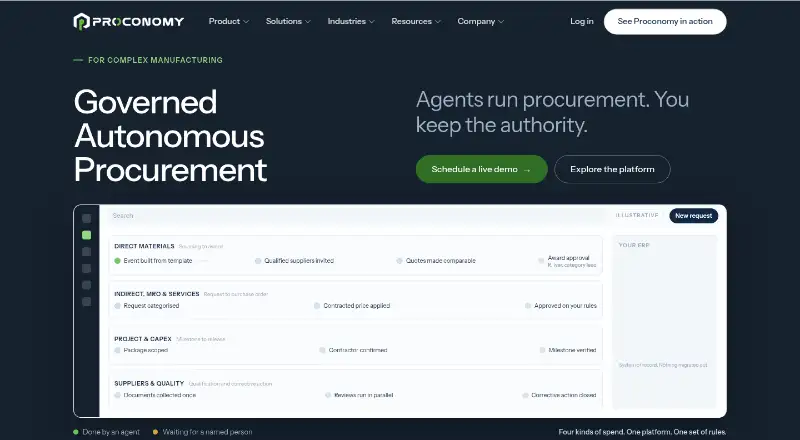
Built for complex manufacturers, Proconomy governs autonomous procurement. Its operating layer brings together sourcing, contracts, purchasing, suppliers and quality, while the ERP remains authoritative. People establish permissions, policies, thresholds and approvals; agents handle authorized tasks and route exceptions to people. It runs on the web and through an API, with pricing available on request.
Review
In a line
Manufacturers that have moved beyond ERP systems, spreadsheets and email can use Proconomy for procurement. It puts sourcing, contracts, purchasing, supplier work and quality processes on one operating layer.
What it does
Coverage includes direct-materials, indirect and services buying, plant maintenance supplies, project procurement, supplier qualification and corrective actions. Agents perform approved tasks under set rules, then return exceptions to people. Completed results are written to existing systems, while the ERP stays the official record.
People can start with one workflow in one business unit, using their existing policy. Approval checkpoints cannot be skipped by agents.
How it connects
ERP and finance integrations named by Proconomy include SAP S/4HANA, Oracle Fusion and Microsoft Dynamics 365. The list also includes product-lifecycle management, quality, identity, collaboration and data integration systems.
REST API, webhooks, SFTP, OData and flat files are listed as data routes. Unlisted systems can be reached through the open API. Proconomy offers web and API access.
Role-based access can be limited by entity, category and data. The platform records actions, rules, approvals, exceptions and overrides with their context. Its listed certifications are SOC 1 Type 2, SOC 2 Type 2 and ISO 27001, and it says personal data is handled under GDPR.
Good fit
The maker positions Proconomy for manufacturers operating several plants or business units with different approval limits. It suits teams that need one layer for sourcing, contracts, purchasing, suppliers and quality, while keeping the ERP in place.
It can fit organizations looking for governed automation across procurement workflows, including supplier onboarding and email-based intake.
Watch for
A single site with one approval chain and few suppliers is probably outside the product's intended fit. It is also not intended to replace an ERP.
Each environment has its own connector configuration. During an enterprise review, hosting locations, encryption details, retention periods and subprocessors are supplied; retention is set for each customer.
Pricing
Proconomy is paid software, with pricing supplied on request. The site offers workflow demonstrations and says a client-success representative replies to demo requests.
Verdict
Choose Proconomy if your manufacturing organization has multiple operating units, complex approval rules and procurement work spread across separate systems. Its agent controls, human checkpoints and audit trail are designed for supervised automation rather than an unattended replacement for enterprise systems.
Look elsewhere if you run one small site with a simple approval path, have few suppliers or want to remove your ERP. Confirm connector setup and enterprise security details during review before committing.
Our take
For complex manufacturers spanning plants or business units, Proconomy offers procurement automation while retaining policy controls and ERP ownership. Its agents can handle authorized work, while people retain approval authority and exceptions. The product is less suitable for a single-site operation with few suppliers and one approval chain, or for anyone seeking to replace an ERP. Buyers should request pricing, confirm the connectors required for each environment and review hosting, encryption, retention and subprocessor details before signing.
- Supports sourcing, contracts, purchasing, suppliers and quality in one layer
- Agents follow policies, permissions, thresholds and human approvals
- Works with major ERP systems and an open API
- Provides role-based access and an action audit trail
- SOC 1, SOC 2 and ISO 27001 certifications are listed
- Probably not suited to a single site with a simple approval chain
- Does not replace the ERP system of record
- Connectors are configured per environment
- Pricing is available only on request
- Pick it ifComplex manufacturers with multiple plants or business units; Teams needing controlled procurement automation
- Skip it ifYou have one site, few suppliers and one approval chain; You want procurement software to replace your ERP
Pricing
Paid software with pricing on request; ask for a workflow demonstration and a quote.
Questions
What is Proconomy?
Proconomy provides governed autonomous procurement for complex manufacturers, bringing sourcing, contracts, purchasing, suppliers and quality together.
Does Proconomy replace an ERP?
No. The ERP remains the system of record, and approved outcomes are written back to it.
Which systems can Proconomy connect to?
Listed examples include SAP S/4HANA, Oracle Fusion and Microsoft Dynamics 365, plus PLM, QMS, identity, collaboration and data systems.
Does it have an API?
Yes. It lists a REST API and says unlisted systems can be reached through its open API. Webhooks, SFTP, OData and flat files are also listed.
How are agent actions controlled?
People set policies, permissions, thresholds and approvals. Role-based access and non-bypassable human checkpoints limit what agents can do.
What security certifications are listed?
The trust centre lists SOC 1 Type 2, SOC 2 Type 2 and ISO 27001. It also states that personal data is processed under GDPR.
How much does Proconomy cost?
Proconomy is paid software, with pricing available on request.