ProseMirror: Structured Rich-Text Editor Toolkit
prosemirror.net · checked 1 Oct 2026
An open-source JavaScript toolkit for building structured rich-text editors on the web.
How it plugs in
Signal on Rich Text Editor Software6.3#4 of 37
ProseMirror is a free, open-source toolkit for creating web-based rich-text editors. It supports structured documents, custom schemas, plugins, table editing, and real-time collaboration. Applications control their document data instead of relying on an HTML blob. It runs in browsers, can be self-hosted, and is installed with npm, but it is not a ready-made editor component.
Review
In a line
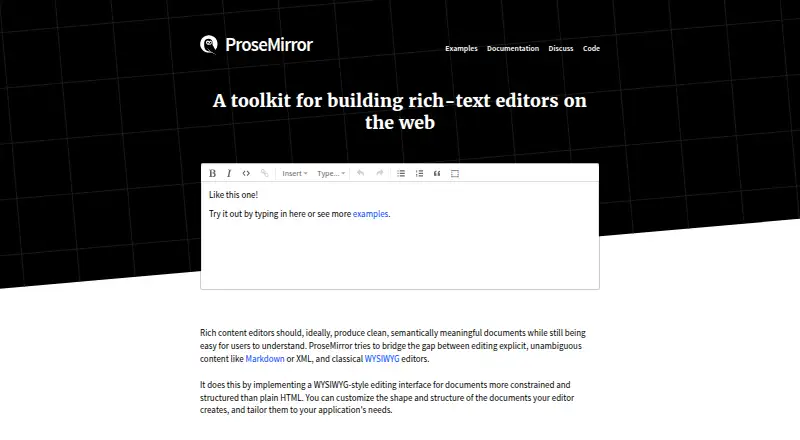
ProseMirror is a toolkit for building rich-text editors on the web. It gives applications a WYSIWYG-style editor for structured, constrained documents.
What it does
Applications can define their own document shape with schemas and keep control of the underlying document data. ProseMirror is designed as a base for different kinds of editors rather than as one finished editor.
Its modules and plugins cover editing commands, keyboard shortcuts, undo history, input macros, tables, and collaborative editing. Multiple people can edit the same document in real time.
How it connects
ProseMirror runs in web browsers and can be self-hosted. It supports JavaScript and TypeScript, and the official site recommends installing it with npm. A bundler is generally needed because it is not supplied as one browser-ready script.
The project is open source under the MIT license, with commercial use legally allowed. Its modular design lets applications load or replace parts, and its examples include Markdown, image URLs, custom schemas, code editors, footnotes, track changes, and collaboration. It works with recent Firefox, Chrome, Safari, and Edge versions, plus Internet Explorer 11.
Good fit
ProseMirror suits teams building a custom web editor around structured content. It fits projects that need custom document rules, plugin-based extensions, table editing, or live multi-person editing.
Its small, generic core can support different editor types, including the patterns shown in its official examples.
Watch for
This is not a drop-in component. Building an editor usually requires a bundler and application-level decisions about schemas, interface parts, and extensions.
The GitHub repository is archived; development has moved to Forgejo. An official forum advisory also reports a cross-site-scripting risk affecting some uses of DOMSerializer. The MIT license includes warranty and liability disclaimers.
Pricing
ProseMirror has a free plan and no free trial. The open-source library can be used commercially, and the project asks profitable users to help fund maintenance.
Verdict
Choose ProseMirror when your product needs a web editor shaped around its own document rules, data model, and collaboration needs. Its free license and replaceable modules make it suitable for organizations that can assemble and maintain an editor.
Do not choose it if you need a ready-to-embed editor with little setup.
Our take
ProseMirror is a strong candidate for developers or product teams who need precise control over structured documents and editing behavior. It is free for commercial use and supports live collaboration, but the project expects you to build the editor around its modules. The archived GitHub repository and reported DOMSerializer security issue deserve review before adoption.
- Free and legally usable for commercial projects
- Custom schemas control document structure
- Built-in real-time collaborative editing support
- Modular plugins and replaceable system parts
- Supports table editing and structured content
- Not a drop-in editor component
- Usually requires a bundler
- GitHub repository is archived
- Security advisory affects some DOMSerializer uses
- MIT license includes warranty and liability disclaimers
- Pick it ifTeams building custom structured web editors; Projects needing schemas and live collaboration; Developers comfortable assembling editor modules
- Skip it ifYou need a ready-made editor with minimal setup; You cannot review the archived repository and security advisory
Pricing
The open-source library has a free plan and no free trial. Commercial use is allowed under the MIT license.
- ProseMirror open-source librarycommercial use legally permitted · install with npmFree
As prosemirror.net lists them, checked 1 Oct 2026.
Questions
Is ProseMirror free?
Yes. The open-source library is free, including for commercial use.
Where does ProseMirror run?
It runs in web browsers and can be self-hosted. It supports JavaScript and TypeScript.
Does ProseMirror support collaboration?
Yes. It includes support for multiple people editing together in real time.
How is ProseMirror installed?
The official site recommends installing it with npm. Users will generally want a bundler because it is not one browser-loadable script.
Can ProseMirror handle custom document structures?
Yes. Schemas let applications define structured documents and keep control of their document data.
Is the ProseMirror GitHub repository active?
The GitHub repository is archived, and development has moved to Forgejo.
What security issue should users check?
An official forum advisory reports a viable cross-site-scripting risk affecting some uses of DOMSerializer.