Pymss: Open-Source Local Stem Separation
pymss.net · checked 14 Oct 2026
Run open-source music stem separation locally through desktop, command-line, Python, WebUI and plugin tools.
How it plugs in
Signal on AI Stem Splitters7.7#1 of 26
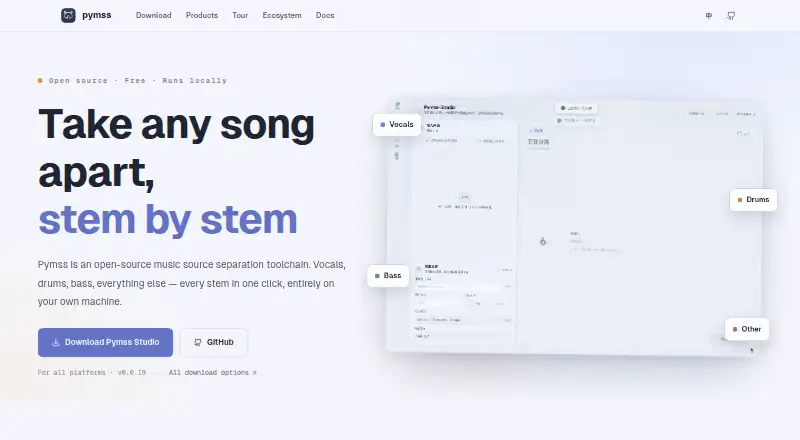
Pymss is an open-source toolchain that divides music into vocals, drums, bass and other stems on your computer. Its Studio desktop app manages models, batch jobs, waveform editing and export. It also offers Python, command-line and HTTP interfaces, a browser UI, ComfyUI nodes and an ARA plugin for compatible digital audio workstations.
Review
In a line
Pymss breaks music into separate components, including vocals, drums, bass and other stems. Processing happens on the user’s own machine.
What it does
Pymss Studio is a desktop workspace for downloading and managing models, running single or batch jobs, and editing separated tracks. It can take audio, video or folders, then lets you choose models, processing settings, devices, output folders and naming rules.
The editor presents multitrack waveforms with clip editing, volume and pan controls, mute and solo, fades, effects, recording, saved projects and mix export. Pymss can also chain models into workflows, combine models with ensemble methods and weights, and accept model files and settings for supported architectures.
Its utility set includes format conversion, file inspection, SDR and SI-SDR checks, speech recognition, vocal-to-MIDI, silence slicing and audio merging.
How it connects
A Python package, command-line tools and an optional self-hosted HTTP service are available. The service can load models, browse a catalog, download files and provide an optional browser interface. The separate WebUI runs in a browser and sends health and version-one requests to a local server.
It provides ComfyUI custom nodes and a VST3 ARA plugin for compatible digital audio workstations. Inside ARA-capable hosts, the plugin separates tracks and offers per-stem mute and solo controls; Reaper and Studio One are named examples.
The project is open source, but each repository has its own license. Studio is AGPL-3.0, whereas the inference package is MIT. Supported output formats include WAV, FLAC, MP3, M4A, AAC, Opus, Vorbis and Ogg.
Good fit
Pymss suits people who want local music separation, batch processing or control over downloaded and custom models. It can serve desktop users, command-line workflows, Python projects and self-hosted services.
Its Studio app is useful for organizing model files, processing folders, editing stems and exporting mixes. ComfyUI and ARA support can fit visual workflows and compatible DAWs. Pymss runs across Android, iOS, Linux, macOS, Windows and the web, with API access available.
Watch for
PyPI classifies PyMSS as Alpha software, and the Studio project warns that early development may bring breaking changes between versions. Linux Studio use currently requires building from source; released targets are Windows x64 and macOS 14 or later on Apple Silicon.
Running it locally means your machine handles the separation work. Development setup requires Node.js 22, pnpm 10.33.2, Rust and Cargo, Python 3.12 and platform WebView or WebKitGTK components. Review the license for each repository and confirm that your DAW supports ARA before choosing the plugin.
Pricing
Pymss is free, with no paid plan and no free trial. The plan is listed as “Free · open source · runs locally.”
Verdict
Pymss fits users seeking an open-source separator that processes audio on their hardware through Studio, scripts, a command line, a local server or plugins. It is also a fit when batch jobs, custom models, workflow chains or stem editing matter.
Consider alternatives if you require a mature, fixed interface, a hosted service that performs the computing for you, or a ready-made Linux desktop release. Its alpha status, separate repository licenses and source-build requirement on Linux deserve a review before adoption.
Our take
Pymss is a practical choice for musicians, editors and technical users who want free local stem separation instead of sending files to a cloud service. The range of interfaces makes it adaptable, from a desktop workspace to Python code, command-line jobs and a local HTTP server. Its main risks are maturity and setup: the project is marked Alpha, Studio can change between releases, and Linux users must build it themselves. Confirm your computer, DAW compatibility and the license for the component you plan to use.
- Free and open source
- Runs separation on your own machine
- Desktop app supports batch jobs and stem editing
- Python, CLI and HTTP API options
- ComfyUI nodes and ARA plugin support
- Exports common audio formats
- PyPI labels the software Alpha
- Studio may have breaking changes between versions
- Linux Studio requires building from source
- Repository licenses vary by component
- Local processing uses your own computer
- Pick it ifLocal stem separation with batch audio workflows; Users who need scripts, APIs or workflow tools; Editors using supported DAWs or ComfyUI
- Skip it ifYou need a mature product with stable releases; You want cloud processing instead of local computing; You need a ready-made Linux Studio package
Pricing
Pymss has one free, open-source plan with local processing. It offers no paid tier or free trial.
- PymssFree · open source · runs locallyFree
As pymss.net lists them, checked 30 Sept 2026.
Questions
Is Pymss free?
Yes. Pymss is free and open source. It has no paid plan or free trial.
What stems can Pymss separate?
It can isolate vocals, drums, bass and other stems.
Does Pymss process files online?
No. The official site says separation runs entirely on your own machine.
Which systems can run Pymss?
The listed platforms are Android, iOS, Linux, macOS, Windows, web and API. Studio releases target Windows x64 and macOS 14 or later on Apple Silicon; Linux currently requires a source build.
Can I use Pymss in a DAW?
Yes, through its VST3 ARA plugin. It separates tracks in an ARA-capable DAW and provides per-stem mute and solo controls; Reaper and Studio One are example hosts.
Does Pymss have an API?
Yes. A Python package, command-line tools and an optional self-hosted HTTP service are available. The service can also provide a browser interface.
Which export formats does Pymss support?
The inference package lists WAV, FLAC, MP3, M4A, AAC, Opus, Vorbis and Ogg output.
How mature is Pymss?
PyPI classifies PyMSS as Alpha. The Studio README says it is early in feature development and that releases may include breaking changes.