RapiFuzz APIFuzzer Review
rapifuzz.in · checked 7 Oct 2026
On-premise API fuzzing for REST, GraphQL, SOAP, and other API formats.
How it plugs in
Signal on API Security Testing Software5.3#23 of 27
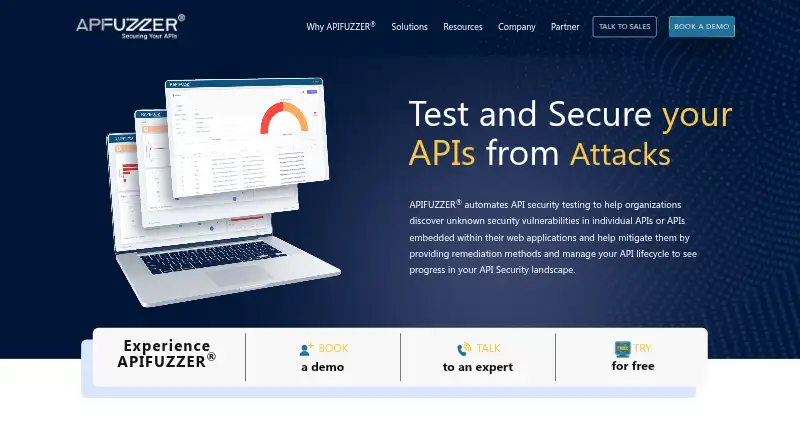
RapiFuzz APIFuzzer sends malformed or surprising data to APIs and web apps to uncover vulnerabilities and outline ways to address them. It can discover APIs from website URLs, build an API software bill of materials for web applications, and detail affected endpoints, payloads, exploits, and mitigation guidance. The software is self-hosted, sold on a quote-based plan, and offered with a 15-day trial.
Review
In a line
RapiFuzz APIFuzzer is a self-hosted tool for uncovering weaknesses in APIs. It sends unexpected or invalid data to API endpoints and explains ways to reduce the risks it finds.
What it does
From web URLs, APIFuzzer finds APIs and builds an API software bill of materials for web applications. Custom APIs can be grouped as REST, GraphQL, SOAP, JSON-RPC, or XML-RPC.
Testing can target standalone APIs as well as those inside web applications. Its checks address the 2019 and 2023 OWASP API Security Top 10, covering authentication, authorization, input validation, BOLA, BFLA, and rate limiting risks.
Teams can provide their own test cases and upload payloads. Findings detail affected endpoints, payloads, exploits, and suggested ways to mitigate them. Other listed functions include injection checks, sensitive-data discovery, zero-day discovery, API lifecycle management, CWE mapping, and flagging suspicious client requests through IP reputation.
How it connects
According to the maker, APIFuzzer fits into CI/CD workflows and can operate alongside JIRA, Eclipse, and ZAP. CI/CD workflows are automated steps that build, test, and deliver software.
The maker's brochure says it operates without a client or agent and supports on-premise deployment, allowing it to run inside an organization's environment. The available facts do not describe a public API, open-source code, or import and export formats.
Good fit
APIFuzzer may suit organizations seeking security checks across multiple API formats, including APIs embedded in web applications. Custom tests and uploaded payloads let teams extend the built-in checks.
The maker names banking and financial services, insurance, healthcare, power, oil, government, and defense among its target sectors. It can fit teams that want API checks in delivery workflows or on-premise systems.
Watch for
This is self-hosted software, so buyers should confirm that they can operate it in their own environment. The facts do not state system requirements, supported operating systems, user limits, or the details of its deployment process.
Pricing is not published. Before committing, confirm which support and integration details are included, and whether the required API formats and custom tests match your security program.
Pricing
RapiFuzz APIFuzzer is a paid product with quote-based pricing. A 15-day trial is advertised.
Verdict
Choose APIFuzzer if you need self-hosted fuzzing for REST, GraphQL, SOAP, JSON-RPC, or XML-RPC APIs, plus reports and mitigation guidance tied to OWASP API risks. Its workflow connections and custom payload support may help security teams fit testing into existing delivery processes.
It may be a poor match if you require published pricing, a hosted service, or documented public API and open-source options.
Our take
RapiFuzz APIFuzzer is worth considering for organizations that want on-premise API security testing across several protocols. Its feature set brings together API discovery, fuzzing, user-supplied payloads, OWASP API Security Top 10 checks, and detailed mitigation reporting. The main buying hurdles are the missing public price and the need to run it as self-hosted software. Confirm deployment requirements, support terms, and workflow compatibility during the 15-day trial before choosing it for a wider rollout.
- Tests REST, GraphQL, SOAP, JSON-RPC, and XML-RPC APIs
- Supports the 2019 and 2023 OWASP API Security Top 10 editions
- Accepts custom test cases and uploaded payloads
- Reports affected endpoints, payloads, exploits, and mitigation guidance
- Connects with CI/CD workflows, JIRA, Eclipse, and ZAP
- Pricing is disclosed only through a request
- Runs as self-hosted software
- Public API, open-source code, and data exchange formats are not described
- Pick it ifSecurity teams testing multiple API formats on premises; Organizations adding API checks to CI/CD workflows; Sectors such as banking, healthcare, government, and defense
- Skip it ifYou need a hosted service instead of self-hosted deployment; You require published plan prices or documented public API access; You need stated system requirements before starting evaluation
Pricing
The product is paid and uses quote-based pricing. Buyers can use the advertised 15-day free trial, but no plan amounts or limits are provided.
Questions
What is RapiFuzz APIFuzzer?
It is a self-hosted tool that feeds invalid or unexpected data to APIs and web applications to uncover vulnerabilities and outline mitigation methods.
Which API formats does it support?
It places custom APIs into REST, GraphQL, SOAP, JSON-RPC, and XML-RPC categories.
What security risks can it test?
Its testing spans the 2019 and 2023 OWASP API Security Top 10, including authentication, authorization, input validation, BOLA, BFLA, and rate limiting.
Can I add my own tests?
Yes. Users can provide custom test cases and upload their own payloads.
What does it report?
Reports show affected endpoints, payloads, exploits, and recommendations that include mitigation techniques.
Does it integrate with other tools?
The maker says it fits CI/CD workflows and works alongside JIRA, Eclipse, and ZAP.
Is there a free version?
It is a paid product with a 15-day free trial advertised; pricing is available on request.
Where can it run?
It runs in a self-hosted setup, with the brochure describing clientless or agentless operation and on-premise deployment.
Near it
All alternatives →- PPurpleTeam#22 on this board
- E
 Equixly#24 on this board
- O
 Operator#21 on this board
- RRESTler#25 on this board
- IW
 Indusface WAS#20 on this board
- E
 Escape#26 on this board
- BS
 Bright Security DAST#19 on this board
- OAOWASP API Security Testing Framework#27 on this board
- PAPentestas API Scanner#18 on this board
- PS
 Parasoft SOAtest#17 on this board