Redmine: Free, Open-Source Project Management
redmine.org · checked 15 Oct 2026
Open-source, self-hosted project management with issue tracking, planning, collaboration, and time reports.
How it plugs in
Signal on Project Management Software7.7#1 of 188
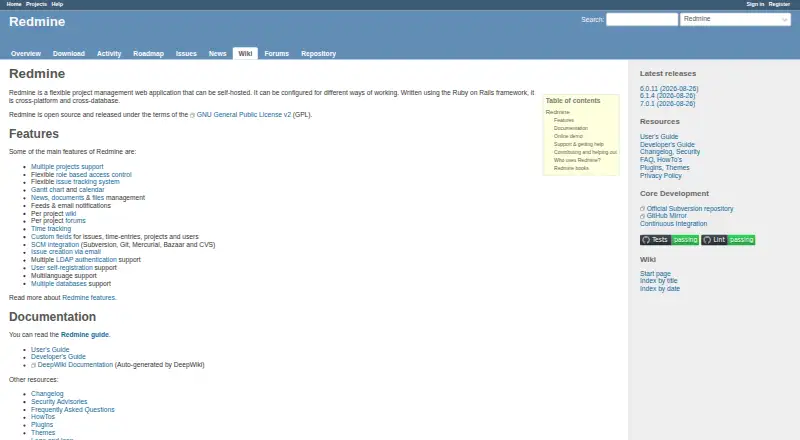
Redmine is a free, open-source project-management web application for self-hosting. One installation can handle multiple public or private projects, with roles, permissions, issue workflows, Gantt charts, calendars, time reports, wikis, forums, files, and notifications. It runs where Ruby is available on supported Unix, Linux, macOS, or Windows systems and offers a REST API.
Review
In a line
Redmine is a free, open-source project-management web application that you run on your own server. It is designed to work across operating systems and databases.
What it does
A single Redmine installation can manage several public or private projects. Each project can have its own roles, permissions, visibility settings, modules, and subprojects.
Teams can track issues with custom statuses, types, and workflow rules. Gantt charts and calendars use issue dates, while time entries can be reported by user, issue type, category, or activity.
Projects also include wikis, forums, news, documents, file sharing, Atom feeds, and email notifications. Custom fields and filtering are available for issues, time entries, projects, and users.
How it connects
Redmine includes a public REST API using JSON or XML. Stable documented resources include issues, projects, users, time entries, and news; many other resources are listed as alpha or beta. Access can use basic login details or an API key.
Its repository browser works with Subversion, CVS, Mercurial, Bazaar, and Git, showing changesets, differences, and blame views. Authentication can connect to multiple LDAP directories, with optional automatic account creation.
The code is open source under the GNU General Public License version 2 or later. Plugin and theme directories provide extension options.
Good fit
Redmine suits organizations that want to host project tracking themselves and control project-level access. It fits teams managing several projects, software work with source repositories, and groups that need issue planning plus time tracking.
It can run on most Unix, Linux, macOS, and Windows systems where Ruby is available. The feature site lists 49 languages, and supported databases include MySQL, PostgreSQL, SQLite, and Microsoft SQL Server.
Watch for
You are responsible for installation, hosting, updates, and administration because Redmine is self-hosted. JRuby is not supported, and SQLite is specifically not recommended for multi-user production use.
Check API coverage before building an integration: only some resources are documented as stable, while many remain alpha or beta. Review the project's security advisories and release branches when choosing a version.
Pricing
Redmine is free. The available plans are self-hosted, open-source installations released under the GNU GPL, with downloadable source rather than a hosted subscription.
Verdict
Choose Redmine if your organization can operate a web application and wants broad project controls without a license fee. Its multiple-project structure, repository connections, LDAP support, API, and time reports cover a wide range of internal workflows.
Look elsewhere if you need a vendor-hosted service or cannot maintain Ruby-based software yourself. Also confirm database, API, and release-support needs before committing, especially for multi-user deployments using SQLite or integrations beyond the stable API resources.
Our take
Redmine is a sensible choice for teams that want ownership of their project data and have staff to run self-hosted software. It combines issue workflows, schedules, time records, collaboration spaces, source-control views, and access rules in one free package. The trade-off is operational work: hosting, upgrades, security review, and compatibility are yours. Teams planning heavy API use should verify that the resources they need are stable. Avoid a production setup on SQLite for multiple users, and confirm that your environment does not rely on JRuby.
- Free, open-source license with downloadable self-hosted source
- One installation supports multiple public or private projects
- Gantt charts, calendars, issue workflows, and time reports
- Repository browser supports Git and four other systems
- REST API offers JSON and XML access
- Self-hosting requires your own installation and administration
- JRuby is unsupported
- SQLite is not recommended for multi-user production
- Many API resources are still alpha or beta
- Release branches have different support levels
- Pick it ifTeams that can host and maintain Ruby-based software; Organizations managing multiple projects with custom access rules; Groups needing source-control views and time reporting
- Skip it ifYou need a vendor-hosted subscription instead of self-hosting; Your server environment depends on JRuby; You plan multi-user production on SQLite
Pricing
Redmine costs nothing to license. Plans are self-hosted open-source installations, so hosting and maintenance are separate responsibilities.
- Redmine (self-hosted)Open source · GNU GPL v2 · Self-hostedFree
- Self-hosted Redminedownloadable source · self-hosted installationFree
As redmine.org lists them, checked 9 Oct 2026.
Questions
Is Redmine free?
Yes. Redmine is free, open-source software distributed under the GNU General Public License and offered as downloadable self-hosted source.
Where can Redmine run?
It should run on most Unix, Linux, macOS, and Windows systems where Ruby is available. JRuby is not supported.
Which databases does Redmine support?
Documentation lists MySQL, PostgreSQL, and SQLite, while installation guidance also covers Microsoft SQL Server. SQLite is not recommended for multi-user production use.
Does Redmine have an API?
Yes. Its REST API supports JSON and XML and basic create, read, update, and delete operations for documented resources.
Can Redmine connect to source repositories?
Its repository browser supports Subversion, CVS, Mercurial, Bazaar, and Git, with changeset, difference, and blame views.
Can Redmine use LDAP login?
Yes. Redmine can authenticate against multiple LDAP directories and optionally create user accounts automatically.