REDTAIL Remote Laboratory Software Review
redtail.rhlab.ece.uw.edu · checked 11 Oct 2026
Open-source remote-lab software joining simulated and digital-twin work with accessible laboratory hardware.
How it plugs in
Signal on Virtual Lab Software5.0#24 of 27
REDTAIL provides free, open-source software for remote laboratory learning. A course assignment can include simulated practice alongside remote equipment, allowing students to check simulated outcomes against physical results. It runs as a self-hosted web service and includes exercise, simulation, and device catalogs for selected FPGA and microcontroller hardware.
Review
In a line
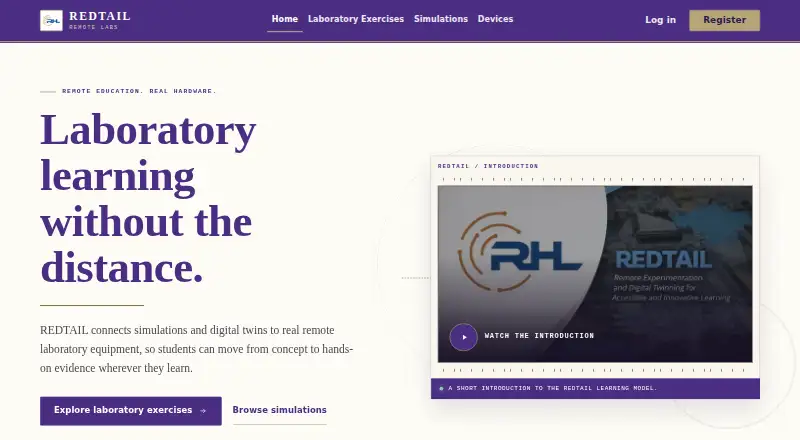
REDTAIL serves remote laboratory courses through the web. The platform brings simulation and digital-twin activities together with laboratory equipment that users can access remotely.
What it does
An instructor may assign simulated practice and remote equipment together, after which students compare outputs from the model and the physical setup.
Separate site routes support instructors who browse or adapt exercises and students who complete course-assigned activities. The exercise catalog reports 19 results, while the simulation catalog contains 12 entries such as parking lot, keypad, breadboard, door, water tank, LED matrix, and wiper activities.
The Remote Hub Lab page says instructors at any institution can deploy REDTAIL scenarios without physical hardware. Experiment authoring is supported.
How it connects
REDTAIL is provided as a web service that institutions host themselves. Its source is public for inspection, with a linked GitHub repository.
Remote laboratories in the device catalog target the Altera DE1-SoC FPGA and STM32 Nucleo WB55RG board. Listed activities use SystemVerilog, VHDL, Mbed OS, Arduino IDE, and Keil Studio Cloud.
Instructors provide learners with the relevant exercise, simulation, or remote-lab URL along with access directions. The repository setup documentation names Python 3.12, Node, and MySQL.
Good fit
REDTAIL fits instructors developing remote electronics or engineering work that combines simulated and physical experiments.
It lets institutions offer remote-lab scenarios without hardware at every location. Category, device, and difficulty filters are available in the exercise catalog.
The Remote Hub Lab at the University of Washington develops the project with LabsLand.
Watch for
Students receive activities through their instructor rather than getting independent access. Instructor solutions are approval-gated, and the site tells users to contact the REDTAIL team for access.
Running REDTAIL yourself calls for Python 3.12, Node, and MySQL. Confirm that staff can maintain this environment and that the available FPGA and STM32 hardware suit the course.
For course use, remote-lab setups, or collaboration, the site asks instructors to contact [email protected].
Pricing
REDTAIL is free to use and open source.
The free model still leaves deployment work to the operator: hosting has the stated software requirements, and instructors arrange student access.
Verdict
Choose REDTAIL when teaching requires both simulation and remote equipment and your institution can operate a self-hosted web deployment. Its catalogs and authoring support provide a defined starting point for course activities.
It is less suitable for learners seeking an independent practice site, since course instructors control links and instructions. Teams should also confirm access to the supported device types and plan for approval when instructor solutions are needed.
Our take
REDTAIL is a practical choice for institutions planning remote electronics laboratories and willing to operate open-source software. It brings simulated and physical results into one course workflow, which can support assignments that would otherwise need on-site hardware. The trade-off is responsibility for hosting and setup, plus dependence on instructor-managed access. Its listed devices and development tools also narrow the fit for courses built around other hardware. Students looking for a standalone learning service should look elsewhere because activities come through an instructor.
- Free and open source
- Pairs simulation with remote equipment
- Supports deployment without physical hardware
- Includes exercise and simulation catalogs
- Supports experiment authoring
- Self-hosting calls for Python 3.12, Node, and MySQL
- Student access is supplied by instructors
- Instructor solutions require approval
- Listed hardware is limited to two device types
- Pick it ifInstitutions building remote electronics laboratory courses; Instructors combining simulated and physical experiments; Teams able to run a self-hosted web service
- Skip it ifYou need a standalone student practice service; Your course uses hardware outside REDTAIL's listed devices; You cannot manage the stated self-hosted setup
Pricing
REDTAIL costs nothing and is open source. Budget for self-hosting and the required Python, Node, and MySQL environment.
Questions
Is REDTAIL free?
Yes. REDTAIL is free and open source.
Where does REDTAIL run?
It runs as a self-hosted web service.
What hardware does it support?
The device catalog includes remote laboratories for the Altera DE1-SoC FPGA and STM32 Nucleo WB55RG board.
Can students use REDTAIL without an instructor?
Access is instructor-led: students receive the exercise or lab link and directions from their instructor.
What does REDTAIL combine?
Simulations and digital twins connect with laboratory equipment reachable remotely, so students can compare modeled and physical results.
What is needed to set up the public repository?
The repository instructions call for Python 3.12, Node, and MySQL.
Can instructors create experiments?
Yes. REDTAIL supports experiment authoring, and its exercise catalog reports 19 results with category, device, and difficulty filters.
How can instructors ask about course use?
Instructors and collaborators can contact [email protected] about courses, remote-lab setups, and collaboration.
Near it
All alternatives →- MHMcGraw Hill Virtual Labs#23 on this board
- SVScholarlab Virtual Labs#25 on this board
- MMaroon#22 on this board
- EL
 Evelyn Learning Virtual Lab Simulations#26 on this board
- TSTableTop Science#21 on this board
- SI
 Science Interactive#27 on this board
- LLabsLand#20 on this board
- VAVRLab Academy#19 on this board
- STSteam to Teach Virtual Labs#18 on this board
- SRScience Remote Laboratory#17 on this board