Resilio Active Everywhere: Review and Pricing
resilio.com · checked 15 Oct 2026
Enterprise file synchronization across data centers, clouds, and edge networks.
How it plugs in
Signal on WAN Optimization Software6.3#2 of 19
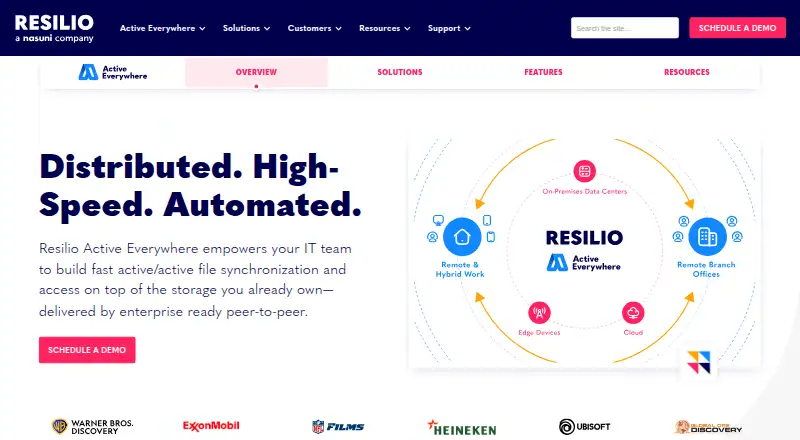
Resilio Active Everywhere is a hybrid, peer-to-peer platform for synchronizing and accessing files across distributed storage. It supports active/active file access, cloud connectors, caching, locking, WAN optimization, and automation through a REST API. Organizations can self-host its management components and deploy agents on major desktop, server, NAS, and Android systems.
Review
In a line
Resilio Active Everywhere is an enterprise platform for active/active file synchronization across existing storage. It gives organizations shared access to file data in data centers, cloud services, and edge locations.
What it does
The platform uses peer-to-peer links to synchronize files between locations. Jobs can run one-to-many, many-to-one, or as a many-to-many mesh, and the system is described as handling hundreds of millions of files of any size or type.
Users can stream requested parts of large files instead of downloading them completely. Policy-based caching keeps often-used files near users, while distributed locking controls exclusive access and supports offline work.
Documented jobs include synchronization, distribution, consolidation, caching, hybrid work, storage tiering, archival, and running scripts. Built-in WAN optimization is intended for high-latency or unreliable links such as cellular, Wi-Fi, internet, and VSAT connections.
How it connects
Hybrid cloud connections cover Amazon S3, Microsoft Azure, Azure Files, Google Cloud Storage, SharePoint Online, Oracle Cloud, and S3-compatible storage. One console can expose file data through NFS, SMB, and Amazon S3 protocols. See Amazon S3 for one supported storage connection.
A public REST API can automate jobs, control agents, and add file delivery to workflows. A local Agent API uses localhost port 3840 and token authentication by default. Resilio also documents a Python command-line wrapper for the Management Console API, which requires a licensed Console API feature and token.
The software is not open source. A native Resilio MCP server is available in Active Everywhere 6 for AI assistant connections. Management Console, agent, tracker, and proxy components can be installed in customer infrastructure.
Good fit
Resilio positions the platform for mid-sized businesses through global enterprises that manage distributed file infrastructure. It suits teams needing continuous, multi-site file replication with failover orchestration and hybrid deployment.
It can connect on-premises storage to major cloud providers, keep working data near users, and automate transfer jobs. Support plans include access to a global support and engineering team around the clock.
Watch for
Agents transfer data over TCP and UDP. Required ports must be open or forwarded between agents, the Management Console, and the Tracker Server, so network setup needs checking before deployment.
Selective sync is unsupported on Linux and can stall Linux cache-server jobs. Moving to version 6 requires a clean installation; existing deployments cannot be upgraded in place.
The Management Console requires Windows Server 2022 or newer. Current agents support Windows 11 x64 or macOS 26 Tahoe, alongside Linux, Synology, QNAP, WD NAS, and Android agents.
Pricing
There is no free plan, but a free trial is available. Resilio lists paid plans with pricing on request for custom solutions.
The Basic plan costs $25,000 a month on a one-year term and includes 10 server agents, basic support, 1 Gbps, no caching, and no locking. Advanced costs $85,000 a month on a one-year term and includes 25 server agents, enhanced support, 2 Gbps, caching, and no locking.
Enterprise pricing is on request. The separately listed Resilio Active Everywhere plan is also priced on request, based on device or endpoint count rather than data volume or transfer use.
Verdict
Choose this platform if your organization needs synchronized files across multiple sites, cloud services, and edge locations, with options for caching, locking, automation, and self-hosted control. Its broad agent coverage can fit mixed Windows, macOS, Linux, NAS, and Android environments.
Check network port requirements, Linux selective-sync behavior, and the version 6 installation change before signing a contract. The published Basic and Advanced prices are aimed at organizations with large infrastructure budgets, while other plans require a quote.
Our take
Resilio Active Everywhere fits organizations that need one file layer across offices, data centers, clouds, and edge sites. Its peer-to-peer design, distributed locking, caching, WAN optimization, and automation interfaces cover complex replication work. It is less suitable for small teams or buyers seeking transparent, low-cost plans: there is no free tier, published entry pricing is high, and several offerings require a custom quote. Linux cache deployments and version 6 migration also need specific checks before adoption.
- Peer-to-peer synchronization across many sites and storage types
- Cloud connectors for AWS, Azure, Google Cloud, SharePoint, and Oracle
- Caching, distributed locking, and file streaming features
- REST API for jobs, agents, and delivery workflows
- Agents for Windows, macOS, Linux, NAS devices, and Android
- No free plan; most pricing requires a quote
- Basic and Advanced plans have high monthly prices
- Linux selective sync is unsupported
- Version 6 requires a clean installation
- Network ports must be opened or forwarded between components
- Pick it ifEnterprises with distributed file infrastructure; Teams needing multi-site replication and cloud storage links; Organizations automating file delivery across mixed systems
- Skip it ifYou need a free or low-cost file synchronization service; You require Linux selective sync; You cannot open required TCP and UDP ports
Pricing
A free trial is available, but there is no free plan. Basic is $25,000 a month and Advanced is $85,000 a month, each on a one-year term. Enterprise and the main Active Everywhere plan require a quote.
- EnterpriseCUSTOM SOLUTION. GET IN TOUCH WITH US. · custom solutionFree
- Basic1-month contract; TERM: 1 YEAR · 10 server agents · basic support · 1 Gbps · no caching · no locking$25,000/mo
- Advanced1-month contract; TERM: 1 YEAR · 25 server agents · enhanced support · 2 Gbps · caching included · no locking$85,000/mo
- Resilio Active EverywherePricing based on number of devices or endpoints, not data volume or transfer usage · Contact Resilio for a quoteOn request
As aws.amazon.com lists them, checked 15 Oct 2026.
Questions
Does Resilio Active Everywhere have a free plan?
No. It has paid plans and offers a free trial, but no free tier.
Which cloud storage services can it connect to?
Documented connectors include Amazon S3, Azure, Azure Files, Google Cloud Storage, SharePoint Online, Oracle Cloud, and S3-compatible storage.
Can it run on Linux and NAS devices?
Yes. Agents are available for Linux, Synology, QNAP, and WD NAS devices, as well as Windows, macOS, and Android.
Does it provide an API?
Yes. A public REST API automates jobs, controls agents, and adds file delivery to workflows. A local Agent API is also documented.
What are the main published prices?
Basic costs $25,000 a month and Advanced costs $85,000 a month, both on a one-year term. Enterprise and the main plan are priced on request.
What should Linux users know before deploying it?
Selective sync is unsupported on Linux and can stall Linux cache-server jobs.
Can an existing deployment upgrade directly to version 6?
No. The version 6 changelog requires a clean installation rather than an in-place upgrade.
Near it
All alternatives →- W
 Wanos#1 on this board
- COCacheGuard-OS#3 on this board
- RW
 Replify WAN Optimization#4 on this board
- VR
 Veeam Recovery Orchestrator#5 on this board
- WWan#6 on this board
- BS
 Barracuda Secure SD-WAN#7 on this board
- EExpeDat#8 on this board
- NHNeverfail HybriStor#9 on this board
- OOpenNOP#10 on this board
- ACAppEx CloudWAN#11 on this board