RSpace Electronic Lab Notebook Review
researchspace.com · checked 15 Oct 2026
Open-source electronic lab notebook and research data platform for collaborative workflows.
How it plugs in
Signal on Life Sciences Software7.7#2 of 28
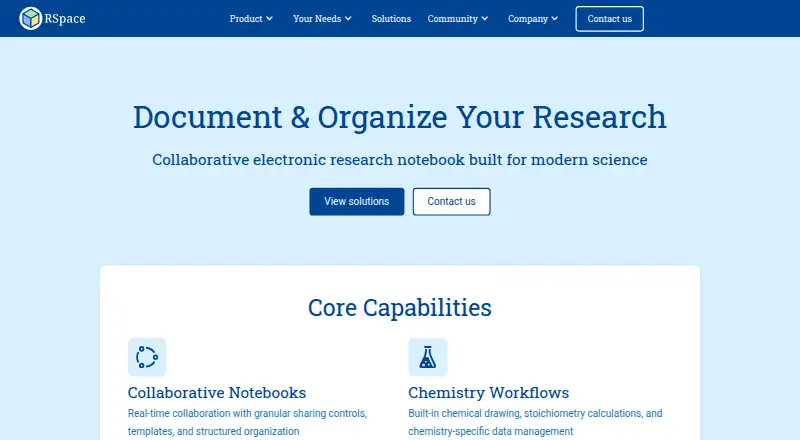
RSpace is an open-source electronic laboratory notebook and research data-management platform. It lets research teams document experiments, organize data, share records, manage samples, and connect workflows through a REST API. Browser access, self-hosting, managed AWS, and on-premises options are available, with free and paid plans.
Review
In a line
RSpace is an electronic research notebook and data-management system for organizing, documenting, sharing, and connecting research work.
It runs in a modern web browser, so end users do not need to install desktop software.
What it does
Teams can write and organize collaborative notebooks with templates, structured sections, comments, annotations, real-time editing, and detailed sharing controls. Full-text, metadata, and chemical-structure search help locate records.
Chemistry tools provide chemical drawing and automatic stoichiometry calculations for reaction planning. RSpace Inventory keeps samples and other research inventory alongside notebook records.
Forms add structured fields and ontology support for FAIR research metadata. Audit trails, version history, electronic signing, and witnessing features record changes and approvals.
Records can be exported in HTML, XML, PDF, Word, JSON, and RO-Crate formats.
How it connects
RSpace offers a REST API for custom integrations and workflows, with public Python and example clients plus guidance for curl, personal API tokens, and OAuth. Its documentation hub lists seven developer articles.
The product page lists more than 20 integrations, but many named connectors—including S3, Box, ChemDraw, Dataverse, Dropbox, and Figshare—are marked as coming soon. Microsoft 365 interoperability is included in the Team plans.
RSpace is open source under the GNU Affero General Public License version 3.0 or later. Self-hosting uses a WAR package or Docker Compose. Managed AWS, private cloud, and on-premises deployments are also available. Enterprise customers can choose data location in their country or, for EU states, in the EU.
Good fit
RSpace suits researchers and teams that need a shared electronic notebook with chemistry support, inventory tracking, structured metadata, and formal records. It also targets research data managers, librarians, stewards, research-computing specialists, and policymakers.
It fits organizations needing browser access, an API, exportable records, or deployment under their own control. Security and compliance material cites encryption in transit and at rest, ISO 27001 and SOC 2 certification, GDPR, 21 CFR Part 11, GLP, and suitability for NIH Data Sharing Policy requirements.
Watch for
The integrations page marks many connectors as coming soon, so confirm that the systems you need are available now. A Reddit reviewer described slow performance and difficulty finding files in one large attachment gallery.
Self-hosting requires your own engineers. Docker guidance suggests at least 4 GB of RAM for a dedicated machine, with 8 GB recommended; server guidance ranges from 8 GB for fewer than 50 users to 32 GB for 250–5,000 users.
When moving between servers, Global IDs, digital signatures, and full audit history cannot be migrated.
Pricing
RSpace has a free self-install plan called RSpace Open Source. Paid offerings start at $5,000 a year, according to the pricing note, while listed plans are $6000 a year for Team (Academia), $12000 a year for Team (Commercial), and $34000 a year for both Enterprise plans. A free trial is also available.
Team plans provide a managed RSpace instance, open-source features, Microsoft 365 interoperability, a private AWS instance, backups, uptime SLA, and basic training and support. Enterprise adds on-premises or private AWS deployment, SAML2/LDAP single sign-on, migration, integration help, premium support, advanced analytics, co-branding, and optional HIPAA support at extra charge.
The Infrastructure plan is price on request for a custom open-source deployment into a Research Cloud or Research Commons with tailored services and support.
Verdict
Choose RSpace if your research group needs a collaborative notebook tied to inventory, chemistry calculations, structured metadata, and formal audit records. Its open-source code, API, export formats, and self-hosting options give technical teams room to control deployment.
Check connector availability, server resources, migration limits, and support needs before committing. Smaller teams may prefer the free self-install route if they can operate it; organizations wanting managed hosting or enterprise controls should budget for the annual Team or Enterprise plans.
Our take
RSpace is a fit for research organizations that need more than a digital notebook: chemistry records, sample inventory, metadata forms, audit trails, signatures, and searchable archives are all part of the platform. The free self-install edition suits groups with engineering capacity, while managed and enterprise plans cover hosted or on-premises operation. Confirm required integrations because several connectors are listed as coming soon, and plan migrations carefully since some identity and audit data cannot move between servers.
- Open-source code with free self-install plan
- Real-time collaboration, sharing controls, comments, and annotations
- Chemistry drawing and automatic stoichiometry calculations
- REST API, SDK examples, and multiple export formats
- Self-hosted, private AWS, managed AWS, and on-premises choices
- Many listed connectors are marked as coming soon
- Server migration cannot transfer Global IDs, signatures, or full audit history
- Self-hosting requires your own engineers and server resources
- A reviewer reported slow performance and hard-to-find attachments
- Pick it ifResearch teams needing collaborative notebooks and formal audit records; Organizations managing chemistry data, samples, and FAIR metadata; Groups requiring API access or self-hosted deployment
- Skip it ifYou need a specific connector that is currently marked as coming soon; You cannot provide engineering resources for self-hosting; You require complete migration of identities and audit history between servers
Pricing
Infrastructure pricing is on request.
- RSpace Open SourceSelf-install with your own engineers · migration cannot transfer Global IDs, digital signatures, or full audit historyFree
- Team (Academia)Minimal annual subscription · Managed RSpace instance · open-source features · Microsoft 365 interoperability · private AWS instance · backups · uptime SLA · basic training/support$6,000/yr
- Team (Commercial)Minimal annual subscription · Managed RSpace instance · open-source features · Microsoft 365 interoperability · private AWS instance · backups · uptime SLA · basic training/support$12,000/yr
- Enterprise (Academia)Minimal annual subscription · On-premises or private AWS · SAML2/LDAP SSO · live training · migration · integration assistance · premium support · advanced analytics · co-branding · HIPAA available at extra charge$34,000/yr
- Enterprise (Commercial)Minimal annual subscription · On-premises or private AWS · SAML2/LDAP SSO · live training · migration · integration assistance · premium support · advanced analytics · co-branding · HIPAA available at extra charge$34,000/yr
- InfrastructureCustom open-source deployment into a Research Cloud or Research Commons · tailored services and supportOn request
As researchspace.com lists them, checked 8 Oct 2026.
Questions
Is RSpace open source?
Yes. RSpace is released under the GNU Affero General Public License version 3.0 or later. Self-hosting is supported with a WAR package or Docker Compose.
Does RSpace have a free plan?
Yes. RSpace Open Source is free for self-installation with your own engineers. A free trial is also available.
What integrations does RSpace support?
The product page lists more than 20 integrations. Many named connectors, including S3, Box, ChemDraw, Dataverse, Dropbox, and Figshare, are marked as coming soon.
Can RSpace connect to custom systems?
Yes. RSpace provides a REST API, a Python client, example clients, and guidance for curl, personal API tokens, and OAuth.
How can RSpace be deployed?
Users can access it in a browser. Deployment choices include self-hosting, managed AWS, private cloud, and on-premises. Enterprise customers can choose a private AWS instance or on-premises setup.
What data can RSpace export?
The ELN exports HTML, XML, PDF, Word, JSON, and RO-Crate files.
What cannot move between RSpace servers?
Global IDs, digital signatures, and full audit history cannot be migrated from one server to another.
Near it
All alternatives →- OOpenClinica#1 on this board
- S
 SciNote#3 on this board
- LLabID#4 on this board
- SNSignals Notebook#5 on this board
- LELabKey ELN#6 on this board
- BN
 Benchling Notebook#7 on this board
- SSimplerQMS#8 on this board
- CV
 CDD Vault Electronic Lab Notebook#9 on this board
- AQAssurX QMS#10 on this board
- TI
 Trial Interactive CTMS#11 on this board