
Rubric: Student Engagement Platform Review
hellorubric.com · checked 30 Sept 2026
Rubric is a student engagement platform for campus clubs, events, services, memberships, and student insights.
How it plugs in
Signal on Student Engagement Software6.6#3 of 25
Rubric helps universities, student unions, associations, and guilds manage clubs, events, forms, payments, communications, and student engagement. It runs on Android, iOS, and the web, with 28 selectable modules. Rubric connects with student and learning systems, single sign-on, and experience platforms. Subscriptions are free, while some sales carry transaction fees.
Review
In a line
Rubric is a campus engagement platform for managing student clubs, groups, events, services, memberships, programs, and engagement information. It is operated by MySmock Pty Ltd, trading as Rubric.
What it does
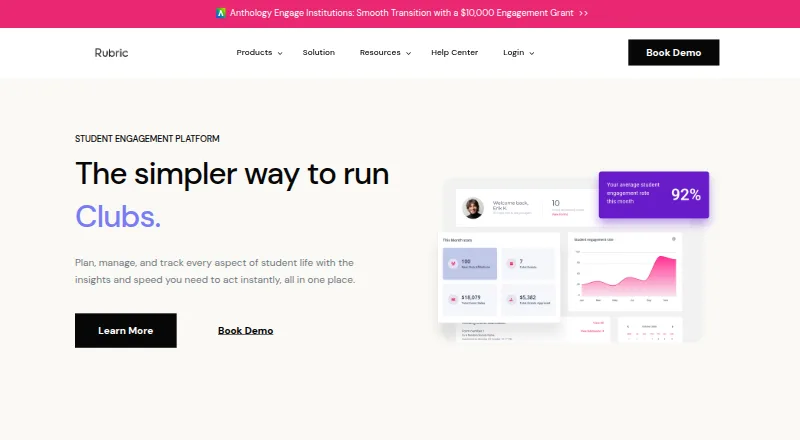
Rubric offers 28 plug-and-play modules that organizations can choose for their campus needs. A club dashboard shows members, events, activity levels, forms, attendance rates, and member types.
Its digital forms use drag-and-drop fields, club-profile data, and approval steps. Event and Ticketing handles membership checks, recurring events, shared event work, marketplaces, tabling, and ticket scanning.
Outreach tools send SMS blasts and email campaigns using templates and live recipient lists. Student CRM & Engagement Tracker links events, clubs, and trainings with student profiles and engagement scoring. Rubric also lists engagement analytics and risk alerts.
The campus app gives students access to events and activities. Rubric is available on Android, iOS, and the web; its App Store listing identifies iPhone availability.
How it connects
Rubric says it connects with existing student information systems, learning management systems, single sign-on, and experience management systems.
Its admin portal lists integrations such as Xero, QuickBooks, and Microsoft Dynamics 365 Business Central. Other listed connections include Stripe, Wallester, Weel, SAML 2.0, AAF OIDC, Google OAuth/OIDC, Microsoft Azure AD/Graph, and StudId.
Production systems and backups run on Amazon EC2. Data-residency options are available in Canada, the USA, Australia, and New Zealand. Rubric states that it uses SSL, encryption, key-management procedures, and quality-assurance controls.
Good fit
Rubric suits universities, student unions, associations, and guilds that need one system for clubs, activities, events, forms, payments, and outreach. Its selectable modules let an organization match the setup to its campus needs.
It may fit teams looking for Student Engagement Software with mobile access, engagement scoring, analytics, and links to existing campus systems.
Watch for
The official site does not publish a standard product subscription price. Prospective customers are directed to book a demo or contact the team.
Subscriptions are free, but paid memberships, tickets, and merchandise can incur tiered selling fees. Purchases may also have service fees that vary by payment method, basket size, and card issuer.
Rubric reports average uptime of 99.5%. It says support usually responds within 24 business hours through an in-app chatbot and email. Most users are up and running in 30–60 days, depending on the package and integration or customization work.
Pricing
Rubric has a free subscription model and a free plan. The US clubs pricing page describes these tiers by rolling 12-month transaction volume:
Free: below $200 in volume. The monthly subscription is free, and paid memberships, tickets, and merchandise are free.
Standard: $200–20,000 in volume. The monthly subscription is free; paid memberships, tickets, and merchandise cost 4% + 70¢.
Champion: above $20,000 in volume. The monthly subscription is free; paid memberships, tickets, and merchandise cost 3% + 50¢. Additional service fees may apply.
Verdict
Rubric is aimed at campus organizations that want club administration, event ticketing, forms, messaging, and student engagement records in a configurable platform. Its mobile apps, campus-system connections, and regional data-residency choices may help institutions with varied requirements.
Check the transaction-fee rules, payment-method charges, integration scope, and expected 30–60-day onboarding window before signing up. Organizations needing a published software price should note that Rubric directs buyers to a demo or sales contact instead.
Our take
Rubric makes sense for higher-education groups coordinating clubs, events, memberships, forms, and student outreach across several channels. The free subscription tiers reduce the fixed software cost, but transaction charges apply once an organization sells memberships, tickets, or merchandise at higher volumes. Buyers should confirm which campus systems and sign-on methods will connect, where data will be stored, and whether the reported support response and onboarding schedule meet their needs. It is less suitable for teams that require a public, fixed product price before speaking with the vendor.
- 28 selectable modules cover different campus needs.
- Free subscription tiers are available.
- Runs on Android, iOS, and the web.
- Connects with student, learning, sign-on, and experience systems.
- Offers data residency in four countries.
- No public standard product price is listed.
- Transaction and possible service fees apply to some sales.
- Most users are up and running within 30–60 days, depending on the package and integration or customization needs.
- Reported average uptime is 99.5%.
- Pick it ifUniversities and student groups managing clubs, events, and memberships; Campus teams needing forms, outreach, and engagement records; Organizations wanting configurable modules and mobile access
- Skip it ifYou need a fixed public subscription price before contacting sales.; Your budget cannot absorb transaction or payment-method fees.; You need onboarding faster than the stated 30–60-day range.
Pricing
All listed plans have no monthly subscription charge. Transaction fees depend on 12-month volume: free below $200, 4% + 70¢ from $200 to 20,000, and 3% + 50¢ above $20,000. Extra service fees may vary by payment method, basket size, and card issuer.
- Champion12 month transaction volume above $20,000 · Monthly subscription fee: Free · Paid memberships, tickets, and merchandise: 3% + 50¢Free
- Free12 month transaction volume below $200 · Monthly subscription fee: Free · Paid memberships, tickets, and merchandise: FreeFree
- Standard12 month transaction volume $200 – 20,000 · Monthly subscription fee: Free · Paid memberships, tickets, and merchandise: 4% + 70¢Free
As hellorubric.com lists them, checked 30 Sept 2026.
Questions
What is Rubric?
Rubric is a student engagement platform for universities, student unions, associations, and guilds. It manages clubs, events, services, memberships, programs, and student engagement information.
Does Rubric have a free plan?
Yes. Rubric lists free subscription plans. Depending on transaction volume, paid memberships, tickets, and merchandise are either free or charged a tiered fee.
Which devices support Rubric?
Rubric runs on Android, iOS, and the web. Its App Store listing says the campus app is available for iPhone.
What systems can Rubric connect to?
Rubric says it connects with student information systems, learning management systems, single sign-on, and experience management systems. Its admin portal lists several accounting, payment, identity, and student-system integrations.
How much does Rubric cost?
The monthly subscription is free on the listed Free, Standard, and Champion tiers. Sales fees range from free to 4% + 70¢ or 3% + 50¢ based on 12-month transaction volume. Other service fees may apply.
How long does Rubric onboarding take?
Rubric says most users are running within 30–60 days. The timing depends on the selected package and the integration or customization required.