SciSummary: AI Summaries for Scientific Papers
scisummary.com · checked 14 Oct 2026
AI summaries and analysis for scientific papers, with figure chat, research folders, and an API.
How it plugs in
Signal on AI Summarizers6.3#5 of 36
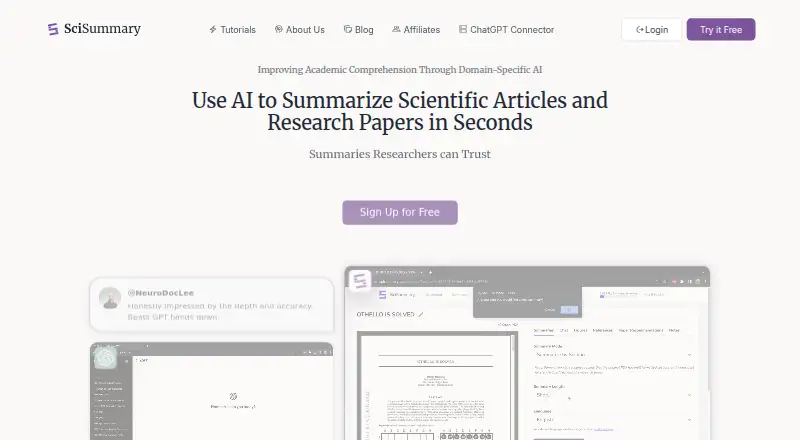
Using AI, SciSummary helps scientists, researchers, students, and professionals get through academic papers faster. It creates organized summaries, interprets figures, compares studies, and supports conversations across one or many documents. Papers can come from uploads, links, text, Zotero, or searches. It runs on the web, as a browser extension, and through an API.
Review
In a line
SciSummary is an AI service for understanding scientific and research papers. It produces summaries, analysis, and insights for academic reading.
What it does
Each paper summary is divided into sections including the abstract, methods, results, and conclusion. Length can be set to short, medium, or detailed; more than 130 languages and selected page ranges are supported.
Batch processing covers as many as 200 papers, while a synthesis can combine 25 and a comparison can cover 10 at once. Conversations may use one paper or several, making it possible to cross-reference studies and spot agreements or conflicts. Responses may point back to relevant pages or source sections.
PDF visuals such as tables, charts, graphs, and diagrams are pulled out for examination. Figure chat lets users ask about p-values, confidence intervals, effect sizes, and other visual details in the context of the paper. Separate PNG, JPG, or PDF files can supply missing visuals.
How it connects
SciSummary works on the web, through a Chrome extension, and through an API. Inputs may include uploaded files, public URLs, raw text, Zotero items, or database article searches. The extension lets you right-click a PDF and place it in a library folder.
Its MCP server works with Claude Desktop, ChatGPT, and other agents to search, summarize, and analyze scientific documents. For bulk requests, the REST API accepts PDFs, links, or full text and authenticates with bearer tokens. OpenAPI support enables generated SDKs, and official npm plus JavaScript/TypeScript tools are available.
The research library has unlimited folders, drag-and-drop organization, search, and article tags. Folders can be summarized, merged into one synthesis, or used for chats across their papers.
Good fit
SciSummary is aimed at scientists, researchers, and students seeking faster academic reading. It suits people seeking paper summaries, cross-paper comparison, citation-aware answers, or help interpreting figures.
APA, Chicago, MLA, and Harvard references can be created, including reference lists spanning multiple documents. Pro adds semantic search over as many as 1,000 indexed documents.
Watch for
Batch and comparison sizes are capped: 200 documents for batch summaries, 25 for one synthesis, and 10 for simultaneous comparison. The Pro semantic-search index is limited to 1,000 documents.
According to its privacy policy, SciSummary may collect account and usage data and uses commercially acceptable safeguards, but it cannot promise absolute security. It is dated May 30, 2023. Card details go directly to third-party processors, including Stripe.
The free offers are time-limited or have usage allowances. Check the limits and the student promotion code before choosing a plan.
Pricing
A free seven-day SciSummary trial provides 30,000 summary words, five AI-analyzed figures, 100 chat messages, and unlimited article searches. The Student plan is free for the first month with promo code STUDENT26, then standard pricing applies; it includes unlimited summaries, figure analysis, chats, searches, and quick-click import during that month.
The Bulk Summarization API is charged monthly according to usage at $0.0037 per 1,000 tokens. It is pay as you go and accepts PDFs, links, or raw text.
Pro Monthly costs $7/month. Pro Yearly is billed at $48/year (listed as $4 a year) and includes unlimited summaries, figures, chat, and 1,000 indexed documents for semantic search.
Verdict
Choose SciSummary if your work centers on scientific literature and you want summaries, figure explanations, source-linked chats, or multi-paper synthesis in one place. Its Zotero import, browser extension, and developer tools cover several ways to bring papers in.
It is less suitable if you need unrestricted document batches, guaranteed security, or a permanently free service without usage limits. The API is a separate pay-as-you-go option, while the student offer depends on a promotion code and changes after its first month.
Our take
SciSummary makes sense for people who regularly read research papers and want structured notes, cross-paper discussion, or help with charts and tables. The web app, Chrome extension, Zotero import, and MCP connection offer flexible ways to work. Researchers with larger libraries should check the 1,000-document Pro search cap and batch limits. Its privacy terms permit account and usage-data collection, and they do not promise absolute security. Try the seven-day allowance before paying, and confirm whether the student code or API billing fits your workflow.
- Paper summaries use abstract, methods, results, and conclusion sections.
- Responses may point to page numbers or source sections.
- Figure chat interprets statistics and separately uploaded visuals.
- Supports Zotero, browser import, web pages, files, and raw text.
- API offers bulk requests and generated SDK clients.
- Batch summaries cap at 200 documents.
- One synthesis supports up to 25 papers; comparisons support 10.
- The Pro semantic-search index is limited to 1,000 documents.
- The privacy policy says absolute security cannot be guaranteed.
- Student pricing depends on promo code STUDENT26.
- Pick it ifResearchers and students reading many scientific papers; Teams needing figure explanations and cross-paper synthesis; Developers sending paper batches through an API
- Skip it ifYou need unlimited batch sizes or more than 1,000 indexed documents.; You require a permanently free plan without usage or time limits.; You cannot accept stated data-collection and security limitations.
Pricing
A free trial lasts seven days. Student access is free for one month with code STUDENT26, then standard pricing. Pro costs $7/month or $48/year. The bulk API is billed monthly at $0.0037 per 1,000 tokens.
- Student$0 first month · Unlimited summaries, AI figure analysis, chat messages, article searches, and quick click import for 1 month · promo code STUDENT26Free
- Student Plan$0 first month with promo code STUDENT26, then standard pricing · Unlimited summaries, figures and chat for first monthFree
- Bulk Summarization APIUsage billed once per month · $0.0037 per 1,000 tokens · pay as you go · PDFs, links or raw text · bulk requestsFree
- Free Trial$0 for 7 days · 30,000 summary words · 5 AI-analyzed figures · 100 chat messages · unlimited article searchesFree
- Pro (Monthly)$7/month · Unlimited summaries · unlimited figures · unlimited chat · 1,000 indexed documents for semantic search$7/mo
- Pro Planbilled as $48/yr · Unlimited summaries, AI figure analysis, chat messages, article searches, and quick click import · 1,000 documents indexed for semantic search$48/yr
- Pro (Yearly)$48/year · Unlimited summaries · unlimited figures · unlimited chat · 1,000 indexed documents for semantic search$48/yr
As scisummary.com lists them, checked 8 Oct 2026.
Questions
Is there a free SciSummary option?
Yes. Its seven-day trial costs nothing and includes 30,000 summary words, five AI-analyzed figures, 100 chat messages, and unlimited article searches.
What files can I give SciSummary?
Accepted inputs include uploaded files, public URLs, raw text, Zotero imports, and database article searches. For bulk work, the API takes PDFs, links, or full text.
Can SciSummary analyze figures?
Yes. Extracted tables, charts, graphs, and diagrams can be explained in context, while missing visuals may be supplied as PNG, JPG, or PDF files.
Does it connect to ChatGPT?
Yes. The MCP server works with ChatGPT, Claude Desktop, and other agents for searching, summarizing, and analyzing scientific documents.
How many papers can it compare?
The limits are 200 documents for batch summarization, 25 for a combined synthesis, and 10 for simultaneous comparison.
Is there an API?
Yes. Its REST API authenticates bulk summarization with bearer tokens. OpenAPI support allows generated SDKs, and official npm and JavaScript/TypeScript tools are available.