SoulX-Singer: Open-Source Singing Voice Synthesis
github.com · checked 1 Oct 2026
Open-source singing voice synthesis and conversion for unseen singers, with MIDI and melody control.
How it plugs in
Signal on AI Song Cover Generators6.4#6 of 56
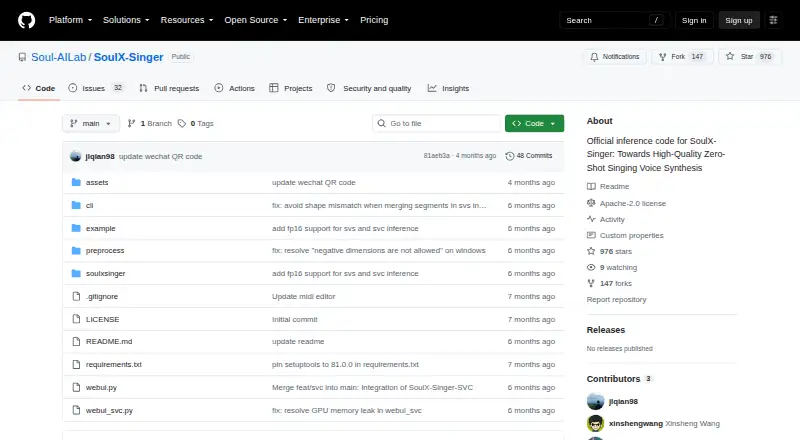
SoulX-Singer is a free, open-source model for making singing voices and converting recorded vocals to another singer’s voice. It runs on Linux through local, self-hosted tools or in web demos. The system supports Mandarin Chinese, English, and Cantonese, with MIDI editing, vocal preprocessing, voice cloning, and exports for MIDI and stems.
Review
In a line
SoulX-Singer is an open-source model that creates realistic singing voices for singers it has not been trained for specifically. It can also convert raw singing into a target singer’s voice.
What it does
You can guide generated singing with a melody’s F0 contour, which controls pitch over time, or with MIDI notes that set pitch, rhythm, and expression. Voice conversion keeps the original melody, rhythm, and lyrics without requiring lyric or MIDI transcriptions.
The system supports singer-timbre cloning, cross-language synthesis, and lyric editing while retaining natural phrasing. Its preprocessing tools separate vocals, reduce room echo, detect pitch and voice activity, and transcribe lyrics and notes.
How it connects
SoulX-Singer runs on Linux through a self-hosted web interface. The repository uses Conda, Python 3.10, pip-installed dependencies, and model downloads from Hugging Face Hub.
A MIDI Editor lets you change lyrics, phoneme timing, pitches, and note lengths, then import the edited data for synthesis. Generated metadata can be exported to MIDI, and stem export is supported. A web demo and a separate MIDI Editor are available on Hugging Face Spaces.
The code and model weights use the Apache 2.0 license, which allows commercial use.
Good fit
This suits researchers and developers who need local control over singing synthesis, voice conversion, or singer cloning. It is also a fit for users working in Mandarin Chinese, English, or Cantonese.
People comparing tools in AI singing voice generators may value its zero-shot operation, MIDI workflow, and self-hosted setup.
Watch for
Automatic preprocessing can misalign singing with lyrics and notes, so the maintainers recommend checking and correcting the results manually.
Plan for a technical installation: local use requires Linux, Conda, Python 3.10, pip dependencies, and downloaded model files. The project also asks users to respect intellectual property, privacy, and consent, and bans unauthorized impersonation or deceptive audio.
Pricing
SoulX-Singer is free. The code and model weights are provided under Apache 2.0, and the stated plan allows researchers and developers to use them commercially.
Verdict
Choose SoulX-Singer if you want open-source singing synthesis or voice conversion with MIDI editing and local deployment. Its support for three languages and unseen-singer generation broadens its use without per-speaker fine-tuning.
Look elsewhere if you need a simple consumer app, automatic alignment you never have to fix, or a non-Linux setup.
Our take
SoulX-Singer is a strong match for technical users who want a no-cost, adaptable singing model rather than a polished plug-and-play service. Its combination of zero-shot voices, conversion, MIDI editing, and commercial licensing covers serious creative and research workflows. The tradeoff is setup and maintenance: local deployment involves several installation steps, and automatic transcription may need hand correction. Users must also handle consent and rights for cloned voices. Choose it when control and open licensing matter more than convenience.
- Free code and model weights under Apache 2.0
- Generates voices for unseen singers without fine-tuning
- Supports Mandarin Chinese, English, and Cantonese
- MIDI editing controls lyrics, pitches, and durations
- Runs locally or through Hugging Face web demos
- Linux local setup needs Conda, Python 3.10, and pip dependencies
- Automatic preprocessing may misalign lyrics and notes
- Voice cloning requires careful consent and rights checks
- Pick it ifResearchers and developers building singing voice workflows; Creators needing MIDI-controlled synthesis or voice conversion; Users working in Mandarin, English, or Cantonese
- Skip it ifYou need a simple consumer app with no technical installation; You cannot manually correct lyric or note alignment; You lack permission to clone or transform a singer's voice
Pricing
The single SoulX-Singer plan is free. Apache 2.0 covers the code and model weights and allows commercial use for researchers and developers.
- SoulX-SingerResearchers and developers are free to use the code and model weights · Apache 2.0 licenseFree
As github.com lists them, checked 1 Oct 2026.
Questions
Is SoulX-Singer free?
Yes. The code and model weights are free under the Apache 2.0 license.
Which languages does it support?
It supports Mandarin Chinese, English, and Cantonese.
Can it convert an existing vocal recording?
Yes. SoulX-Singer-SVC converts raw singing to a target singer’s voice while preserving melody, rhythm, and lyrics.
Does it support MIDI?
Yes. You can export metadata to MIDI, edit lyrics, phonemes, pitches, and durations, then import it for synthesis.
Where can I run it?
It supports Linux, self-hosted local deployment, and web demos on Hugging Face Spaces.
Does it clone voices?
Yes. Its features include singer-timbre cloning and zero-shot generation for unseen singers.
What should I check before using it?
Automatic preprocessing can misalign audio, lyrics, and notes, so manual correction may be needed. Follow consent, privacy, and intellectual-property rules.
Near it
All alternatives →- KAKits AI#5 on this board
- BA
 BeatMV AI Music Remixer#7 on this board
- RA
 Revocalize AI#4 on this board
- AA
 Audjust AI Song Cover Generator#8 on this board
- MIMedia.io AI Song Cover Generator#3 on this board
- MMusicful#9 on this board
- BA
 BeMusic AI Cover#2 on this board
- TATopMediai AI Song Cover#10 on this board
- A
 Applio#1 on this board
- AAICoverGen#11 on this board