SourceMeld Code Search and Migration
sourcemeld.com · checked 15 Oct 2026
SourceMeld brings together code search, translation, and repository connections across programming languages.
How it plugs in
Signal on Code Transpilers6.1#17 of 28
SourceMeld provides self-hosted tools for finding and migrating code. Repositories from GitHub, GitLab, Bitbucket, and Gerrit can be indexed, letting users search by meaning or translate code between supported languages. A REST API, MCP server, and bring-your-own LLM keys extend access. A free Community Edition is available, while Enterprise pricing requires contact.
Review
In a line
SourceMeld is a service for searching, connecting, and migrating code written in different programming languages.
It runs through an API or as a Docker container on your own infrastructure.
What it does
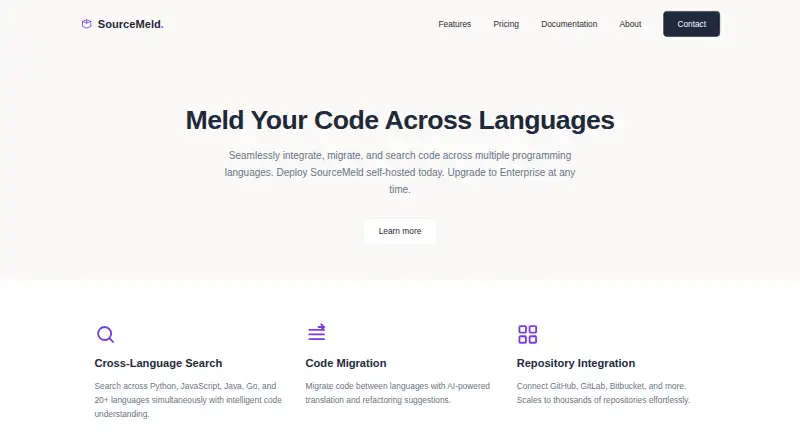
Its semantic search looks for code by meaning rather than only matching words. More than 20 programming languages are covered, with natural-language queries and similar-pattern discovery across languages.
The migration engine translates source code while preserving structure, mapping dependencies, and providing side-by-side checks. Migration documentation lists Python, JavaScript, TypeScript, Java, Go, Rust, C#, and Ruby.
Users can also generate documentation, dependency visualizations, and code-quality insights from indexed code.
How it connects
Connections are available for GitHub, GitLab, Bitbucket, and Gerrit repositories. They can sync repository permissions and keep indexes updated in real time.
A REST API provides programmatic access. The Community Edition includes an MCP server, and users can supply their own LLM key; the documentation names OpenAI, Anthropic, and Google as providers.
SourceMeld runs in a self-hosted Docker deployment, requiring Docker 20.10 or newer. Its documentation lists encryption in transit, role-based access control, and audit logging. Anonymous telemetry is on by default but can be disabled; the pricing FAQ says codebase and query data is not transmitted.
Good fit
SourceMeld suits teams working across several languages or repositories that need one place to search related code and plan migrations.
It is useful when repositories live in GitHub, GitLab, Bitbucket, or Gerrit, or when a team wants an API, MCP server, or its own LLM account.
The Community Edition offers community support. Enterprise adds dedicated support and extra access controls for organizations that need them.
Watch for
Running it yourself requires Docker, at least 4GB of RAM, 8GB recommended, and 10GB of disk space. Larger deployments may need load balancing, shared storage, Redis caching, and Prometheus or Grafana monitoring.
The core uses a source-available license that is not OSI-approved and restricts redistribution in competing products, so check the terms before building a competing service.
Fine-grained share links, search contexts, code navigation, SSO, and GCP IAP are Enterprise-only. Enterprise pricing is not published. Migration does not provide syntax-version conversion or intermediate output.
Pricing
The Community Edition is free and provides a single Docker image deployment, agentic search with supported model providers, code search, the MCP server, connections to the listed code hosts, and community support.
The Enterprise Edition is price on request. It includes Community features plus SSO, OAuth and IAP support, code-host permission syncing, code navigation, search contexts, and dedicated support.
A free trial is available.
Verdict
Choose SourceMeld if your code is spread across languages and repositories, and you can run a Docker service inside your own environment. Its free tier covers core search and repository connections, while the API and MCP server provide additional ways to use results.
Review the license, hardware needs, telemetry setting, and Enterprise-only features before adoption. Teams needing published Enterprise costs, OSI-approved open-source licensing, or syntax-version conversion should look elsewhere.
Our take
SourceMeld is a practical option for organizations that want cross-language code discovery and source-to-source migration without sending code to a hosted service. The free Community Edition lowers the entry cost and includes major repository connections, but self-hosting adds setup and capacity work. Enterprise functions are gated behind an unpublished price, and the source-available license may not suit companies building competing products. Confirm migration coverage, infrastructure resources, and telemetry preferences before choosing it.
- Semantic search covers more than 20 programming languages.
- Migrates code with dependency mapping and side-by-side validation.
- Connections are available for GitHub, GitLab, Bitbucket, and Gerrit.
- The free Community Edition includes an MCP server.
- Self-hosting keeps code and query data within your infrastructure.
- Enterprise pricing is not published.
- Docker, memory, and disk requirements apply to self-hosting.
- Anonymous telemetry is enabled by default.
- The core license is source-available rather than OSI-approved.
- Several sharing, navigation, and identity features require Enterprise.
- Pick it ifTeams searching and migrating code across multiple languages; Organizations that need repositories kept on their own infrastructure; Users wanting API, MCP, or bring-your-own LLM access
- Skip it ifYou need a hosted service rather than a Docker deployment; You require OSI-approved open-source licensing; You need syntax-version conversion or published Enterprise pricing
Pricing
Community Edition is free and includes core search, repository connections, MCP, and community support. Enterprise pricing is available only by contacting SourceMeld and adds identity, navigation, permission, context, and dedicated-support features. A free trial is available.
- Community Edition (CE)Free · Single docker image deploy · Agentic search with any supported model provider · Blazingly fast precise code search · MCP server · GitHub, Gerrit, Bitbucket and Gitlab connections · Community supportFree
- Enterprise Edition (EE)Contact Us · All Community Edition features · SSO, OAuth, and IAP support · Code host permission syncing · Code navigation · Search contexts · Dedicated supportOn request
As sourcemeld.com lists them, checked 15 Oct 2026.
Questions
Is SourceMeld free?
Yes. The Community Edition is free. Enterprise pricing is available on request, and a free trial is offered.
Where does SourceMeld run?
It runs as a self-hosted Docker container on your infrastructure. Docker 20.10 or newer, 4GB RAM minimum, and 10GB of disk space are listed requirements.
Which code hosts can it connect to?
Connections support GitHub, GitLab, Bitbucket, and Gerrit, with repository permission syncing and real-time indexing.
Which languages can SourceMeld migrate?
The migration documentation lists Python, JavaScript, TypeScript, Java, Go, Rust, C#, and Ruby.
Can I use my own AI provider?
Yes. Users can bring an LLM API key. Documentation names OpenAI, Anthropic, and Google as supported providers.
Does SourceMeld send code outside my infrastructure?
The pricing FAQ says codebase and query data is not transmitted. Anonymous telemetry is enabled by default and can be turned off.
Is SourceMeld open source?
No. Its core uses a source-available license that is not OSI-approved and restricts redistribution in competing products.