
Sparksee: Embedded Graph Database Review
sparsity-technologies.com · checked 15 Oct 2026
An embeddable graph engine for examining connected data within applications and on devices.
How it plugs in
Signal on Mobile Databases6.7#4 of 26
Sparksee embeds in an application and stores connected data in a local database file. It supports mobile and desktop targets while offering APIs, graph algorithms, and import/export tools. A free academic plan and one-month trial are available; commercial licensing is priced on request.
Review
In a line
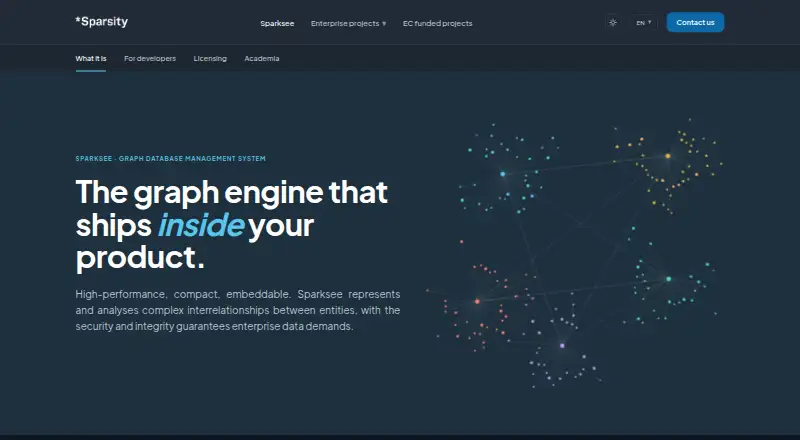
Sparksee is a graph database management system designed for embedding. It models entities and their relationships for connected-data analysis in applications.
What it does
The engine operates within an application process and uses a database file, eliminating the need to provision a cluster or query server. Local processing can keep graph analysis running when cloud access is poor and can reduce delays caused by a remote connection.
Its labelled, attributed multigraph model handles directed or undirected edges, typed objects, attributes and loops. Traversal, shortest-path, connectivity, community-detection and PageRank algorithms are available.
Sparksee uses compact bitmap-based structures to reduce resource needs. It also provides disk-level encryption and can recover a database after corruption.
How it connects
Sparksee is proprietary rather than open source. Its API covers database creation, node and edge work, attributes, collections, scripting, graph algorithms, and data import and export.
Queries use Sparksee Cypher, an implementation of openCypher with product-specific differences, or Sparksee Algebra. Graphviz and GraphML are available for export, and the documentation discusses Blueprints integration.
API references are available for .NET, Java, C++, Objective-C, Python and openCypher. Packages support Windows, Linux, macOS, Android, iOS and QNX, with self-hosted deployment inside your application. Graph databases provide a wider category for comparison.
Good fit
Teams developing software for local graph storage and analysis may find Sparksee suitable, particularly for phones, desktops or embedded devices. Its local model can support privacy-focused apps and work without constant cloud connectivity.
It is a fit for relationship-heavy workloads such as connected-entity analysis, graph traversal and path finding. Mobile projects can compare it with other mobile databases when memory use and offline operation matter.
Watch for
Commercial licenses are sized by deployment details, including supported platforms and whether the engine ships to customers. The licensing page does not publish a fixed commercial price.
Sparksee is not open source. High-availability capabilities became deprecated in version 6.0, had not been updated since version 5.2.3, and could be removed. GDB-Engines reports no sharding, replication, distributed queries, automatic rebalancing or high-availability support.
Check language runtime requirements before deployment. Installation normally involves downloading and unpacking packages; macOS Objective-C uses a framework installer, while Java packages are also available through Apache Maven.
Pricing
Sparksee follows a freemium model offering both a free plan and a free trial. Teachers, PhD students and university research groups can use the Academic licence at no charge after manual validation with a school or university ID.
The Free trial lasts one month at no charge and supplies a trial build, sample project, and selected platform and API language. Industry and Startup licences are available by request; the Startup plan targets small and midsize businesses, and the first 10 startups receive a three-year licence waiver.
Verdict
Choose Sparksee when your application needs a graph engine embedded on the device or within a desktop service, with local algorithms and several programming-language APIs. It is especially relevant for offline or privacy-sensitive products.
Look elsewhere if you need a published commercial price, distributed database features, or current high-availability tooling. Teams should also confirm that Sparksee’s proprietary license and runtime requirements match their delivery model before committing.
Our take
Sparksee is a practical option for applications that must analyze relationships locally instead of relying on a cloud graph service. Its file-based deployment, mobile targets, encryption and broad language coverage suit embedded products and offline workflows. Deprecated high-availability support adds another qualification for systems that require failover. Academic users and startups can evaluate it with free options, while other buyers should request a deployment-specific quote.
- Operates within an application without requiring a cluster or query server
- Targets Android, iOS, Windows, Linux and macOS
- Provides graph algorithms, import/export and scripting
- Offers disk-level encryption and database recovery
- Free academic licence and one-month trial
- Commercial pricing is available only on request
- Proprietary license; it is not open source
- High-availability capabilities are deprecated
- No listed sharding, replication or distributed queries
- Runtime requirements vary by language
- Pick it ifEmbedded graph analysis on mobile or desktop devices; Offline and privacy-focused relationship data apps; Academic projects and eligible startups
- Skip it ifA published commercial price is essential; You require sharding, replication or distributed queries; You need current high-availability features
Pricing
Academic use is free after validation. A one-month trial is free. Industry and Startup licences require a quote; the first 10 startups get a three-year waiver.
- Academic licenceFree to use for teachers, PhD students and university research groups; manual validation required · Academic use · valid university or school IDFree
- Free trial1-month subscription for free · Trial build · sample project · platform and API-language selectionOn request
- IndustryRequest licence · Enterprise real-time graph applications · terms sized by deploymentOn request
- StartupRequest licence · For SMEs · first 10 startups get a 3-year licence waiverOn request
As sparsity-technologies.com lists them, checked 15 Oct 2026.
Questions
Is Sparksee open source?
No. Sparksee uses a proprietary license, with free academic, evaluation and certain startup arrangements.
Does Sparksee need a database server?
No. The engine works within an application process using a database file, so there is no cluster or query server to provision.
Which platforms does Sparksee support?
Supported targets include Windows, Linux, macOS, Android, iOS and QNX. It can be deployed self-hosted inside an application.
What query languages does Sparksee use?
Sparksee offers Sparksee Cypher, its implementation of openCypher with product-specific differences, together with Sparksee Algebra.
Is there a free Sparksee plan?
Yes. Academic users can get a free licence after manual validation, and a one-month trial is free. Commercial plans are priced on request.