Sprag Speech API and Voice Agent Platform
sprag.ai · checked 7 Oct 2026
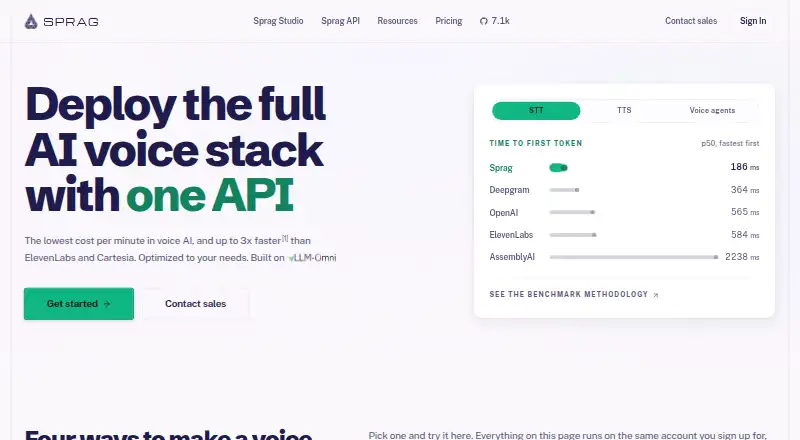
Sprag is a speech platform for voice agents, transcription, voice generation, and audio captioning.
How it plugs in
Signal on Text-to-Speech Software6.7#113 of 223
Sprag combines speech recognition, voice synthesis, voice cloning, and realtime agents behind one API. It runs through a web service, API, or self-hosted deployment. Rhythm handles transcription in 30 languages, Chorus creates speech with different voice types, and Symphony supports realtime tool calls and interruptions. There is no free plan, and realtime use costs more than batch processing.
Review
In a line
Sprag is a speech platform for building voice agents and audio features. Web, API, and self-hosted access cover transcription, speech generation, cloning, and captioning.
What it does
Rhythm turns submitted audio into text in 30 languages, with both streaming and batch processing. Chorus turns text into speech using a built-in voice, a cloned voice, or a voice designed from a text prompt.
Symphony handles realtime agents that can call tools, respond to interruptions, and manage turn-taking. Symphony Notes covers audio-clip details such as speech, speakers, emotion, and background sound.
How it connects
Sprag provides an HTTP API shaped like OpenAI's format. To use existing clients, update the base URL and supply a Sprag API key. Sprag documents Pipecat connections through its OpenAI services and places LiveKit in the integrations navigation.
You can deploy it through the web service, an API, or a self-hosted option. Its export choices include MP3, Opus, AAC, FLAC, WAV, and PCM.
Good fit
Sprag suits developers aged 16 or older who need speech features in applications. It covers jobs such as transcription, voice output, cloned voices, designed voices, realtime conversations, and audio descriptions.
It may also fit teams comparing voice cloning software or text-to-speech software that can work with an OpenAI-style client.
Watch for
There is no free plan. Rhythm and Symphony realtime use carries a 25% premium over batch rates, while speech output is priced the same in either mode.
Sprag says data is stored in its cloud infrastructure and sent over HTTPS/TLS. Payment cards are handled by Stripe rather than stored on Sprag's systems. California residents can opt out of advertising-measurement cookies that may count as sharing.
For questions about account costs, billing, rate limits, enterprise agreements, or metering, the pricing page directs users to contact Sprag.
Pricing
Sprag is paid and lists pricing from $0.70. Chorus has a $0.70 monthly charge, with generated speech measured at $0.70 per hour and stock-voice text-to-speech listed at $19.44 per 1M audio tokens. Chorus Design is $15 a month for creating a voice from a text prompt. Chorus Clone has a $4.50 monthly charge and adds $1.00 per hour of input audio when cloning from a short reference.
Symphony Notes carries a free label and uses $0.0019-per-minute billing, plus $2.03 per 1M output tokens. Rhythm has a $0.08 one-time charge and bills submitted audio at $0.075 per hour on the batch rate. Symphony has a $0.09 one-time charge and bills audio at $0.09 per hour on the batch rate.
The built-in Chorus voice option costs $0.70 one-time, with generated speech at $0.70 per hour and $19.44 per 1M audio tokens. The cloned-voice option costs $4.50 one-time, then $4.50 per 1M characters and $0.27 per hour of speech, with reference audio adding $1.00 per hour. The designed-voice option is $15 one-time and bills $15.00 per 1M characters.
Verdict
Choose Sprag if you want several speech functions under one API, need an OpenAI-style connection, or require self-hosting. Its range covers basic transcription through realtime tool-using agents and custom voices.
Look elsewhere if a free plan is essential, if you need predictable realtime costs without a surcharge, or if your project is not aimed at developers aged 16 and older. Check the metering and enterprise details with Sprag before committing to larger usage.
Our take
Sprag is a practical choice for developers who want transcription, speech output, voice cloning, and realtime agent behavior in one service. Its OpenAI-style API can reduce connection work, and self-hosting is available. The trade-offs are a paid-only offering, several usage meters, and a 25% realtime premium for Rhythm and Symphony. Buyers should also review how cloud storage, privacy controls, and organization billing fit their requirements. It is less suitable for casual users or projects that need a simple free voice tool.
- One API covers transcription, speech synthesis, cloning, and realtime agents.
- Supports 30 transcription languages and six listed audio export formats.
- OpenAI-style clients can connect by changing the base URL and API key.
- Web, API, and self-hosted deployment options are available.
- No free plan is available.
- Rhythm and Symphony realtime sessions cost 25% more than batch use.
- Several features use separate hourly, character, minute, or token meters.
- The service is intended for developers aged 16 and older.
- Pick it ifDevelopers building voice agents and audio features; Teams needing cloning, designed voices, or realtime tool calls; Projects that need an OpenAI-style speech API
- Skip it ifYou need a free plan for regular use.; You want one simple price instead of multiple usage meters.; Your users or developers fall outside the stated 16-and-older audience.
Pricing
Sprag is paid overall; Symphony Notes carries a free label but still uses per-minute and output-token billing. Other options use monthly, one-time, hourly, character, minute, or token pricing. Rhythm and Symphony realtime sessions are billed 25% above batch rates.
- Chorus$0.70 per hour of speech generated; also listed as $19.44 per 1M audio tokens · Stock-voice text-to-speech$0.70/mo
- Chorus DesignDesigns new voices from a text prompt$15/mo
- Chorus ClonePlus $1.00 per hour of input audio · Clones a voice from a short reference$4.50/mo
- Symphony Notes$0.0019/ minute · Audio captioning · + $2.03 per 1M output tokensFree
- Rhythm$0.075/ hour of audio submitted; batch rate · Streaming and batch · realtime sessions cost 25% over batch rates$0.08 one-time
- Symphony$0.09/ hour of audio; batch rate · Text, image, audio, and video in · text and speech out · tool calling · realtime sessions cost 25% over batch rates$0.09 one-time
- Chorus — built-in voice$0.70/ hour of speech generated · Built-in voices · $19.44 per 1M audio tokens$0.70 one-time
- Chorus — cloned voice$4.50/ 1M characters · $0.27 per hour of speech · + $1.00 per hour of reference audio$4.50 one-time
As sprag.ai lists them, checked 20 Sept 2026.
Questions
Is any Sprag plan free?
Sprag is paid overall. Symphony Notes carries a free label, yet billing is $0.0019 per minute plus $2.03 per 1M output tokens.
What is Rhythm's transcription language coverage?
Its Rhythm speech recognition supports transcription in 30 languages, with streaming and batch use.
Does Sprag support voice cloning?
Yes. Chorus Clone creates a voice from a short reference, and the cloned-voice option also charges for reference audio.
Does Sprag offer an API?
Yes. Sprag exposes speech models through an HTTP API following OpenAI's shape. Existing clients can connect after the base URL and API key are changed.
Can Sprag run on my own infrastructure?
Sprag's homepage links to a self-hosted deployment option. It also offers web and API access.
How does Sprag price realtime sessions?
For Rhythm and Symphony, realtime sessions cost 25% more than batch sessions, while speech output keeps the same rate in both modes.
Near it
All alternatives →- TSTTS-Story#112 on this board
- AP
 Amazon Polly#114 on this board
- NNaturalReader#111 on this board
- BVBreezeBlue Voice TTS#115 on this board
- B
 BeyondWords#110 on this board
- NBNarration Box#116 on this board
- VA
 Voice.ai#109 on this board
- RRaritone#117 on this board
- OVOpenSpeaker Voice Changer#108 on this board
- SASeed Audio#118 on this board