SPS Analytics: Retail Sales and Inventory Analytics
spscommerce.com · checked 21 Oct 2026
Cloud-based retail intelligence for sales, inventory, and item performance.
How it plugs in
Signal on Augmented Analytics Software5.2#21 of 32
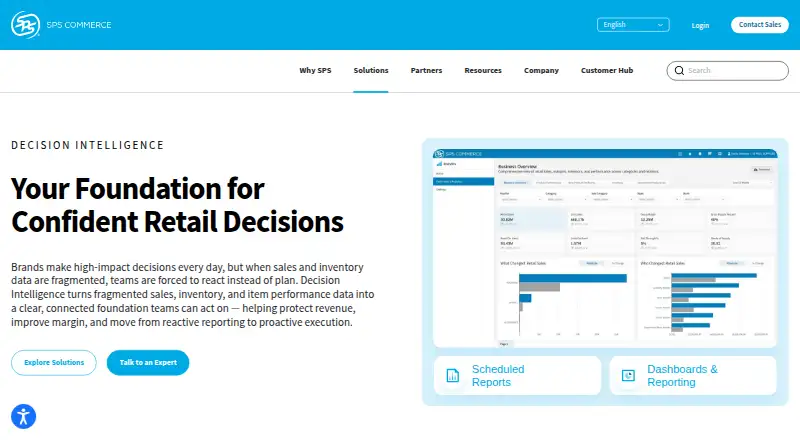
Decision Intelligence, the current presentation of SPS Analytics, brings together retail sales, inventory, and product-performance information. It shows sell-through by item and location, supports forecasting and replenishment, and helps teams spot supply gaps and excess stock. Results come through dashboards, reports, files, or cloud data shares. The service runs in the cloud and has no free plan.
Review
In a line
SPS Analytics is a cloud offering from Minneapolis-based SPS Analytics, established in 1987. Its data foundation combines retail sales, inventory, and item-performance information for supplier decision-making.
What it does
The service shows sell-through at the product and location level across retailers and channels. Teams use this view for forecasting, replenishment, and inventory allocation.
It tracks days of supply, distribution gaps, and performance changes. That helps users rebalance stock, reduce excess inventory, avoid stockouts, and limit markdowns.
Promotion, assortment, and retailer-performance analysis gives sales and planning groups shared information for retailer discussions. Automated insights, forecasting, and root-cause analysis are available, but there is no natural-language analysis or AI explanation feature.
The older Select and Plus descriptions list over 800 retail metrics and attributes, with charts, tables, filters, drilldowns, exports, alerts, and emailed reports. Power Users can create reports covering totals, trends, variances, and same-store comparisons across weekly, monthly, quarterly, seasonal, and yearly periods.
How it connects
SPS gathers, validates, and standardizes retail sales and inventory files from trading partners before matching the enhanced records with a supplier's product catalog. Dashboards, scheduled reports, files, and cloud links to business-intelligence or planning systems provide delivery options.
Cloud data shares support Snowflake, Databricks, and Oracle NetSuite. SPS also publishes a REST API with public guidance; access uses OAuth 2.0 tokens and authenticated requests. In plain terms, that API lets connected software request data securely.
The product is cloud hosted, with no self-hosted option stated. It is proprietary rather than open source.
Good fit
SPS Analytics suits sales and account teams, demand planners, supply-chain groups, marketing and revenue operations, and analytics or business-intelligence teams.
It fits suppliers that need retailer and channel sell-through in one place, or that want shared data for supply-chain planning conversations. Snowflake and Databricks users can send validated retail data into those environments for wider reporting.
The service supports retailer performance work as well as inventory decisions. Its dashboards, scheduled outputs, and file delivery also suit teams that do not want every user working directly in an analytics system.
Watch for
The breadth of available data is determined by what retailers and suppliers send. Retailer feeds that arrive daily can refresh each day, while many others update weekly. Store-level and margin views also depend on available data.
Implementation time varies with data sources and project scope. SPS handles retrieval, validation, standardization, and setup through structured onboarding, so buyers should confirm the expected sources and schedule before signing up.
Users need an SPS account set up by an administrator or account manager. The service has no free plan, and pricing is not published.
SPS describes controls such as audit logging, role-based access, backups, and encryption at rest, and says its framework includes ISO/IEC 27001, SOC 1 Type 2, and SOC 2 Type 2 certifications.
Pricing
SPS Analytics is paid software with pricing on request and no free tier.
The Decision Intelligence plan includes retail sales, inventory, and item-performance data, dashboards, scheduled reports, file delivery, and cloud integrations.
SPS Analytics Select covers single-retailer performance with dashboards, ad-hoc reports, filters, drilldowns, exports, alerts, email reports, and multi-device access. SPS Analytics Plus adds everything in Select, plus cross-retailer visibility, item and location masters, normalized weekly data, data-file delivery, and Analytics Monitor, which tracks trading-partner file processing and can send event notifications.
Verdict
Choose SPS Analytics if your organization supplies multiple retailers and needs item- and location-level sell-through, inventory signals, or shared retailer reporting. It is also a fit when validated data must flow into Snowflake, Databricks, NetSuite, or planning tools.
Look elsewhere if you need a free starting tier, self-hosting, natural-language analysis, or explanations generated by AI. Before committing, check which trading partners provide data, how often they refresh it, and whether your required store and margin views are available.
Our take
SPS Analytics is designed for suppliers overseeing retail performance, not casual spreadsheet users. Its main value is bringing sales, inventory, and product data together for forecasting, replenishment, allocation, and retailer conversations. Cloud delivery, scheduled outputs, files, and data shares cover several working styles. The trade-offs are commercial onboarding, undisclosed pricing, and dependence on partner data quality and refresh timing. Buyers should verify coverage, implementation scope, and account access before choosing a plan.
- Item- and location-level sell-through across retailers and channels
- Forecasting, replenishment, allocation, and root-cause analysis
- Dashboards, scheduled reports, file delivery, and cloud integrations
- Snowflake, Databricks, and Oracle NetSuite cloud-share options
- Security controls and stated ISO, SOC 1, and SOC 2 certifications
- Pricing is available only on request
- No free plan or self-hosted deployment
- Data refresh and store or margin views depend on partner data
- No natural-language analysis or AI explanations
- Implementation time varies by sources and project scope
- Pick it ifRetail suppliers planning demand and inventory across channels; Teams needing shared retailer-performance reporting; Organizations using Snowflake, Databricks, or NetSuite
- Skip it ifYou need a free tier or published prices; You require self-hosting or natural-language AI analysis; Your key retailers cannot provide the data views you need
Pricing
Paid plans only. Decision Intelligence is priced on request; Select and Plus also have no published prices. There is no free plan.
- Decision IntelligenceContact sales; pricing not published · Retail sales, inventory and item-performance data · dashboards · scheduled reports · file delivery · cloud integrationsOn request
- SPS Analytics PlusPrice not stated · Everything in Select · cross-retailer visibility · item and location masters · normalized weekly data · data-file delivery · Analytics MonitorOn request
- SPS Analytics SelectPrice not stated · Single-retailer performance · dashboards · ad-hoc reports · filters · drilldowns · exports · alerts · email reports · multi-device accessOn request
As spscommerce.com lists them, checked 21 Oct 2026.
Questions
Is SPS Analytics free?
No. SPS Analytics is paid software, pricing is on request, and there is no free plan.
Where does SPS Analytics run?
It is cloud hosted and available through the web. No self-hosted deployment option is stated.
Which systems can receive SPS Analytics data?
Dashboards, scheduled reports, files, and cloud integrations can receive insights. Cloud data shares support Snowflake, Databricks, and Oracle NetSuite.
Does SPS Analytics have an API?
Yes. SPS publishes public REST API guidance. Requests use OAuth 2.0 tokens and authenticated bearer-token calls.
How often does the data refresh?
Retailer feeds supplied daily may refresh each day, while many other retailers provide weekly updates. Store-level and margin views depend on available data.
Who is SPS Analytics for?
It supports sales and account management, demand planning and supply chain, marketing and revenue operations, and analytics or business-intelligence teams.
Does it offer AI explanations or natural-language analysis?
No. The listed capabilities include automated insights, forecasting, and root-cause analysis, but not natural-language analysis or AI explanations.