Squawk PostgreSQL Migration and SQL Linter Review
squawkhq.com · checked 4 Oct 2026
Open-source PostgreSQL migration and SQL linter with editor and pull request checks.
How it plugs in
Signal on SQL Linters and Formatters6.4#5 of 26
For PostgreSQL migrations and SQL, Squawk identifies changes that could prevent database reads or writes. It runs from a command line, editor, browser playground, or CI workflow, with a VS Code extension and GitHub options. You can set rules, PostgreSQL versions, paths, and transaction assumptions. The project is available at no cost as open-source software.
Review
In a line
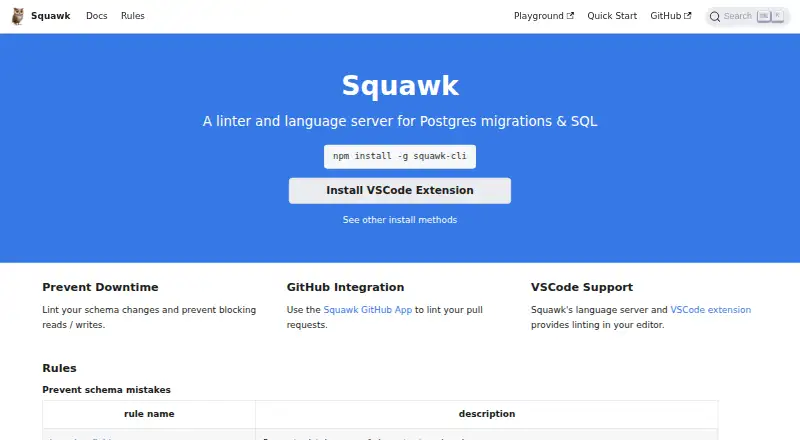
Squawk serves as a PostgreSQL migration and SQL linter, with a language server for editor use. It looks for schema changes that may stop database reads or writes.
What it does
Squawk checks migration files for unsafe statements, incompatible changes, and risky migration patterns. Its messages include examples and reasons so developers can adjust the SQL.
You can lint files with its command-line tool, check code while editing in VS Code, or run checks on changed migrations in a pull request.
How it connects
Squawk supports PostgreSQL only. It offers a VS Code extension, a language server for editor checks, and a GitHub Action for pull requests. Comments on pull requests are available through its upload-to-github command or GitHub App.
Installation options documented by the project include npm, PyPI, release binaries, Docker, a browser playground, and VS Code. The playground runs a WebAssembly build in your browser. Configuration can include or exclude rules, set a PostgreSQL version, choose transaction assumptions, and set paths. Some rules must be enabled explicitly.
When using the GitHub App, setup requires permission to write pull requests. The documentation recommends that app setup for CI systems outside GitHub Actions, including CircleCI.
Good fit
Squawk suits teams making PostgreSQL schema changes who want checks before migrations run. It fits local command-line work, editor linting, and pull request workflows.
The rules focus on changes that can block reads or writes, making the tool useful for reviewing migration safety during development and code review.
Watch for
Squawk is limited to the PostgreSQL dialect. It does not provide automatic fixes or custom rules.
Some checks are off by default, so your configuration may need an explicit include setting. GitHub comments also require the listed pull-request write permission for the App.
Pricing
Squawk has no charge and is distributed as open-source software.
Verdict
Choose Squawk if your work centers on PostgreSQL migrations and you want the same safety checks in a terminal, VS Code, or pull requests. Its configuration covers rule selection, PostgreSQL versions, file paths, and transaction assumptions, while GitHub options can leave comments for reviewers.
Look elsewhere if you need another SQL dialect, automatic repairs, or user-defined rules. Teams using GitHub Apps should also review the required pull-request permission before enabling comments.
Our take
Squawk is a practical match for PostgreSQL teams that want migration warnings before schema changes reach a shared database. It can cover several stages: local linting, editor feedback, browser checks, and pull request comments. Because it is open source and free, there is no licensing charge; GitHub App comments still need write access to pull requests. It is not suitable for teams working in other SQL dialects or seeking automatic fixes and custom lint rules.
- Free and open source
- Checks migration risks that can block reads or writes
- Works in VS Code and pull request workflows
- Supports browser, Docker, npm, PyPI, and binary installs
- Rules include examples and reasoning
- Supports PostgreSQL only
- No automatic fixes
- No custom rules
- Some rules require explicit enabling
- GitHub App comments need pull-request write permission
- Pick it ifTeams reviewing PostgreSQL schema migrations; Developers who want editor or pull request linting; Projects needing configurable migration rules
- Skip it ifYou need support for SQL dialects other than PostgreSQL; You require automatic fixes or custom lint rules; Your GitHub setup cannot grant pull-request write access
Pricing
The project is free and open source; no paid plans or free trial are listed.
Questions
What is Squawk?
Squawk serves as a linter and language server for PostgreSQL migrations and SQL. It flags schema changes that may block database reads or writes.
Where can I use Squawk?
Its command-line tool, VS Code extension, browser playground, Docker image, npm or PyPI package, release binaries, and CI integrations are documented ways to use it.
Can Squawk check pull requests?
Yes. A GitHub Action lints modified SQL migrations, while the upload-to-github command or GitHub App can post pull-request comments.
Does Squawk support databases besides PostgreSQL?
No. The supported SQL dialect listed for Squawk is PostgreSQL.
Can Squawk fix SQL automatically?
No. Automatic fixes are not provided.
Can I write custom Squawk rules?
No. Custom rules are not supported. You can include or exclude the provided rules instead.
Is Squawk free?
Yes. It is offered as free, open-source software, and no paid plans or trial period are listed.
What permissions does the GitHub App need?
The setup guide specifies write permission for pull requests so Squawk can post comments.