StatusIQ Review: Status Pages, Pricing and Limits
site24x7.com · checked 28 Sept 2026
StatusIQ hosts public or private status pages for outages, maintenance, and incident updates.
How it plugs in
Signal on Status Page Software6.6#4 of 31
StatusIQ is a status-page service for sharing service health, outage notices, maintenance windows, and incident updates. It offers public or password-protected pages, custom domains, subscriber alerts, widgets, analytics, and postmortem editing. Android, iOS, web, and API access are available. A free plan covers one page, while paid plans add capacity and longer histories.
Review
In a line
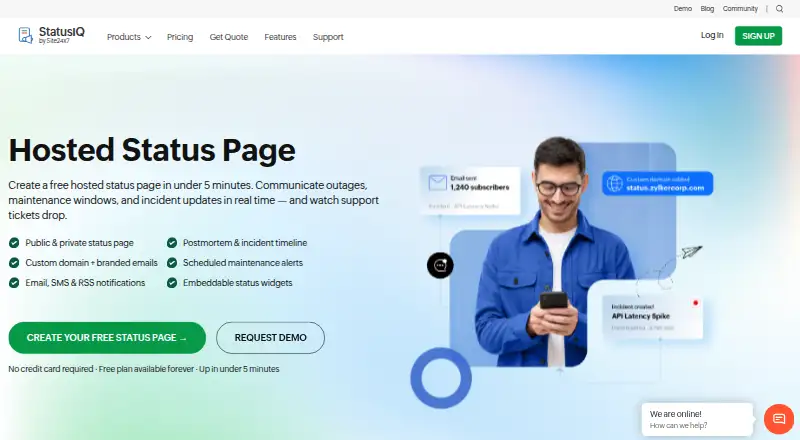
StatusIQ hosts status pages that communicate outages, maintenance windows, and incident updates in real time. Pages can be public or password-protected for internal groups, partners, or selected customers.
What it does
You can publish service components, post incident updates, schedule maintenance, and show current health with floating or inline widgets. A postmortem editor supports formatted text, tables, and links.
Subscribers can follow individual components and receive notices by email, SMS, or RSS. Page analytics include visits, iCalendar, and RSS feed support.
How it connects
StatusIQ accepts monitoring data through email and REST APIs, so it can display status and metrics from monitoring tools. Linked Site24x7 monitors can update a component automatically after a downtime alert.
Team alerts can use Slack, Microsoft Teams, PagerDuty, and webhooks. Android and iOS apps are available, alongside web access and API use.
Custom domains, logos, favicons, brand colors, and sender domains are supported. Paid custom-domain plans provision SSL automatically.
Good fit
StatusIQ suits teams that need a customer-facing service page or a private page for staff and partners. It fits outage communication, planned maintenance, subscriber notifications, and service-health displays.
The Green and Blue plans include unlimited team members.
Watch for
The Free plan allows 10 components and 100 subscribers. Green allows 50 components per page and 250 subscribers; Blue allows 200 components per page and 500 subscribers, plus 50 authenticated subscribers.
History limits vary by plan: the Free and Green plans keep component status history for 7 days, while Blue keeps it for 90 days. Incident history lasts up to 1 year on Free and up to 5 years on paid plans.
Check whether your monitoring source can send data by email or REST API, and whether you need private pages, custom domains, or longer history.
Pricing
StatusIQ has a free plan. Free includes one page, 10 components, five team members, 1,000 API calls per day, 100 subscribers, one year of incident history, and seven days of component history.
Green costs $10 a month, or $9/mo billed annually. It includes one Green page plus two Free/Basic pages, 50 components per page, 50,000 API calls per day, 250 subscribers, unlimited team members, and five years of incident history.
Blue costs $59 a month, or $50/mo billed annually. It includes one Blue page plus two Free/Basic pages, 200 components per page, 100,000 API calls per day, 500 subscribers, 50 authenticated subscribers, unlimited team members, and five years of incident history.
Paid plans have a 30-day free trial. No credit card is required for the trial or a free account. Extra Green pages cost $10 per month each, and extra Blue pages cost $59 per month each; add-ons require a paid account.
Verdict
Choose StatusIQ if you need both public and password-protected status pages, several subscriber channels, or direct links to monitoring and team-alert tools. The free tier is suitable for a small page with modest subscriber and component counts.
Move to Green or Blue when you need more components, subscribers, API calls, team members, or longer incident history. Check the history limits and add-on charges before expanding. Teams without a monitoring source that supports email or REST API input may need another setup.
Our take
StatusIQ is a practical option for publishing service health to customers while keeping separate private pages for internal audiences. Its free tier gives small teams a starting page, and paid plans raise limits for components, subscribers, API traffic, and history. Monitoring imports, Site24x7 synchronization, and alerts through common team tools can reduce manual updates. Before choosing it, confirm your required history period, subscriber volume, and component count. Also check whether extra pages will add to the bill and whether your monitoring system can provide the supported data feeds.
- Public and password-protected status pages
- Email, SMS, and RSS incident notifications
- REST API, email, and monitoring-tool data imports
- Custom domains with SSL on paid plans
- Android and iOS mobile apps
- Free plan with 10 components and 100 subscribers
- Free plan limits history and capacity
- Green and Blue extra pages cost separately
- Component and subscriber limits vary by plan
- Longer component history is limited to Blue
- Pick it ifTeams publishing outage and maintenance updates; Organizations needing public and private status pages; Users wanting monitoring and team-alert connections
- Skip it ifYou need more than the plan's component or subscriber limits; Your monitoring tool cannot send email or REST API data; You require more than seven days of component history on Green
Pricing
Free plan available. Green is $10 a month or $9/mo billed annually; Blue is $59 a month or $50/mo billed annually. Paid plans include a 30-day trial without a required credit card. Extra Green pages cost $10/month and extra Blue pages $59/month.
- Free$ 0 billed anually · 1 Free page · 10 components · 5 team members · 1,000 API calls/day · 100 subscribers · incident history up to 1 year · component status history up to 7 daysFree
- Green$9/mo billed anually · 1 Green + 2 Free/Basic pages · 50 components per page · unlimited team members · 50,000 API calls/day · 250 subscribers · incident history up to 5 years · component status history up to 7 days$10/mo
- Blue$50/mo billed anually · 1 Blue + 2 Free/Basic pages · 200 components per page · unlimited team members · 100,000 API calls/day · 500 subscribers · 50 Auth subscribers · incident history up to 5 years · component status history up to 90 days$59/mo
- Additional Green page$10 per status page/month$10/mo
- Additional Blue page$59 per status page/month$59/mo
As site24x7.com lists them, checked 28 Sept 2026.
Questions
Does StatusIQ have a free plan?
Yes. Free includes one page, 10 components, five team members, 1,000 API calls per day, and 100 subscribers.
Can StatusIQ pages be private?
Yes. StatusIQ supports public pages and password-protected private pages.
How do subscribers receive incident alerts?
Subscribers can receive notifications by email, SMS, or RSS, including updates for selected components.
Does StatusIQ connect to monitoring tools?
It can import monitoring data through email and REST APIs. Linked Site24x7 monitors can update components automatically after downtime alerts.
Is there a free trial?
Paid plans include a 30-day free trial. A credit card is not required to start the trial or a free account.
What platforms support StatusIQ?
StatusIQ is available on the web, Android, iOS, and through an API.