Financial Crime Compliance Software
Tazama: Open-Source Transaction Monitoring
tazama.org · checked 15 Oct 2026
Real-time, open-source monitoring of transactions to spot fraud and money-laundering activity.
How it plugs in
Signal on Financial Crime Compliance Software7.7#1 of 57
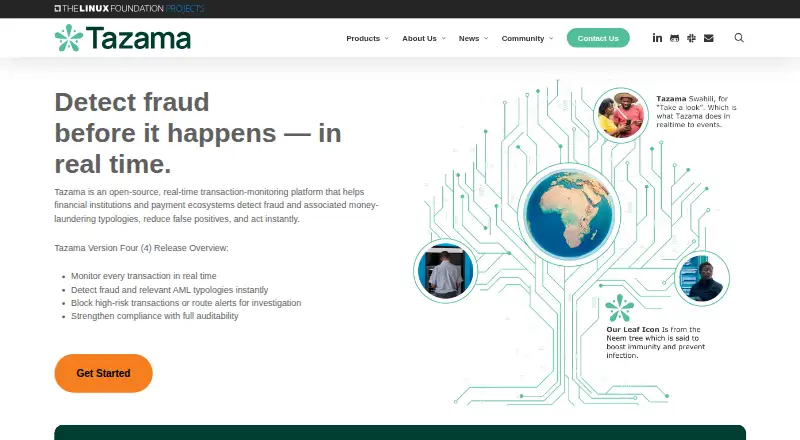
Tazama is a free, open-source platform for monitoring payment transactions in real time. It uses rules, participant history and configurable thresholds to detect fraud and money-laundering patterns. Teams can stop suspicious payments, route alerts for review, and then handle cases, dashboards and audits. It runs on self-hosted systems and Kubernetes-based cloud setups.
Review
In a line
This open-source platform watches transactions as they occur, looking for fraud and money-laundering patterns.
What it does
Rules assess current transaction details and past participant behavior. Their results are combined into typologies, which are patterns linked to suspicious activity, using thresholds that teams can set.
High-risk transactions may be blocked, while other events can become investigator alerts. Rule Studio offers a visual way to create rules, replay older transactions and submit changes for review. Investigators can assign, examine, file and close alerts in a case system that records decisions.
BIAR combines detection results with case outcomes in a lakehouse, then provides dashboards and calibration notebooks. Tazama describes AI help for finding anomalies, recommending rules, calibrating thresholds and ranking alerts.
How it connects
Connection Studio and DEMS map, transform and test incoming data feeds. ISO 20022 payment messages are the API's standard input, while a Payment Platform Adapter brings in other formats.
Tazama publishes API references and setup guidance in GitHub. Its case-management service includes an interactive Swagger page for REST operations. The repositories use the Apache License 2.0.
You can run the platform with Docker Compose on a local machine or deploy it with Kubernetes on premises or through EKS, GKE and AKS. In a shared installation, tenant data, rules, thresholds and access controls can remain separate.
Good fit
Central banks, payment services advisers, banks, government agencies and other financial institutions are among the organizations Tazama identifies for its monitoring and investigation workflows.
It fits teams that want to build their own detection rules, connect ISO 20022 feeds, review alerts in cases and keep an audit trail of configuration and workflow changes.
Watch for
The software has no license charge, but you still need hardware or cloud services, implementation work, support and possibly custom rule development. A local installation needs Git, an editor, Docker Desktop with WSL or a Linux/macOS equivalent, plus a GitHub token with package-read permission.
Docker Compose is documented for demonstration, exploration, testing and sandbox scenarios rather than production. Before adding extensions, deploy the core stack, including DEMS and DEAPI, on the core server.
Access to private rule repositories is limited to representatives of organizations with a legitimate interest in Tazama.
Pricing
There is no software or license fee for Tazama's open-source code. Operators must still provide infrastructure, implementation, support and other operational resources.
Verdict
Choose Tazama if your organization needs a self-hosted transaction-monitoring system and has people who can operate infrastructure, create rules and investigate alerts. Its open code, visual rule tools, case records and audit controls support teams that need to adapt monitoring to their own payment data.
It is a poor match for a small business seeking a ready-to-run hosted fraud service. The free license does not remove deployment work, and the documented local stack is not a production setup.
Our take
Tazama makes sense for financial organizations that can run software themselves and need control over payment-monitoring rules, data and investigations. It supports real-time blocking or alerting, visual rule work, case handling and audit records without a license fee. The tradeoff is operational responsibility: infrastructure, deployment, integration, support and rule development remain with the buyer. Check the production Kubernetes guidance, message formats and team skills before adopting it. Smaller organizations wanting a managed service should look elsewhere.
- Free software with no license charge
- Open-source Apache License 2.0 repositories
- Real-time blocking and investigation alerts
- Visual rule building and replay testing
- Case records, dashboards and audit trails
- Hosting, hardware and implementation still require resources
- Docker Compose is not a production deployment
- Extensions depend on the core stack
- Private rule repositories have restricted access
- Pick it ifBanks and payment organizations running their own monitoring stack; Teams needing custom rules and investigation cases; Organizations working with ISO 20022 payment messages
- Skip it ifYou need a fully managed fraud-monitoring service; You cannot provide infrastructure and implementation support; You want the local Docker setup for production use
Pricing
The software carries no license fee. Budget separately for hosting, hardware or cloud services, implementation, support and custom-rule work.
- Tazama open-source softwareNo software or license charge · hosting, hardware/cloud services, implementation, support and custom-rule development require resourcesFree
As tazama.org lists them, checked 15 Oct 2026.
Questions
Is Tazama free?
Yes. The open-source code is available without a software or license fee, while infrastructure, implementation, support and custom rules still require resources.
What can Tazama do with risky payments?
It can block high-risk transactions or route alerts to investigators for review.
Which payment messages does it accept?
The API takes ISO 20022 messages as its designed format; a Payment Platform Adapter handles messages in other formats.
Can teams create their own detection rules?
Yes. Rule Studio offers a visual canvas, replay testing and review steps before deployment.
Where can Tazama run?
It supports self-hosted Linux, macOS and Windows environments, plus web and API access. Production guides cover Kubernetes on premises, EKS, GKE and AKS.
Is the Docker Compose setup production-ready?
No. The project positions that stack for demonstration, exploration, testing and sandbox use, not production.
Who is Tazama aimed at?
Its stated audience includes central banks, payment services advisers, banks, government agencies and financial institutions.
Near it
All alternatives →- JJube#2 on this board
- SP
 Sift Payment Protection#3 on this board
- MC
 Marble Case Manager#4 on this board
- E
 EyesClear#5 on this board
- LPLucinity Platform#6 on this board
- L
 Lexis+#7 on this board
- U
 Unit21#8 on this board
- NA
 NICE Actimize#9 on this board
- NVNasdaq Verafin#10 on this board
- ES
 Eastnets SafeWatch AML#11 on this board