TDengine Industrial Data Platform
tdengine.com · checked 14 Oct 2026
An open-source industrial platform for gathering, storing, analyzing, and visualizing equipment data.
How it plugs in
Signal on OLAP Software7.7#1 of 32
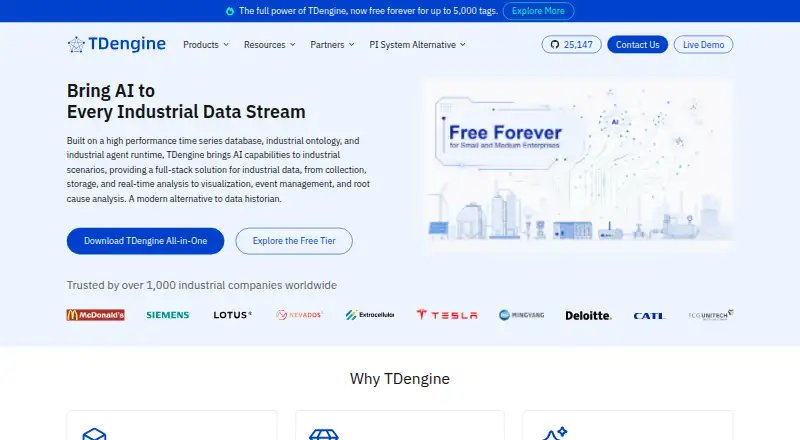
TDengine combines a distributed time-series database with industrial data management, dashboards, analytics, and AI tools. Industrial inputs such as MQTT, OPC, and Kafka can feed it, while REST, JDBC, and ODBC provide access. You can run it yourself or use managed service offerings on AWS, Azure, or Google Cloud. Self-hosted deployments have a no-cost tier covering up to 5,000 tags.
Review
In a line
TDengine is an industrial data platform built around TDengine TSDB, a distributed time-series database, and TDengine IDMP for managing industrial assets and context.
The platform is aimed at high-volume readings generated by IoT, manufacturing, energy, utilities, connected vehicles, and similar operations.
What it does
The platform ingests, stores, and queries time-stamped readings. Caching, stream processing, and subscriptions are included in the database rather than requiring separate components.
IDMP models equipment and processes as a tree, with reusable templates, dashboards, trends, process visualizations, KPI reporting, and automatic scenario recognition. Available analytics include forecasting, anomaly detection, data imputation, natural-language exploration, and AI-generated root-cause analysis.
Its data models include one table for each collection point, super-tables, and virtual tables. Subscriptions defined in SQL support windowed aggregation and real-time computation. Enterprise editions provide automated replication between edge and cloud deployments.
How it connects
TDengine is open source under the GNU Affero General Public License version 3.0. Developer access covers an OpenAPI-documented REST API plus JDBC, ODBC, Kafka, MQTT, iframe embedding, an Excel Add-In, client libraries, and Rust bindings.
Inputs may be submitted via SQL, InfluxDB Line Protocol, OpenTSDB protocols, MQTT, OPC UA and OPC DA, Kafka, CSV, PI System, MySQL, PostgreSQL, Oracle, and MongoDB. Zero-code connectors are advertised for MQTT, Kafka, OPC, PI System, and other sources.
Official integrations include Prometheus, Telegraf, collectd, StatsD, Icinga2, Flink, EMQX, HiveMQ, Grafana, Power BI, Tableau, Superset, Spark, Pandas, DBeaver, qStudio, JetBrains, Node-RED, and Ignition. Related choices include InfluxDB and other time-series databases.
Self-managed instances can run at the edge, on local servers, in containers or virtual machines, and in public, private, or hybrid clouds. TDengine Cloud is offered as a managed service on Amazon Web Services, Microsoft Azure, and Google Cloud Platform.
Good fit
TDengine is designed for industrial enterprises and organizations running traditional data historians or legacy industrial IoT platforms.
It fits connected equipment, manufacturing lines, energy and utility systems, and other workloads with many high-frequency time-series readings. SQL access and connections to tools such as Grafana, Power BI, and Tableau help teams query and present that data.
Watch for
The wider community, third-party tutorials, plugins, and ecosystem are smaller than those around InfluxDB or TimescaleDB. Check whether the integrations and guidance your team needs are available.
Enterprise editions add tiered storage, incremental backup, views, replication, data sharing, PI/MQTT/OPC integrations, privilege controls, encryption, auditing, and IP whitelisting. Confirm which of these are required before choosing the open-source build.
The open-source build supports Linux Ubuntu 18.04 or later, CentOS 7 or later, macOS 10.15 or later, limited Windows, x86_64 or ARM64, with 4 GB RAM and 2 GB disk recommended.
Pricing
TDengine uses a freemium model. Its Free Tier costs nothing for self-hosted deployments with up to 5,000 tags. The self-hosted free option can add support for $3,375/year, while high availability adds 30%.
Managed cloud plans include TDengine Cloud Starter at $970 a month, billed monthly, for 5,000 tags; Small at $1740 a month for 10,000 tags; and Medium at $2570 a month for 20,000 tags. A Starter annual plan is $11640 a year, billed annually, for 5,000 tags.
Self-hosted annual licenses include $12500 a year for 7,500 tags and $15500 a year for 10,000 tags, each billed annually with standard support included and high availability adding 30%. A 7,500-tag perpetual license is $31250 one-time.
Verdict
Choose TDengine when industrial telemetry, SQL queries, and deployment control matter more than having the largest surrounding ecosystem. Its open-source core, industrial connectors, and edge-to-cloud options cover both self-managed and managed setups.
It is less suitable if your project depends on a broad community of plugins and tutorials, or if a free deployment needs more than 5,000 tags.
Our take
TDengine fits industrial teams collecting large equipment-reading streams and adding asset context, dashboards, and analytics around a time-series database. A free self-hosted option lowers the entry cost, while cloud and enterprise plans cover managed operations and larger deployments. The trade-off is a smaller surrounding ecosystem than some established alternatives, plus feature and support differences between open-source and enterprise editions. Check tag limits, required connectors, operating system support, and whether enterprise security or replication is needed.
- Open-source time-series database with a self-hosted free tier covering up to 5,000 tags
- Connects with MQTT, OPC, Kafka, PI System, and numerous analytics tools
- Supports edge, server, container, and major public-cloud deployments
- Caching, stream processing, and subscriptions are built in
- Provides dashboards, asset models, forecasting, and anomaly detection
- Smaller community and third-party ecosystem than InfluxDB or TimescaleDB
- Replication and auditing are among the enterprise-only capabilities
- Cloud plans begin at $970 a month when billed monthly
- Windows support is limited in the open-source build
- Pick it ifIndustrial IoT and manufacturing telemetry; Teams moving from historians or legacy IIoT platforms; High-volume time-series workloads needing self-hosting or cloud
- Skip it ifYou depend on a large plugin and tutorial ecosystem; Your free deployment needs more than 5,000 tags; You need enterprise-only controls without an enterprise plan
Pricing
Self-hosted use for up to 5,000 tags has no charge. Paid choices include optional support at $3,375/year, managed cloud, annual licenses, and a $31250 one-time perpetual license; high availability adds 30% where stated.
- Free Tierup to 5,000 tags · self-hostedFree
- Self-hosted Free Tierup to 5,000 tags · optional support $3,375/year · HA +30%Free
- TDengine Cloud Startermonthly · 5,000 tags · managed AWS, Azure or Google Cloud service$970/mo
- Startermonthly · 5,000 tags · fully managed cloud$970/mo
- TDengine Cloud Smallmonthly · 10,000 tags · managed cloud infrastructure$1,740/mo
- TDengine Cloud Mediummonthly · 20,000 tags · managed cloud infrastructure$2,570/mo
- Optional Annual Supportannual support · free-tier deployments up to 5,000 tags$3,375/yr
- Starterannually · 5,000 tags · fully managed cloud$11,640/yr
As tdengine.com lists them, checked 30 Sept 2026.
Questions
Is TDengine open source?
Yes. The TDengine TSDB repository is licensed under GNU Affero General Public License version 3.0.
What can TDengine connect to?
It accepts MQTT, OPC UA and OPC DA, Kafka, PI System, CSV, SQL, InfluxDB Line Protocol, OpenTSDB protocols, and several databases. Integrations include Grafana, Power BI, Tableau, Spark, and others.
Can I run TDengine myself?
Yes. You can run deployments at the edge, on local servers, in containers or virtual machines, and in public, private, or hybrid clouds. Managed TDengine Cloud is available on AWS, Azure, and Google Cloud.
Does TDengine have a free plan?
Yes. The Free Tier covers self-hosted deployments with up to 5,000 tags. Optional support for that tier costs $3,375/year.
What is TDengine Cloud Starter pricing?
TDengine Cloud Starter costs $970 a month, billed monthly, for 5,000 tags on managed AWS, Azure, or Google Cloud infrastructure.
Which operating systems are supported?
The open-source build supports Ubuntu 18.04 or later, CentOS 7 or later, macOS 10.15 or later, limited Windows, and x86_64 or ARM64 systems.