Tebra EHR, Billing and Practice Platform
tebra.com · checked 21 Oct 2026
Cloud software unifies practice records, revenue work, appointments, patient engagement, virtual visits, marketing and AI.
How it plugs in
Signal on Neurology EMR Software5.9#1 of 20
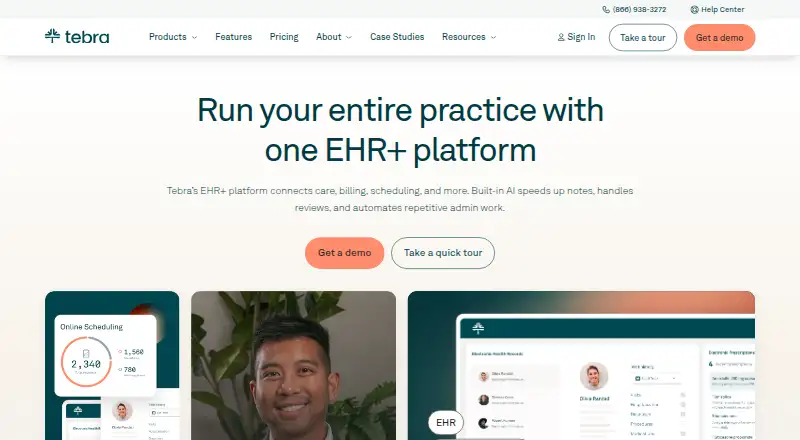
Independent practices can use Tebra's hosted service for clinical records, billing, appointments, patient communication, virtual care, marketing and AI features. Access spans web, desktop, mobile and APIs. Plans are paid subscriptions starting at $49 per provider monthly, with neither a free option nor a trial.
Review
In a line
Tebra serves independent physician, non-physician and therapy practices through a hosted healthcare platform.
Clinical records, revenue-cycle tools, appointments, patient engagement, virtual care, marketing and AI are delivered through the same service.
What it does
The EHR stores patient histories and supports charting, provider scheduling, electronic prescriptions, electronic labs, telehealth and AI-produced clinical notes. It also supports MACRA/MIPS work.
For billing, Tebra handles claim preparation and submission, eligibility verification, denial management, payment posting and patient invoices. Patient features cover online appointment booking, text, email or phone reminders, digital intake forms, secure messaging and a portal.
Practice marketing includes custom websites, profile management, AI-generated review responses and retention insights. Other AI tools help with patient calls and claim review.
How it connects
The platform lists links to laboratories, imaging centers, e-prescribing networks, prescription-monitoring databases, insurance payers and payment processors. Online payment collection and recurring appointments are also available.
External software can connect through Tebra's SOAP Web Services or FHIR APIs; its documentation explains registration and technical use. The hosted service receives automatic updates and does not require customer-run servers.
Users can reach it on the web, through a Practice Management desktop application, or with iPhone and iPad apps. Telehealth is not supported inside the mobile app, but video visits can be joined in a mobile browser.
Good fit
Tebra suits independent practices that want clinical records, revenue-cycle work, scheduling and patient communication in one system. It covers physician, non-physician and therapy workflows.
It is a reasonable match for practices needing built-in telehealth, digital intake, reminders, online payments or marketing tools alongside their EHR.
Watch for
A subscription is required because Tebra has neither a free plan nor a trial. Certain EHR packages also call for a separate Billing Starter subscription.
Check mobile needs carefully: the mobile app does not support telehealth directly. Customer Care phone hours are Monday through Friday, 5 AM to 4 PM Pacific Time, while a virtual assistant is available 24/7.
Plan prices and claim limits vary by provider type and volume. Low-volume tiers cover 100 or fewer claims per month.
Pricing
Tebra bills providers from $49 through $399 per month. Its $49 Patient Experience + Marketing tier serves non-physicians with fewer than 100 monthly claims; the corresponding physician tier costs $99.
For EHR Starter, the non-physician price is $99 monthly and the physician price is $199, both below 100 claims per month and both requiring Billing Starter. Practice Essentials plans range from $199 a month to $349 a month; Practice Automation plans range from $249 a month to $399 a month. Therapist plans listed are $225 a month for Practice Essentials and $299 a month for Practice Automation.
There is no free tier and no free trial.
Verdict
Choose Tebra if your independent practice wants one cloud service for records, claims, appointments and patient-facing work, with optional marketing and AI assistance. Its APIs and healthcare connections may help when other systems must exchange data.
Look elsewhere if you need telehealth inside a mobile app, a free way to start, or pricing that does not vary by provider type and claim volume. Review the required billing subscription and plan limits before signing up.
Our take
Tebra is aimed at independent healthcare practices that prefer a single hosted system over separate clinical, billing and engagement tools. Its broad scope can reduce the number of products a practice has to manage, while API options support outside applications. The trade-offs are paid-only access, provider-based pricing, claim-volume limits and a mobile app that cannot host telehealth visits. Practices should compare plan requirements and confirm that the available integrations match their existing systems.
- Combines EHR, billing, scheduling, engagement, telehealth and marketing in one service
- Includes claim submission, eligibility checks and denial management
- Makes SOAP and FHIR APIs available to external applications
- Offers reminders, digital intake, secure messaging and a patient portal
- Cloud delivery includes automatic updates and remote access
- No free plan or free trial
- Telehealth is unavailable inside the mobile app
- Some EHR plans require Billing Starter
- Prices vary by provider type and claim volume
- Low-volume tiers limit claims to 100 or fewer per month
- Pick it ifIndependent physician, non-physician and therapy practices; Practices wanting clinical and billing tools in one cloud service; Teams needing patient engagement, telehealth or marketing features
- Skip it ifYou need telehealth to work directly inside a mobile app; You require a free tier or free trial; Your claim volume or provider mix does not fit the listed plan tiers
Pricing
The amount depends on provider type, chosen features and claim volume, and Tebra offers neither a free plan nor a trial.
- Patient Experience + Marketing — Non-physicianstarting price per provider; fewer than 100 claims monthly · patient experience · marketing$49/mo
- Patient Experience + Marketing — Physicianstarting price per provider; fewer than 100 claims monthly · patient experience · marketing$99/mo
- EHR Starter — Non-physicianstarting price per provider; fewer than 100 claims monthly · EHR · requires Billing Starter$99/mo
- Practice Essentials — Non-Physician, low volumeStarting at $199 / month; per provider · Low-volume tier: 100 or fewer claims per month · Clinical EHR · billing software · telehealth$199/mo
- EHR Starter — Physicianstarting price per provider; fewer than 100 claims monthly · EHR · requires Billing Starter$199/mo
- Practice Essentials — Therapist, standard$225 / month; per provider · Clinical EHR · billing software · telehealth$225/mo
- Practice Essentials — Therapistper provider · clinical EHR · billing · telehealth$225/mo
- Practice Automation — Non-Physician, low volumeStarting at $249 / month; per provider · Low-volume tier: 100 or fewer claims per month · Practice Essentials · Patient Experience tools$249/mo
As tebra.com lists them, checked 21 Oct 2026.
Questions
What is Tebra?
Tebra is a hosted platform for independent practices that combines EHR, billing, scheduling, patient engagement, telehealth, marketing and AI tools.
Does Tebra offer a free plan or trial?
No. Access requires a paid subscription, and Tebra lists neither a free plan nor a trial.
How much does Tebra cost?
The listed provider plans run from $49 to $399 per month. Pricing varies with provider type, features and claim volume.
Can Tebra connect to other systems?
Yes. Tebra lists connections for labs, imaging centers, e-prescribing networks, prescription-monitoring databases, insurance payers and payment processing. It also provides SOAP and FHIR APIs.
Does Tebra support telehealth on phones?
Telehealth is included in the clinical platform, but the Tebra mobile app does not support it. Users can join a video appointment through a mobile browser.
Who is Tebra designed for?
Tebra describes its platform for independent physician, non-physician and therapy practices.
Near it
All alternatives →- C
 Clinicea#2 on this board
- OEOneTouch EMR#3 on this board
- HCHARRIS CareTracker#4 on this board
- SESevocity EHR#5 on this board
- EHEnable Healthcare Neurology EHR#6 on this board
- NENextGen Enterprise Dermatology#7 on this board
- CCCareCloud Charts#8 on this board
- AVAllegianceMD Veracity Neurology EMR#9 on this board
- CPChartLogic Plastic Surgery EHR#10 on this board
- NCNeurology-Cloud#11 on this board