testRigor: Plain-English AI Testing
testrigor.com · checked 15 Oct 2026
Plain-English, generative-AI testing for web, mobile, desktop, API and mainframe applications.
How it plugs in
Signal on AI software testing tools7.5#3 of 34
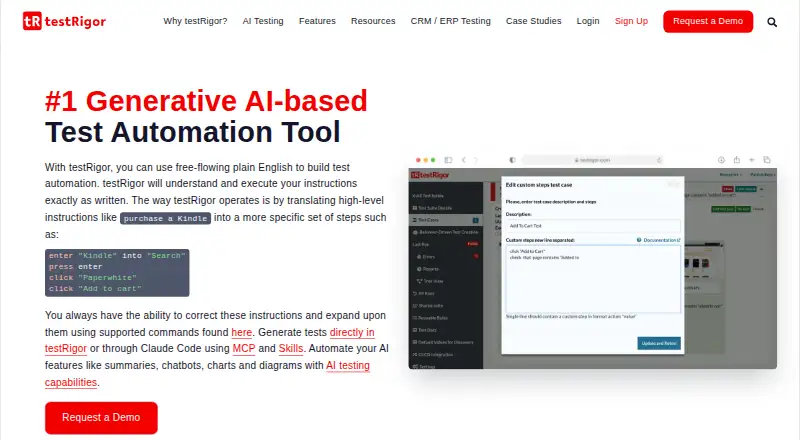
testRigor is a no-code testing platform that creates and runs end-to-end tests from plain-English instructions. It covers web, native and hybrid mobile, Windows desktop, APIs, email, SMS, phone calls and mainframe applications. Plans range from a free public option to paid and custom enterprise plans, with cloud or on-premise execution.
Review
In a line
Generative AI lets testRigor create and execute software tests described in everyday language. It is a no-code platform for end-to-end testing across several application types.
What it does
Documented test cases can serve as a starting point for generated tests, which users can then revise or expand using plain-English directions. One test flow can cover web applications across browsers and platforms, while other plans support native and hybrid iOS and Android apps and native Windows desktop testing.
Its test scope includes API calls and mocked responses, email delivery, SMS, phone calls, two-factor authentication, data-driven checks, downloaded files, visual comparisons, image checks and accessibility testing. Tests can run in parallel across browsers and devices, and AI self-healing can adjust steps when interface elements change.
How it connects
The integrations page names Jira, TestRail, Zephyr, XRay, GitLab, GitHub Actions, Jenkins, CircleCI, Azure DevOps, BrowserStack, LambdaTest and Twilio. A command-line tool can start test suites, pass tokens and variables, upload test files and tunnel to a local environment.
The API features can inspect status codes, extract JsonPath values and save results for later steps. Its MCP server lets AI assistants manage suites, runs, variables, datasets and reusable rules. Cloud execution is the default, with an on-premise option and a self-hosted codecake agent distributed through PyPI.
The hosted product is proprietary rather than open source. Auxiliary GitHub projects use open-source licences such as MIT.
Good fit
The About page positions testRigor for developers and QA teams, including fast-moving startups that need to verify essential application functions. It is suited to teams creating plain-English tests for web, mobile, desktop and API work.
It can also fit workflows involving email, phone or SMS checks, two-factor login, mainframe applications and parallel browser or device runs.
Watch for
With the free public plan, both tests and results are exposed publicly and can be shared through a unique public URL; they are also publicly searchable. Check whether that exposure is acceptable before using it.
Native Windows desktop testing is available in paid versions. Games are outside the product's supported testing scope. Access to sensitive Trust Center reports requires signing an MNDA, while support differs by plan: Public uses StackOverflow, Private Complete includes standard support, and Enterprise offers Slack or Microsoft Teams support.
Cloud execution is the default; teams needing local control should review the on-premise and self-hosted options.
Pricing
testRigor uses a freemium model with a free plan and a 14-day trial. Free - Public is free forever, with public and searchable tests and results. Public Open Source is price on request and also keeps tests and results public.
The Private Linux Chrome plan is listed at $300 per month, billed from $300 monthly, and provides Linux Chrome execution, AI generation and execution, plus a 14-day trial. Private Complete is quoted on request; its details show a 14-day trial and coverage for Ubuntu, Windows, Mac, Android, iOS, Windows Native and all AI capabilities.
Enterprise is price on request with custom pricing. Parallel-execution capacity affects pricing.
Verdict
Choose testRigor if your team wants to describe end-to-end checks in everyday language and cover several kinds of software from one platform. Its integrations, command-line tools, API features and optional self-hosting support established delivery pipelines.
The free option is mainly for public work, so private testing requires a paid or custom plan. Teams testing games should look elsewhere, and anyone requiring native Windows desktop coverage must budget for a paid version. Review support, execution location and report access before selecting a plan.
Our take
testRigor is a practical choice for developers and QA groups that want one plain-English workflow for web, mobile, API and related checks. It is especially relevant when tests must include email, SMS, calls, two-factor codes or mainframe screens. The free tier is suitable only when public tests and results are acceptable. Private Linux Chrome starts at $300 per month, while broader environments and enterprise support require custom plans. Avoid it for game testing, and confirm the execution model and compliance-report access your organization needs.
- Plain-English test creation and AI-generated test flows
- Web, mobile, API, email, SMS and phone-call coverage
- Integrations with common issue, CI and device-testing tools
- Cloud execution plus on-premise and self-hosted options
- Parallel browser and device runs with AI self-healing
- Public free plan leaves tests and results visible to others
- Native Windows desktop testing requires a paid version
- Games are not supported
- Sensitive compliance reports require an MNDA
- Private Complete and Enterprise pricing is by request
- Pick it ifQA and developer teams automating end-to-end checks; Startups needing broad application coverage; Teams using plain-English test instructions
- Skip it ifYou need to test games; Your free plan must keep tests and results private; You require native Windows desktop tests without a paid plan
Pricing
The public free option remains free indefinitely, but its tests and results are public. A 14-day trial is listed for the free model and Private Linux Chrome.
- Public Open SourceTests and test results are public · Results can be shared using a unique public URLOn request
- Free - Publicfree forever · tests and results public · publicly searchableFree
- Private Linux Chromefrom $300 / month · Linux Chrome execution · AI generation and execution · 14-day trial$300/mo
- Enterprisecustom pricing · personalized enterprise offerOn request
- Private Complete14-day trial · Ubuntu · Windows · Mac · Android · iOS · Windows Native · all AI capabilitiesOn request
As testrigor.com lists them, checked 21 Sept 2026.
Questions
Does testRigor have a free plan?
Yes. The Free - Public tier costs nothing indefinitely, while its tests and results remain public and searchable.
What does the 14-day trial apply to?
The pricing facts list a 14-day trial for the free plan and Private Linux Chrome. Private Complete also lists a 14-day trial in its plan details.
Which applications can testRigor test?
It tests web, native and hybrid iOS and Android apps, native Windows desktop apps in paid versions, APIs and mainframe applications. It also checks email, SMS, calls and two-factor flows.
Is testRigor open source?
The hosted product is proprietary. Some auxiliary GitHub projects use open-source licences such as MIT.
Can testRigor run tests on my own systems?
Cloud execution is the default, with an on-premise option. A self-hosted codecake agent CLI is distributed through PyPI.
Does it integrate with Jira and CI tools?
The integration list covers Jira, GitLab, GitHub Actions, Jenkins, CircleCI, Azure DevOps, TestRail, Zephyr, XRay, BrowserStack, LambdaTest and Twilio.
Does testRigor test games?
No. Its homepage FAQ says games are not supported.