TiCDC: Open-Source Change Data Capture for TiDB
docs.pingcap.com · checked 21 Oct 2026
Open-source, self-hosted change-data capture for moving TiDB updates to databases, Kafka and cloud storage.
How it plugs in
Signal on Change Data Capture Software7.4#1 of 23
TiCDC is an open-source service that reads TiKV change logs from TiDB, orders row-level updates and sends them to other systems. It supports disaster recovery, multi-active TiDB clusters and real-time feeds. Destinations include MySQL-compatible databases, Kafka, object storage and NFS. It runs self-hosted on Linux or macOS, with an Open API for managing replication tasks.
Review
In a line
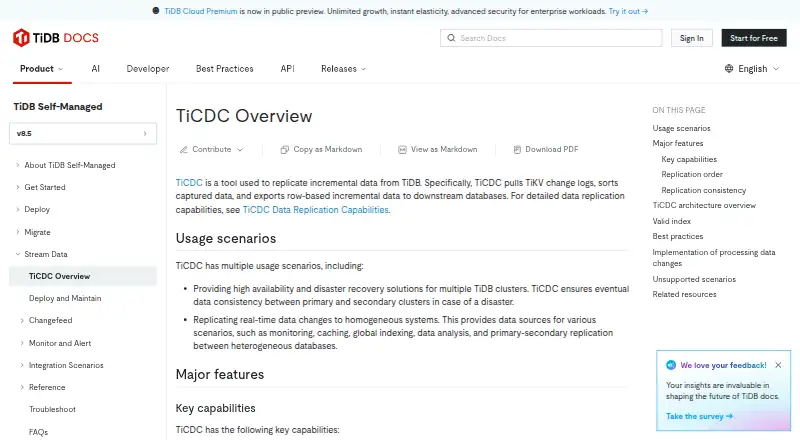
TiCDC is a self-hosted, open-source change-data capture tool for replicating incremental data from TiDB.
What it does
TiCDC captures TiKV change logs, sorts the changes and exports row-based updates to downstream systems. It can send changes to TiDB, MySQL-compatible databases, Kafka, Amazon S3, Google Cloud Storage, Azure Blob Storage and NFS.
Use cases include disaster recovery, real-time feeds for monitoring, caching, indexing and analysis, and replication between different database types. Bidirectional replication between TiDB clusters supports multi-active deployments.
How it connects
Replication rules can filter databases, tables, data-change events and schema-change events. Kafka output supports Canal-JSON, Avro, Debezium, Open Protocol and Simple formats.
TiCDC has an Open API for checking status and creating, updating, pausing, resuming or deleting replication tasks. Its code is public under Apache-2.0. It can be deployed with a new or existing TiDB cluster using TiUP. See change data capture software and data replication software for related categories.
Good fit
TiCDC suits teams running TiDB that need disaster recovery, low-latency MySQL replication, Kafka feeds or storage exports. It also fits multi-active TiDB setups and heterogeneous database replication.
The service has no single point of failure and allows TiCDC nodes to be added or removed while running. The newer architecture is documented as scaling beyond 100 nodes and more than 10,000 changefeeds.
Watch for
Delivery is at least once for data and schema changes, so failures can repeat SQL statements or Kafka messages. Tables normally need a primary key or qualifying non-null unique index; force-replicate can override that rule.
RawKV-only clusters, sequence features and TiDB Lightning physical imports on replicated tables are listed as unsupported. Extremely large transactions can cause an out-of-memory risk because the newer architecture does not yet split them into batches.
The newer architecture requires TiDB 7.5.0 or later. Production guidance calls for at least 16 CPU cores, 64 GB of memory, a 500 GB SSD, a 10-Gigabit network card and two TiCDC instances. OpenAPI v1 is deprecated; the documentation recommends v2.
Pricing
TiCDC is free and open source. The listed plan, TiCDC (open-source), has no paid plans or usage caps stated on the TiCDC pages. You run it yourself on supported Linux or macOS binaries, or compile it with Go 1.25.12 and make cdc.
Verdict
Choose TiCDC when your data starts in TiDB and you need controlled streams to databases, Kafka or storage, including cross-cluster recovery and active-active designs.
It is a poor fit if you need a managed service, must replicate unsupported TiDB features, or cannot handle duplicate delivery and the stated infrastructure requirements. Review TiDB version compatibility, table indexes, transaction sizes and security settings before deployment.
Our take
TiCDC is a practical option for organizations already operating TiDB and needing self-managed replication paths. Its free Apache-2.0 license removes software fees, while the Open API and filtering rules give administrators control over many feeds. The trade-off is operational responsibility: you supply the servers, meet demanding production guidance and plan for repeated deliveries. Compatibility checks matter, especially for the newer architecture and TiDB 7.5.0 requirement. Teams wanting a hosted product, exactly-once delivery or support for the documented unsupported cases should look elsewhere.
- Free and open-source under Apache-2.0
- Replicates to databases, Kafka, cloud storage and NFS
- Supports bidirectional TiDB replication
- Filtering for databases, tables, DML and DDL
- No single point of failure; nodes can change dynamically
- At-least-once delivery can repeat statements or Kafka messages
- Usually requires a primary key or qualifying unique index
- Very large transactions can risk out-of-memory failures
- Some TiDB features and scenarios are unsupported
- Self-hosted production guidance requires substantial hardware
- Pick it ifTiDB teams building recovery or multi-active setups; Real-time feeds to Kafka, databases or storage; Self-hosted replication between different database systems
- Skip it ifYou need a managed service instead of self-hosting; Exactly-once delivery is required; Your workload relies on listed unsupported features or huge transactions
Pricing
TiCDC is free and open source. No paid plans or usage caps are stated; infrastructure and operation remain your responsibility.
- TiCDC (open-source)No paid plans or usage caps stated on the TiCDC pages openedFree
As docs.pingcap.com lists them, checked 2 Oct 2026.
Questions
What is TiCDC?
TiCDC captures TiKV change logs from TiDB, orders them and exports row-level incremental changes to downstream systems.
Where can TiCDC send data?
Destinations include TiDB, MySQL-compatible databases, Kafka, Amazon S3, Google Cloud Storage, Azure Blob Storage and NFS.
Does TiCDC support disaster recovery?
Yes. It can replicate between TiDB clusters with second-level RPO and minute-level RTO.
Is TiCDC free?
Yes. TiCDC is an open-source Apache-2.0 project with a free plan and no paid plans or usage caps stated in the listed pages.
How does TiCDC deliver changes?
DDL and DML are delivered at least once. A failure can therefore produce repeated SQL statements or duplicate Kafka messages.
What systems can run TiCDC?
Published binaries cover Linux amd64 and arm64 plus macOS amd64 and arm64. The deployment model is self-hosted.
Does TiCDC have an API?
Yes. Its Open API can inspect status and manage replication tasks. OpenAPI v1 is deprecated, and the documentation recommends v2.